Get your patient on Zyflo - Zileuton tablet (Zileuton)
Zyflo - Zileuton tablet prescribing information

INDICATIONS AND USAGE
ZYFLO is indicated for the prophylaxis and chronic treatment of asthma in adults and children 12 years of age and older.
DOSAGE AND ADMINISTRATION
The recommended dosage of ZYFLO for the symptomatic treatment of patients with asthma is one 600-mg tablet four times a day for a total daily dose of 2400 mg. For ease of administration, ZYFLO may be taken with meals and at bedtime. Hepatic transaminases should be evaluated prior to initiation of ZYFLO and periodically during treatment (see PRECAUTIONS, Hepatic ).
CONTRAINDICATIONS
ZYFLO tablets are contraindicated in patients with:
- Active liver disease or transaminase elevations greater than or equal to three times the upper limit of normal (≥3xULN) (see PRECAUTIONS, Hepatic ).
- Hypersensitivity to zileuton or any of its inactive ingredients.
ADVERSE REACTIONS
Clinical Studies :
A total of 5542 patients have been exposed to zileuton in clinical trials, 2252 of them for greater than 6 months and 742 for greater than 1 year.
Adverse events most frequently occurring (frequency ≥3%) in ZYFLO-treated patients and at a frequency greater than placebo-treated patients are summarized in Table 2.
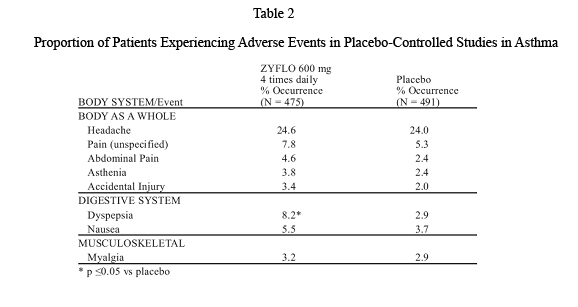
Less common adverse events occurring at a frequency of greater than 1% and more commonly in ZYFLO-treated patients included: arthralgia, chest pain, conjunctivitis, constipation, dizziness, fever, flatulence, hypertonia, insomnia, lymphadenopathy, malaise, neck pain/rigidity, nervousness, pruritus, somnolence, urinary tract infection, vaginitis, and vomiting.
The frequency of discontinuation from the asthma clinical studies due to any adverse event was comparable between ZYFLO (9.7%) and placebo-treated (8.4%) groups.
In placebo-controlled clinical trials, the frequency of ALT elevations ≥3xULN was 1.9% for ZYFLO-treated patients, compared with 0.2% for placebo-treated patients. In controlled and uncontrolled trials, one patient developed symptomatic hepatitis with jaundice, which resolved upon discontinuation of therapy. An additional 3 patients with transaminase elevations developed mild hyperbilirubinemia that was less than three times the upper limit of normal. There was no evidence of hypersensitivity or other alternative etiologies for these findings. ZYFLO is contraindicated in patients with active liver disease or transaminase elevations greater than or equal to 3xULN (see CONTRAINDICATIONS ). It is recommended that hepatic transaminases be evaluated at initiation of and during therapy with ZYFLO (see P RECAUTIONS , Hepatic ).
Occurrences of low white blood cell count (≤2.8 x 10 9 /L) were observed in 1.0% of 1,678 patients taking ZYFLO and 0.6% of 1,056 patients taking placebo in placebo-controlled studies. These findings were transient and the majority of cases returned toward normal or baseline with continued ZYFLO dosing. All remaining cases returned toward normal or baseline after discontinuation of ZYFLO. Similar findings were also noted in a long-term safety surveillance study of 2458 patients treated with ZYFLO plus usual asthma care versus 489 patients treated only with usual asthma care for up to one year. The clinical significance of these observations is not known.
In the long-term safety surveillance trial of ZYFLO plus usual asthma care versus usual asthma care alone, a similar adverse event profile was seen as in other clinical trials.
Post-Marketing Experience : Cases of sleep disorders and behavior changes have been reported ( see PRECAUTIONS, Neuropsychiatric Events ). Rash and urticaria have been also reported with ZYFLO.
DESCRIPTION
Zileuton is an orally active inhibitor of 5-lipoxygenase, the enzyme that catalyzes the formation of leukotrienes from arachidonic acid. Zileuton has the chemical name (±)-1-(1-Benzo[b]thien-2-ylethyl)-1-hydroxyurea and the following chemical structure:
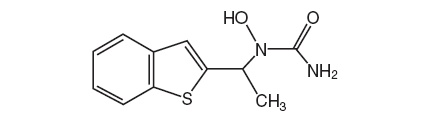
Zileuton has the molecular formula C 11 H 12 N 2 O 2 S and a molecular weight of 236.29. It is a racemic mixture (50:50) of R(+) and S(-) enantiomers. Zileuton is a practically odorless, white, crystalline powder that is soluble in methanol and ethanol, slightly soluble in acetonitrile, and practically insoluble in water and hexane. The melting point ranges from 144.2˚C to 145.2˚C. ZYFLO tablets for oral administration are supplied in one dosage strength containing 600 mg of zileuton.
Inactive Ingredients: crospovidone, hydroxypropyl cellulose, hypromellose, magnesium stearate, microcrystalline cellulose, pregelatinized starch, propylene glycol, sodium starch glycolate, talc, and titanium dioxide.
CLINICAL PHARMACOLOGY
Mechanism of Action :
Zileuton is a specific inhibitor of 5-lipoxygenase and thus inhibits leukotriene (LTB 4 , LTC 4 , LTD 4 , and LTE 4 ) formation. Both the R(+) and S(-) enantiomers are pharmacologically active as 5-lipoxygenase inhibitors in in vitro systems. Leukotrienes are substances that induce numerous biological effects including augmentation of neutrophil and eosinophil migration, neutrophil and monocyte aggregation, leukocyte adhesion, increased capillary permeability, and smooth muscle contraction. These effects contribute to inflammation, edema, mucus secretion, and bronchoconstriction in the airways of asthmatic patients. Sulfido-peptide leukotrienes (LTC 4 , LTD 4 , LTE 4 , also known as the slow-releasing substances of anaphylaxis) and LTB 4 , a chemoattractant for neutrophils and eosinophils, can be measured in a number of biological fluids including bronchoalveolar lavage fluid (BALF) from asthmatic patients.
Zileuton is an orally active inhibitor of ex vivo LTB 4 formation in several species, including dogs, monkeys, rats, sheep, and rabbits. Zileuton inhibits arachidonic acid-induced ear edema in mice, neutrophil migration in mice in response to polyacrylamide gel, and eosinophil migration into the lungs of antigen-challenged sheep.
Zileuton inhibits leukotriene-dependent smooth muscle contractions in vitro in guinea pig and human airways. The compound inhibits leukotriene-dependent bronchospasm in antigen and arachidonic acid-challenged guinea pigs. In antigen-challenged sheep, zileuton inhibits late-phase bronchoconstriction and airway hyperreactivity. In humans, pretreatment with zileuton attenuated bronchoconstriction caused by cold air challenge in patients with asthma.
CLINICAL STUDIES
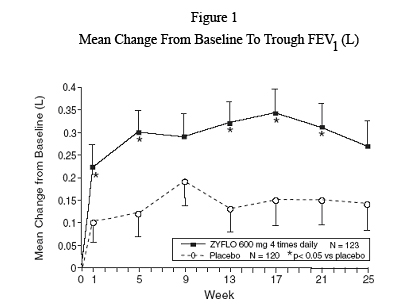
Two double-blind, parallel, placebo-controlled, multi-center studies have established the efficacy of ZYFLO in the treatment of asthma. Three hundred seventy-three (373) patients were enrolled in the 6-month, double-blind phase of Study 1, and 401 patients were enrolled in the 3-month double-blind phase of Study 2. In these studies, the patients were mild-to-moderate asthmatics who had a mean baseline FEV 1 of approximately 2.3 liters and who used inhaled beta-agonists as needed, the mean being approximately 6 puffs of albuterol per day from a metered-dose inhaler. In each study, patients were randomized to receive either ZYFLO 400 mg four times daily, ZYFLO 600 mg four times daily, or placebo. Only the ZYFLO 600 mg four times daily dosage regimen was shown to be efficacious by demonstrating statistically significant improvement across several parameters.
Efficacy endpoints measured in Study 1 are shown in Table 1 below as mean change from baseline to the end of the study (six months). Statistically significant differences from placebo at the p<0.05 level are indicated by an asterisk(•). Similar results were observed after three months in Study 2.
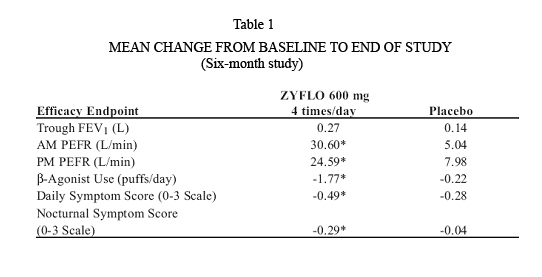
Figure 1 shows the mean effect of ZYFLO versus placebo for the primary efficacy variable, trough FEV 1 , over the course of Study 1.
Of all the patients in Study 1 and Study 2, 7.0% of those administered ZYFLO 600 mg four times daily required systemic corticosteroid therapy for exacerbation of asthma, whereas 18.7% of the placebo group required corticosteroid treatment. This difference was statistically significant.
In these trials, there was a statistically significant improvement from baseline in FEV 1 , which occurred 2 hours after initial administration of ZYFLO. This mean increase was approximately 0.10 L greater than that in placebo-treated patients.
These studies evaluated patients receiving as-needed inhaled beta-agonist as their only asthma therapy. In this patient population, post-hoc analyses suggested that individuals with lower FEV 1 values at baseline showed a greater improvement.
The role of ZYFLO in the management of patients with more severe asthma, patients receiving anti-asthma therapy other than as-needed, inhaled beta-agonists, or patients receiving it as an oral or inhaled corticosteroid-sparing agent remains to be fully characterized.
HOW SUPPLIED
ZYFLO Tablets are available as 1 dosage strength: 600-mg white to off white, ovaloid, film coated tablets debossed “CT 1” on one side and bisect on the other side.
High-density polyethylene bottles of: 120 Tablets.....................................................................................NDC 10122-901-12
Recommended storage: Store tablets at controlled room temperature between 20˚-25˚C, (68˚-77˚F). See USP. Protect from light.
CTZI-003-0314-01-SPL-3
Manufactured for:
Chiesi USA, Inc.
Cary, NC 27518
