Get your patient on Ursodiol - Ursodiol capsule (Ursodiol)
Ursodiol - Ursodiol capsule prescribing information

INDICATIONS & USAGE
1. Ursodiol capsules, USP are indicated for patients with radiolucent, noncalcified gallbladder stones < 20 mm in greatest diameter in whom elective cholecystectomy would be undertaken except for the presence of increased surgical risk due to systemic disease, advanced age, idiosyncratic reaction to general anesthesia, or for those patients who refuse surgery. Safety of use of ursodiol capsules beyond 24 months is not established. 2. Ursodiol capsules are indicated for the prevention of gallstone formation in obese patients experiencing rapid weight loss.
DOSAGE & ADMINISTRATION
Gallstone Dissolution The recommended dose for Ursodiol capsules treatment of radiolucent gallbladder stones is 8 - 10 mg/kg/day given in 2 or 3 divided doses. Ultrasound images of the gallbladder should be obtained at 6-month intervals for the first year of Ursodiol capsules therapy to monitor gallstone response. If gallstones appear to have dissolved, Ursodiol capsules therapy should be continued and dissolution confirmed on a repeat ultrasound examination within 1 to 3 months. Most patients who eventually achieve complete stone dissolution will show partial or complete dissolution at the first on treatment reevaluation. If partial stone dissolution is not seen by 12 months of Ursodiol capsules therapy, the likelihood of success is greatly reduced. Gallstone Prevention The recommended dosage of Ursodiol capsules for gallstone prevention in patients undergoing rapid weight loss is 600 mg/day (300 mg b.i.d.).
CONTRAINDICATIONS
1. Ursodiol capsules will not dissolve calcified cholesterol stones, radiopaque stones, or radiolucent bile pigment stones. Hence, patients with such stones are not candidates for Ursodiol therapy. 2. Patients with compelling reasons for cholecystectomy including unremitting acute cholecystitis, cholangitis, biliary obstruction, gallstone pancreatitis, or biliary-gastrointestinal fistula are not candidates for Ursodiol therapy. 3. Allergy to bile acids.
ADVERSE REACTIONS
The nature and frequency of adverse experiences were similar across all groups. The following tables provide comprehensive listings of the adverse experiences reported that occurred with a 5% incidence level:
| GALLSTONE DISSOLUTION | ||||
| Ursodiol | Placebo | |||
| 8-10 mg/kg/day | - | |||
| (N=155) | (N=159) | |||
| N | (%) | N | (%) | |
| Body as a Whole | ||||
| Allergy | 8 | (5.2) | 7 | (4.4) |
| Chest Pain | 5 | (3.2) | 10 | (6.3) |
| Fatigue | 7 | (4.5) | 8 | (5.0) |
| Infection Viral | 30 | (19.4) | 41 | (25.8) |
| Digestive System | ||||
| Abdominal Pain | 67 | (43.2) | 70 | (44.0) |
| Cholecystitis | 8 | (5.2) | 7 | (4.4) |
| Constipation | 15 | (9.7) | 14 | (8.8) |
| Diarrhea | 42 | (27.1) | 34 | (21.4) |
| Dyspepsia | 26 | (16.8) | 18 | (11.3) |
| Flatulence | 12 | (7.7) | 12 | (7.5) |
| Gastrointestinal Disorder | 6 | (3.9) | 8 | (5.0) |
| Nausea | 22 | (14.2) | 27 | (17.0) |
| Vomiting | 15 | (9.7) | 11 | (6.9) |
| Musculoskeletal System | ||||
| Arthralgia | 12 | (7.7) | 24 | (15.1) |
| Arthritis | 9 | (5.8) | 4 | (2.5) |
| Back Pain | 11 | (7.1) | 18 | (11.3) |
| Myalgia | 9 | (5.8) | 9 | (5.7) |
| Nervous System | ||||
| Headache | 28 | (18.1) | 34 | (21.4) |
| Insomnia | 3 | (1.9) | 8 | (5.0) |
| Respiratory System | ||||
| Bronchitis | 10 | (6.5) | 6 | (3.8) |
| Coughing | 11 | (7.1) | 7 | (4.4) |
| Pharyngitis | 13 | (8.4) | 5 | (3.1) |
| Rhinitis | 8 | (5.2) | 11 | (6.9) |
| Sinusitis | 17 | (11.0) | 18 | (11.3) |
| Upper Respiratory Tract Infection | 24 | (15.5) | 21 | (13.2) |
| Urogenital System | ||||
| Urinary Tract Infection | 10 | (6.5) | 7 | (4.4) |
| GALLSTONE PREVENTION | ||||
| Ursodiol | Placebo | |||
| 600 mg | - | |||
| (N=322) | (N=325) | |||
| N | (%) | N | (%) | |
| Body as a Whole | ||||
| Fatigue | 25 | (7.8) | 33 | (10.2) |
| Infection Viral | 29 | (9.0) | 29 | (8.9) |
| Influenza-like Symptoms | 21 | (6.5) | 19 | (5.8) |
| Digestive System | ||||
| Abdominal Pain | 20 | (6.2) | 39 | (12.0) |
| Constipation | 85 | (26.4) | 72 | (22.2) |
| Diarrhea | 81 | (25.2) | 68 | (20.9) |
| Flatulence | 15 | (4.7) | 24 | (7.4) |
| Nausea | 56 | (17.4) | 43 | (13.2) |
| Vomiting | 44 | (13.7) | 44 | (13.5) |
| Musculoskeletal System | ||||
| Back Pain | 38 | (11.8) | 21 | (6.5) |
| Musculoskeletal Pain | 19 | (5.9) | 15 | (4.6) |
| Nervous System | ||||
| Dizziness | 53 | (16.5) | 42 | (12.9) |
| Headache | 80 | (24.8) | 78 | (24.0) |
| Respiratory System | ||||
| Pharyngitis | 10 | (3.1) | 19 | (5.8) |
| Sinusitis | 17 | (5.3) | 18 | (5.5) |
| Upper Respiratory Tract Infection | 40 | (12.4) | 35 | (10.8) |
| Skin and Appendages | ||||
| Alopecia | 17 | (5.3) | 8 | (2.5) |
| Urogenital System | ||||
| Dysmenorrhea | 18 | (5.6) | 19 | (5.8) |
Postmarketing Experience
The following adverse reactions, presented by system organ class in alphabetical order, have been identified during post-approval use of ursodiol. Because these reactions are reported voluntarily from a population of uncertain size, it is not always possible to reliably estimate their frequency or establish a causal relationship to drug exposure.
Gastrointestinal disorders: enteroliths (bezoars)
Drug Interactions
Bile acid sequestering agents such as cholestyramine and colestipol may interfere with the action of Ursodiol by reducing its absorption. Aluminum-based antacids have been shown to adsorb bile acids in vitro and may be expected to interfere with Ursodiol in the same manner as the bile acid sequestering agents. Estrogens, oral contraceptives, and clofibrate (and perhaps other lipid-lowering drugs) increase hepatic cholesterol secretion, and encourage cholesterol gallstone formation and hence may counteract the effectiveness of Ursodiol.
DESCRIPTION
Ursodiol Capsules, USP are a bile acid available as 300 mg capsules suitable for oral administration. Ursodiol (ursodeoxycholic acid) is a naturally occurring bile acid found in small quantities in normal human bile and in the biles of certain other mammals. It is a white or almost white crystalline powder freely soluble in alcohol and in glacial acetic acid, sparingly soluble in chloroform, slightly soluble in ether; practically insoluble in water. The chemical name for ursodiol is 3α,7β-Dihydroxy-5β-cholan-24-oic acid (C 24 H 40 O 4 ). Ursodiol has a molecular weight of 392.57. Its structure is shown below:
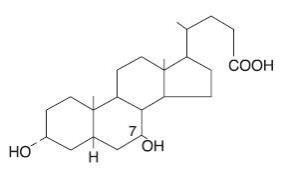
Each capsule contains 300 mg of ursodiol with the following inactive ingredients: Pregelatinized starch, Silicon Dioxide, Magnesium Stearate and Hard Gelatin capsule shell. Capsule shell contains iron oxide red, iron oxide yellow, titanium dioxide and gelatin. The imprinting ink contains the following: Shellac, Dehydrated Alcohol, Isopropyl Alcohol, Butyl Alcohol, Propylene Glycol, Strong Ammonia Solution, Black Iron Oxide and Potassium Hydroxide.
CLINICAL PHARMACOLOGY
About 90% of a therapeutic dose of Ursodiol is absorbed in the small bowel after oral administration. After absorption, ursodiol enters the portal vein and undergoes efficient extraction from portal blood by the liver (i.e., there is a large “first-pass” effect) where it is conjugated with either glycine or taurine and is then secreted into the hepatic bile ducts. Ursodiol in bile is concentrated in the gallbladder and expelled into the duodenum in gallbladder bile via the cystic and common ducts by gallbladder contractions provoked by physiologic responses to eating. Only small quantities of ursodiol appear in the systemic circulation and very small amounts are excreted into urine. The sites of the drug’s therapeutic actions are in the liver, bile, and gut lumen. Beyond conjugation, ursodiol is not altered or catabolized appreciably by the liver or intestinal mucosa. A small proportion of orally administered drug undergoes bacterial degradation with each cycle of enterohepatic circulation. Ursodiol can be both oxidized and reduced at the 7-carbon, yielding either 7-keto-lithocholic acid or lithocholic acid, respectively. Further, there is some bacterially catalyzed deconjugation of glyco- and tauro-ursodeoxycholic acid in the small bowel. Free ursodiol, 7-keto-lithocholic acid, and lithocholic acid are relatively insoluble in aqueous media and larger proportions of these compounds are lost from the distal gut into the feces. Reabsorbed free ursodiol is reconjugated by the liver. Eighty percent of lithocholic acid formed in the small bowel is excreted in the feces, but the 20% that is absorbed is sulfated at the 3-hydroxyl group in the liver to relatively insoluble lithocholyl conjugates which are excreted into bile and lost in feces. Absorbed 7-keto-lithocholic acid is stereospecifically reduced in the liver to chenodiol. Lithocholic acid causes cholestatic liver injury and can cause death from liver failure in certain species unable to form sulfate conjugates. Lithocholic acid is formed by 7-dehydroxylation of the dihydroxy bile acids (ursodiol and chenodiol) in the gut lumen. The 7-dehydroxylation reaction appears to be alphaspecific, i.e., chenodiol is more efficiently 7-dehydroxylated than ursodiol and, for equimolar doses of ursodiol and chenodiol, levels of lithocholic acid appearing in bile are lower with the former. Man has the capacity to sulfate lithocholic acid. Although liver injury has not been associated with ursodiol therapy, a reduced capacity to sulfate may exist in some individuals, but such a deficiency has not yet been clearly demonstrated. Pharmacodynamics Ursodiol suppresses hepatic synthesis and secretion of cholesterol, and also inhibits intestinal absorption of cholesterol. It appears to have little inhibitory effect on synthesis and secretion into bile of endogenous bile acids and does not appear to affect secretion of phospholipids into bile. With repeated dosing, bile ursodeoxycholic acid concentrations reach a steady-state in about 3 weeks. Although insoluble in aqueous media, cholesterol can be solubilized in at least two different ways in the presence of dihydroxy bile acids. In addition to solubilizing cholesterol in micelles, ursodiol acts by an apparently unique mechanism to cause dispersion of cholesterol as liquid crystals in aqueous media. Thus, even though administration of high doses (e.g., 15 - 18 mg/kg/day) does not result in a concentration of ursodiol higher than 60% of the total bile acid pool, ursodiol-rich bile effectively solubilizes cholesterol. The overall effect of ursodiol is to increase the concentration level at which saturation of cholesterol occurs. The various actions of ursodiol combine to change the bile of patients with gallstones from cholesterol-precipitating to cholesterol-solubilizing, thus resulting in bile conducive to cholesterol stone dissolution. After ursodiol dosing is stopped, the concentration of the bile acid in bile falls exponentially, declining to about 5 to 10% of its steady-state level in about 1 week. Clinical Results Gallstone Dissolution On the basis of clinical trial results in a total of 868 patients with radiolucent gallstones treated in 8 studies (three in the U.S. involving 282 patients, one in the U.K. involving 130 patients, and four in Italy involving 456 patients) for periods ranging from 6 to 78 months with Ursodiol doses ranging from about 5 – 20 mg/kg/day, an Ursodiol dose of about 8 - 10 mg/kg/day appeared to be the best dose. With an Ursodiol dose of about 10 mg/kg/day, complete stone dissolution can be anticipated in about 30% of unselected patients with uncalcified gallstones < 20 mm in maximal diameter treated for up to 2 years. Patients with calcified gallstones prior to treatment, or patients who develop stone calcification or gallbladder nonvisualization on treatment, and patients with stones > 20 mm in maximal diameter rarely dissolve their stones. The chance of gallstone dissolution is increased up to 50% in patients with floating or floatable stones (i.e., those with high cholesterol content), and is inversely related to stone size for those < 20 mm in maximal diameter. Complete dissolution was observed in 81% of patients with stones up to 5 mm in diameter. Age, sex, weight, degree of obesity, and serum cholesterol level are not related to the chance of stone dissolution with Ursodiol. A nonvisualizing gallbladder by oral cholecystogram prior to the initiation of therapy is not a contraindication to Ursodiol therapy (the group of patients with nonvisualizing gallbladders in the Ursodiol studies had complete stone dissolution rates similar to the group of patients with visualizing gallbladders). However, gallbladder nonvisualization developing during ursodiol treatment predicts failure of complete stone dissolution and in such cases therapy should be discontinued. Partial stone dissolution occurring within 6 months of beginning therapy with Ursodiol appears to be associated with a > 70% chance of eventual complete stone dissolution with further treatment; partial dissolution observed within 1 year of starting therapy indicates a 40% probability of complete dissolution. Stone recurrence after dissolution with Ursodiol therapy was seen within 2 years in 8/27 (30%) of patients in the U.K. studies. Of 16 patients in the U.K. study whose stones had previously dissolved on chenodiol but later recurred, 11 had complete dissolution on Ursodiol. Stone recurrence has been observed in up to 50% of patients within 5 years of complete stone dissolution on ursodiol therapy. Serial ultrasonographic examinations should be obtained to monitor for recurrence of stones, bearing in mind that radiolucency of the stones should be established before another course of Ursodiol is instituted. A prophylactic dose of Ursodiol has not been established. Gallstone Prevention Two placebo-controlled, multicenter, double-blind, randomized, parallel group trials in a total of 1,316 obese patients were undertaken to evaluate Ursodiol in the prevention of gallstone formation in obese patients undergoing rapid weight loss. The first trial consisted of 1,004 obese patients with a body mass index (BMI) ≥ 38 who underwent weight loss induced by means of a very low-calorie diet for a period of 16 weeks. An intent-to-treat analysis of this trial showed that gallstone formation occurred in 23% of the placebo group, while those patients on 300, 600, or 1200 mg/day of Ursodiol experienced a 6%, 3%, and 2% incidence of gallstone formation, respectively. The mean weight loss for this 16-week trial was 47 lb for the placebo group, and 47 lb, 48 lb, and 50 lb for the 300, 600, and 1200 mg/day Ursodiol groups, respectively. The second trial consisted of 312 obese patients (BMI ≥ 40) who underwent rapid weight loss through gastric bypass surgery. The trial drug treatment period was for 6 months following this surgery. Results of this trial showed that gallstone formation occurred in 23% of the placebo group, while those patients on 300, 600, or 1200 mg/day of Ursodiol experienced a 9%, 1%, and 5% incidence of gallstone formation, respectively. The mean weight loss for this 6-month trial was 64 lb for the placebo group, and 67 lb, 74 lb, and 72 lb for the 300, 600, and 1200 mg/day Ursodiol groups, respectively. ALTERNATIVE THERAPIES Watchful Waiting: Watchful waiting has the advantage that no therapy may ever be required. For patients with silent or minimally symptomatic stones, the rate of development of moderate-to-severe symptoms or gallstone complications is estimated to be between 2% and 6% per year, leading to a cumulative rate of 7 to 27% in 5 years. Presumably the rate is higher for patients already having symptoms. Cholecystectomy For patients with symptomatic gallstones, surgery offers the advantage of immediate and permanent stone removal, but carries a high risk in some patients. About 5% of cholecystectomized patients have residual symptoms or retained common duct stones. The spectrum of surgical risk varies as a function of age and the presence of disease other than cholelithiasis. Mortality Rates for Cholecystectomy in the U.S. (National Halothane Study, JAMA 1966; 197:775-8) 27,600 Cholecystectomies (Smoothed Rates) Deaths/1000 Operations•••
| Age (Yrs) | Cholecystectomy | Cholecystectomy+Common Duct Exploration | |
| Low Risk Patients• | |||
| Women | 0-49 | 0.54 | 2.13 |
| 50-69 | 2.80 | 10.10 | |
| Men | 0-49 | 1.04 | 4.12 |
| 50-69 | 5.41 | 19.23 | |
| High Risk Patients•• | |||
| Women | 0-49 | 12.66 | 47.62 |
| 50-69 | 17.24 | 58.82 | |
| Men | 0-49 | 24.39 | 90.91 |
| 50-69 | 33.33 | 111.11 | |
| • In good health or with moderate systemic disease. •• With severe or extreme systemic disease ••• Includes both elective and emergency surgery | |||
Women in good health or who have only moderate systemic disease and are under 49 years of age have the lowest surgical mortality rate (0.054); men in all categories have a surgical mortality rate twice that of women. Common duct exploration quadruples the rates in all categories. The rates rise with each decade of life and increase tenfold or more in all categories with severe or extreme systemic disease.
HOW SUPPLIED
Ursodiol Capsules, USP are beige opaque color capsule plain on the cap and imprinted with ‘E33’ on the body of the capsule in black ink filled with white to off white granular powder. Bottles of 100 are supplied with child-resistant closures.
(NDC 71930- 015 -12) Store at 20°C to 25°C (68° to 77°F). [See USP Controlled Room Temperature].
Dispense in tight container as defined in the USP with a child-resistant closure. KEEP THIS AND ALL MEDICATIONS OUT OF THE REACH OF CHILDREN. Distributed by: Eywa Pharma Inc. 2 Research Way, 3rd Floor Princeton, NJ 08540 Made in India Revised: December 2023
