Get your patient on Relafen Ds - Nabumetone tablet (Nabumetone)
Relafen Ds - Nabumetone tablet prescribing information

Cardiovascular Risk
- Nonsteroidal anti-inflammatory drugs (NSAIDs Throughout this package insert, the term NSAID refers to a non-aspirin non-steroidal anti-inflammatory drug. ) cause an increased risk of serious cardiovascular thrombotic events, including myocardial infarction and stroke, which can be fatal. This risk may occur early in treatment and may increase with duration of use [see WARNINGS and PRECAUTIONS ].
- Nabumetone is contraindicated in the setting of coronary artery bypass graft (CABG) surgery [see CONTRAINDICATIONS and WARNINGS ].
Gastrointestinal Risk
- NSAIDs cause an increased risk of serious gastrointestinal adverse events including bleeding, ulceration, and perforation of the stomach or intestines, which can be fatal. These events can occur at any time during use and without warning symptoms. Elderly patients are at greater risk for serious gastrointestinal events [see WARNINGS ].
INDICATIONS AND USAGE
Carefully consider the potential benefits and risks of nabumetone tablets and other treatment options before deciding to use nabumetone tablets. Use the lowest effective dose for the shortest duration consistent with individual patient treatment goals [see WARNINGS ].
Nabumetone tablets are indicated for relief of signs and symptoms of osteoarthritis and rheumatoid arthritis
DOSAGE AND ADMINISTRATION
Carefully consider the potential benefits and risks of nabumetone tablets and other treatment options before deciding to use nabumetone tablets. Use the lowest effective dose for the shortest duration consistent with individual patient treatment goals [see WARNINGS ].
After observing the response to initial therapy with nabumetone tablets, the dose and frequency should be adjusted to suit an individual patient's needs.
Osteoarthritis and Rheumatoid Arthritis
The recommended starting dose is 1,000 mg taken as a single dose with or without food. Some patients may obtain more symptomatic relief from 1,500 mg to 2,000 mg per day. Nabumetone tablets can be given in either a single or twice-daily dose. Dosages greater than 2,000 mg per day have not been studied. The lowest effective dose should be used for chronic treatment [see WARNINGS ]. Patients weighing under 50 kg may be less likely to require dosages beyond 1,000 mg; therefore, after observing the response to initial therapy, the dose should be adjusted to meet individual patients' requirements.
CONTRAINDICATIONS
Nabumetone tablets are contraindicated in patients with known hypersensitivity to nabumetone or product excipients.
Nabumetone tablets should not be given to patients who have experienced asthma, urticaria, or allergic-type reactions after taking aspirin or other NSAIDs. Severe, rarely fatal, anaphylactic-like reactions to NSAIDs have been reported in such patients [see WARNINGS and PRECAUTIONS ].
Nabumetone tablets are contraindicated in the setting of coronary artery bypass graft (CABG) surgery [see WARNINGS ].
ADVERSE REACTIONS
To report SUSPECTED ADVERSE REACTIONS, contact Carwin Pharmaceutical Associates at 1-844-700-5011 or www.carwinpharma.com or FDA at 1-800-FDA-1088 or www.fda.gov/medwatch.
Adverse reaction information was derived from blinded-controlled and open-labeled clinical trials and from worldwide marketing experience. In the description below, rates of the more common events (greater than 1%) and many of the less common events (less than 1%) represent results of U.S. clinical studies.
Of the 1,677 patients who received nabumetone during U.S. clinical trials, 1,524 were treated for at least 1 month, 1,327 for at least 3 months, 929 for at least a year, and 750 for at least 2 years. More than 300 patients have been treated for 5 years or longer.
The most frequently reported adverse reactions were related to the gastrointestinal tract and included diarrhea, dyspepsia, and abdominal pain.
Incidence ≥ 1% - Probably Causally Related
Gastrointestinal
Diarrhea (14%), dyspepsia (13%), abdominal pain (12%), constipation Incidence of reported reaction between 3% and 9%. Reactions occurring in 1% to 3% of the patients are unmarked. , flatulence, nausea, positive stool guaiac, dry mouth, gastritis, stomatitis, vomiting.
Central Nervous System
Dizziness, headache, fatigue, increased sweating, insomnia, nervousness, somnolence.
Dermatologic
Pruritus, rash.
Special Senses
Tinnitus.
Miscellaneous
Edema.
Incidence < 1% - Probably Causally Related Adverse reactions reported only in worldwide postmarketing experience or in the literature, not seen in clinical trials, are considered rarer and are italicized.
Gastrointestinal
Anorexia, jaundice, duodenal ulcer, dysphagia, gastric ulcer, gastroenteritis, gastrointestinal bleeding, increased appetite, liver function abnormalities, melena, hepatic failure.
Central Nervous System
Asthenia, agitation, anxiety, confusion, depression, malaise, paresthesia, tremor, vertigo.
Dermatologic
Bullous eruptions, photosensitivity, urticaria, pseudoporphyria cutanea tarda, toxic epidermal necrolysis, erythema multiforme, Stevens-Johnson syndrome.
Cardiovascular
Vasculitis.
Metabolic
Weight gain.
Respiratory
Dyspnea, eosinophilic pneumonia, hypersensitivity pneumonitis, idiopathic interstitial pneumonitis.
Genitourinary
Albuminuria, azotemia, hyperuricemia, interstitial nephritis, nephrotic syndrome, vaginal bleeding, renal failure.
Special Senses
Abnormal vision.
Hematologic/Lymphatic
Thrombocytopenia.
Hypersensitivity
Anaphylactoid reaction, anaphylaxis, angioneurotic edema.
Incidence < 1% - Causal Relationship Unknown
Gastrointestinal
Bilirubinuria, duodenitis, eructation, gallstones, gingivitis, glossitis, pancreatitis, rectal bleeding.
Central Nervous System
Nightmares.
Dermatologic
Acne, alopecia.
Cardiovascular
Angina, arrhythmia, hypertension, myocardial infarction, palpitations, syncope, thrombophlebitis.
Respiratory
Asthma, cough.
Genitourinary
Dysuria, hematuria, impotence, renal stones.
Special Senses
Taste disorder.
Body as a Whole
Fever, chills.
Hematologic/Lymphatic
Anemia, leukopenia, granulocytopenia.
Metabolic/Nutritional
Hyperglycemia, hypokalemia, weight loss.
Drug Interactions
ACE-Inhibitors
Reports suggest that NSAIDs may diminish the antihypertensive effect of ACE-inhibitors. This interaction should be given consideration in patients taking NSAIDs concomitantly with ACE-inhibitors.
Aspirin
When nabumetone tablets are administered with aspirin, its protein binding is reduced, although the clearance of free nabumetone is not altered. The clinical significance of this interaction is not known; however, as with other NSAIDs, concomitant administration of nabumetone tablets and aspirin is not generally recommended because of the potential of increased adverse effects.
Diuretics
Clinical studies, as well as postmarketing observations, have shown that nabumetone tablets can reduce the natriuretic effect of furosemide and thiazides in some patients. This response has been attributed to inhibition of renal prostaglandin synthesis. During concomitant therapy with NSAIDs, the patient should be observed closely for signs of renal failure [see WARNINGS ], as well as to assure diuretic efficacy.
Lithium
NSAIDs have produced an elevation of plasma lithium levels and a reduction in renal lithium clearance. The mean minimum lithium concentration increased 15% and the renal clearance was decreased by approximately 20%. These effects have been attributed to inhibition of renal prostaglandin synthesis by the NSAID. Thus, when NSAIDs and lithium are administered concurrently, subjects should be observed carefully for signs of lithium toxicity.
Methotrexate
NSAIDs have been reported to competitively inhibit methotrexate accumulation in rabbit kidney slices. This may indicate that they could enhance the toxicity of methotrexate. Caution should be used when NSAIDs are administered concomitantly with methotrexate.
Warfarin
The effects of warfarin and NSAIDs on GI bleeding are synergistic, such that users of both drugs together have a risk of serious GI bleeding higher than users of either drug alone.
In vitro studies have shown that, because of its affinity for protein, 6MNA may displace other protein-bound drugs from their binding site. Caution should be exercised when administering nabumetone tablets with warfarin since interactions have been seen with other NSAIDs.
Concomitant administration of an aluminum-containing antacid had no significant effect on the bioavailability of 6MNA. When administered with food or milk, there is more rapid absorption; however, the total amount of 6MNA in the plasma is unchanged [see CLINICAL PHARMACOLOGY ].
DESCRIPTION
Nabumetone is a naphthylalkanone designated chemically as 4-(6-methoxy-2-naphthalenyl)-2-butanone. It has the following structure:
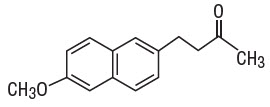 | |
| C 15 H 16 O 2 | M.W. 228.3 |
Nabumetone is a white to off-white crystalline substance. It is nonacidic and practically insoluble in water, but soluble in alcohol and most organic solvents. It has an n-octanol:phosphate buffer partition coefficient of 2,400 at pH 7.4.
Each tablet, for oral administration, contains either 500 mg, 750 mg, or 1000 mg of nabumetone. In addition, each tablet contains the following inactive ingredients: povidone, croscarmellose, magnesium stearate, sodium lauryl sulfate, and colloidal silicon dioxide. The coating contains hydroxypropyl cellulose and hypromellose.
CLINICAL PHARMACOLOGY
Nabumetone is a non-steroidal anti-inflammatory drug (NSAID) that exhibits anti-inflammatory, analgesic, and antipyretic properties in pharmacologic studies. As with other non-steroidal anti-inflammatory agents, its mode of action is not known; however, the ability to inhibit prostaglandin synthesis may be involved in the anti-inflammatory effect.
The parent compound is a prodrug, which undergoes hepatic biotransformation to the active component, 6-methoxy-2-naphthylacetic acid (6MNA), that is a potent inhibitor of prostaglandin synthesis.
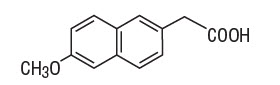
6-methoxy-2-naphthylacetic acid (6MNA)
It is acidic and has an n-octanol:phosphate buffer partition coefficient of 0.5 at pH 7.4.
Pharmacokinetics
After oral administration, approximately 80% of a radiolabeled dose of nabumetone is found in the urine, indicating that nabumetone is well absorbed from the gastrointestinal tract. Nabumetone itself is not detected in the plasma because, after absorption, it undergoes rapid biotransformation to the principal active metabolite, 6-methoxy-2-naphthylacetic acid (6MNA). Approximately 35% of a 1,000 mg oral dose of nabumetone is converted to 6MNA and 50% is converted into unidentified metabolites which are subsequently excreted in the urine. Following oral administration of nabumetone, 6MNA exhibits pharmacokinetic characteristics that generally follow a one-compartment model with first order input and first order elimination.
6MNA is more than 99% bound to plasma proteins. The free fraction is dependent on total concentration of 6MNA and is proportional to dose over the range of 1,000 mg to 2,000 mg. It is 0.2% to 0.3% at concentrations typically achieved following administration of 1,000 mg of nabumetone and is approximately 0.6% to 0.8% of the total concentrations at steady state following daily administration of 2,000 mg.
Steady-state plasma concentrations of 6MNA are slightly lower than predicted from single-dose data. This may result from the higher fraction of unbound 6MNA which undergoes greater hepatic clearance.
Coadministration of food increases the rate of absorption and subsequent appearance of 6MNA in the plasma but does not affect the extent of conversion of nabumetone into 6MNA. Peak plasma concentrations of 6MNA are increased by approximately one third.
Coadministration with an aluminum-containing antacid had no significant effect on the bioavailability of 6MNA.
| Abbreviation (units) | Young Adults Mean ± SD 1,000 mg n = 31 | Young Adults Mean ± SD 2,000 mg n = 12 | Elderly Mean ± SD 1,000 mg n = 27 |
|---|---|---|---|
| T max (hr) | 3.0 (1.0 to 12.0) | 2.5 (1.0 to 8.0) | 4.0 (1.0 to 10.0) |
| T 1/2 (hr) | 22.5 ± 3.7 | 26.2 ± 3.7 | 29.8 ± 8.1 |
| CL ss /F (mL/min) | 26.1 ± 17.3 | 21.0 ± 4.0 | 18.6 ± 13.4 |
| Vd ss /F (L) | 55.4 ± 26.4 | 53.4 ± 11.3 | 50.2 ± 25.3 |
The simulated curves in the graph below illustrate the range of active metabolite plasma concentrations that would be expected from 95% of patients following 1,000 mg to 2,000 mg doses to steady state. The cross-hatched area represents the expected overlap in plasma concentrations due to intersubject variation following oral administration of 1,000 mg to 2,000 mg of nabumetone.
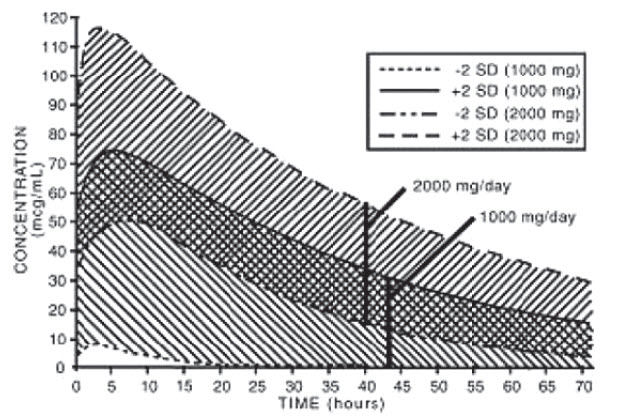 |
| Nabumetone Active Metabolite (6MNA) Plasma Concentrations at Steady State Following Once-Daily Dosing of Nabumetone 1,000 mg (n = 31) 2,000 mg (n = 12) |
6MNA undergoes biotransformation in the liver, producing inactive metabolites that are eliminated as both free metabolites and conjugates. None of the known metabolites of 6MNA has been detected in plasma. Preliminary in vivo and in vitro studies suggest that unlike other NSAIDs, there is no evidence of enterohepatic recirculation of the active metabolite. Approximately 75% of a radiolabeled dose was recovered in urine in 48 hours. Approximately 80% was recovered in 168 hours. A further 9% appeared in the feces. In the first 48 hours, metabolites consisted of:
| - Nabumetone, unchanged | not detectable |
| - 6-methoxy-2-naphthylacetic acid (6MNA), unchanged | < 1% |
| - 6MNA, conjugated | 11% |
| - 6-hydroxy-2-naphthylacetic acid (6HNA), unchanged | 5% |
| - 6HNA, conjugated | 7% |
| - 4-(6-hydroxy-2-naphthyl)-butan-2-ol, conjugated | 9% |
| - O -desmethyl-nabumetone, conjugated | 7% |
| - unidentified minor metabolites | 34% |
| Total % Dose: | 73 % |
Following oral administration of dosages of 1,000 mg to 2,000 mg to steady state, the mean plasma clearance of 6MNA is 20 to 30 mL/min and the elimination half-life is approximately 24 hours.
Elderly Patients
Steady-state plasma concentrations in elderly patients were generally higher than in young healthy subjects (see Table 1 for summary of pharmacokinetic parameters).
Renal Insufficiency
In moderate renal insufficiency patients (creatinine clearance 30 to 49 mL/min), the terminal half-life of 6MNA was increased by approximately 50% (39.2 ± 7.8 hrs, N = 12) compared to the normal subjects (26.9 ± 3.3 hrs, N = 13), and there was a 50% increase in the plasma levels of unbound 6MNA.
Additionally, the renal excretion of 6MNA in the moderate renal impaired patients decreased on average by 33% compared to that in the normal patients. A similar increase in the mean terminal half-life of 6MNA was seen in a small study of patients with severe renal dysfunction (creatinine clearance < 30 mL/min). In patients undergoing hemodialysis, steady-state plasma concentrations of the active metabolite 6MNA were similar to those observed in healthy subjects. Due to extensive protein binding, 6MNA is not dialyzable.
Dosage adjustment of nabumetone generally is not necessary in patients with mild renal insufficiency (≥ 50 mL/min). Caution should be used in prescribing nabumetone to patients with moderate or severe renal insufficiency. The maximum starting doses of nabumetone in patients with moderate or severe renal insufficiency should not exceed 750 mg or 500 mg, respectively once daily. Following careful monitoring of renal function in patients with moderate or severe renal insufficiency, daily doses may be increased to a maximum of 1,500 mg and 1,000 mg, respectively [see WARNINGS ].
Hepatic Impairment
Data in patients with severe hepatic impairment are limited. Biotransformation of nabumetone to 6MNA and the further metabolism of 6MNA to inactive metabolites is dependent on hepatic function and could be reduced in patients with severe hepatic impairment (history of or biopsy-proven cirrhosis).
Special Studies
Gastrointestinal
Nabumetone was compared to aspirin in inducing gastrointestinal blood loss. Food intake was not monitored. Studies utilizing 51Cr-tagged red blood cells in healthy males showed no difference in fecal blood loss after 3 or 4 weeks' administration of 1,000 mg or 2,000 mg of nabumetone daily when compared to either placebo-treated or non-treated subjects. In contrast, aspirin 3,600 mg daily produced an increase in fecal blood loss when compared to subjects who received nabumetone, placebo, or no treatment. The clinical relevance of the data is unknown.
The following endoscopy trials entered patients who had been previously treated with NSAIDs. These patients had varying baseline scores and different courses of treatment. The trials were not designed to correlate symptoms and endoscopy scores. The clinical relevance of these endoscopy trials, i.e., either G.I. symptoms or serious G.I. events, is not known.
Ten endoscopy studies were conducted in 488 patients who had baseline and post-treatment endoscopy. In 5 clinical trials that compared a total of 194 patients on 1,000 mg of nabumetone daily or naproxen 250 mg or 500 mg twice daily for 3 to 12 weeks, treatment with nabumetone resulted in fewer patients with endoscopically detected lesions (> 3 mm). In 2 trials a total of 101 patients administered 1,000 mg or 2,000 mg of nabumetone daily or piroxicam 10 mg to 20 mg for 7 to 10 days, there were fewer patients treated with nabumetone with endoscopically detected lesions. In 3 trials of a total of 47 patients on 1,000 mg of nabumetone daily or indomethacin 100 mg to 150 mg daily for 3 to 4 weeks, the endoscopy scores were higher with indomethacin. Another 12 week trial in a total of 171 patients compared the results of treatment with 1,000 mg of nabumetone daily to ibuprofen 2,400 mg/day and ibuprofen 2,400 mg/day plus misoprostol 800 mcg/day. The results showed that patients treated with nabumetone had a lower number of endoscopically detected lesions (> 5 mm) than patients treated with ibuprofen alone but comparable to the combination of ibuprofen plus misoprostol. The results did not correlate with abdominal pain.
Other
In 1 week, repeat-dose studies in healthy volunteers, 1,000 mg of nabumetone daily had little effect on collagen-induced platelet aggregation and no effect on bleeding time. In comparison, naproxen 500 mg daily suppressed collagen-induced platelet aggregation and significantly increased bleeding time.
CLINICAL TRIALS
Osteoarthritis
The use of nabumetone in relieving the signs and symptoms of osteoarthritis (OA) was assessed in double-blind, controlled trials in which 1,047 patients were treated for 6 weeks to 6 months. In these trials, nabumetone in a dose of 1,000 mg/day administered at night was comparable to naproxen 500 mg/day and to aspirin 3,600 mg/day.
Rheumatoid Arthritis
The use of nabumetone in relieving the signs and symptoms of rheumatoid arthritis (RA) was assessed in double-blind, randomized, controlled trials in which 770 patients were treated for 3 weeks to 6 months. Nabumetone, in a dose of 1,000 mg/day administered at night, was comparable to naproxen 500 mg/day and to aspirin 3,600 mg/day.
In controlled clinical trials of rheumatoid arthritis patients, nabumetone has been used in combination with gold, d-penicillamine, and corticosteroids.
Patient Exposure in Clinical Trials of Osteoarthritis and Rheumatoid Arthritis
In clinical trials with osteoarthritis and rheumatoid arthritis patients, most patients responded to nabumetone in doses of 1,000 mg/day administered nightly; total daily dosages up to 2,000 mg were used. In open-labeled studies, 1,490 patients were permitted dosage increases and were followed for approximately 1 year (mode). Twenty percent of patients (n = 294) were withdrawn for lack of effectiveness during the first year of these open-labeled studies. The following table provides patient-exposure to doses used in the U.S. clinical trials:
| Dose of Nabumetone | Number of Patients | Mean/Mode Duration of Treatment (yr) | ||
|---|---|---|---|---|
| OA | RA | OA | RA | |
| 500 mg | 17 | 6 | 0.4/- | 0.2/- |
| 1,000 mg | 917 | 701 | 1.2/1 | 1.4/1 |
| 1,500 mg | 645 | 224 | 2.3/1 | 1.7/1 |
| 2,000 mg | 15 | 100 | 0.6/1 | 1.3/1 |
As with other NSAIDs, the lowest dose should be sought for each patient. Patients weighing under 50 kg may be less likely to require dosages beyond 1,000 mg; therefore, after observing the response to initial therapy, the dose should be adjusted to meet individual patients' requirements.
HOW SUPPLIED
Nabumetone Tablets USP, 1000 mg are white, coated, modified capsule-shaped tablets, deep bisect on one side and debossed logo "NB 1000" on the other. They are available in bottles of:
100 tablets – NDC 15370-170-10
60 tablets – NDC 15370-170-60
30 tablets – NDC 15370-170-30
Store at 20° to 25°C (68° to 77°F) [See USP Controlled Room Temperature].
Dispense in a tight, light-resistant container as defined in the USP, with a child-resistant closure (as required).
