Get your patient on Radiogardase - Prussian Blue Insoluble Capsules capsule (Prussian Blue Insoluble Capsules)
Radiogardase - Prussian Blue Insoluble Capsules capsule prescribing information

INDICATIONS AND USAGE
Radiogardase is indicated for treatment of patients with known or suspected internal contamination with radioactive cesium and/or radioactive or non-radioactive thallium, in order to increase their rates of elimination.
DOSAGE AND ADMINISTRATION
2.1 Important Administration Instructions
- Obtain quantitative baseline of the internalized contamination by radioactive cesium (137Cs) and/or thallium by appropriate whole-body counting and/or by bioassay (e.g., biodosimetry), or feces/urine samples, whenever possible prior to Radiogardase treatment.
- Initiate treatment with Radiogardase as soon as possible after contamination is suspected. Even when delayed, treatment with Radiogardase is effective and should not be withheld.
- Take Radiogardase capsules with food to stimulate excretion of cesium or thallium.
- In patients who cannot tolerate swallowing large numbers of capsules, open the capsules and mix with bland food or liquids.
Decontamination Procedures for Radioactive Cesium or Thallium Contamination
Prior to initiating treatment with Radiogardase, follow radioactive decontamination safety procedures including:
- Use appropriate radiation protective attire and closely monitor personnel and treatment area for radiation levels using radiation detection, indication, and computation devices (RADIAC) or thermal luminescent devices (TLD).
- Control spread of radiation contamination through the establishment of a patient decontamination area and a contaminated material disposal site (with proper labeling, handling, and disposal of contaminated material).
Recommended Dosage
- Adults and Adolescents : 3 grams (6 capsules) taken orally three times a day (a total daily dose of 9 grams)
- Pediatric Patients (2 – 12 years) : 1 gram (2 capsules) taken orally three times a day (a total daily dose of 3 grams)
Treatment of Radioactive Cesium Contamination
- Anticipate that treatment with Radiogardase may last 30 days or longer.
- Base duration of Radiogardase treatment on weekly measurements of radioactivity in urine and fecal samples to monitor cesium elimination rate.
- Obtain weekly laboratory evaluations (complete blood count, serum chemistry and electrolytes).
Treatment of Radioactive and Non-radioactive Thallium Contamination
- Anticipate that treatment with Radiogardase may last 30 days or longer.
- For radioactive thallium:
- Base duration of Radiogardase treatment on weekly measurements of radioactivity inurine and fecal samples to monitor thallium elimination rate.
- Continue Radiogardase treatment until a 24-hour urine thallium test is normal (less than 5 micrograms per liter) and radiation level is acceptable.
- For non-radioactive thallium: Continue Radiogardase treatment until a 24-hour urine thallium test is normal (less than 5 micrograms per liter).
- Obtain weekly laboratory evaluations (complete blood count, serum chemistry and electrolytes).
- In cases of severe thallium intoxication, additional types of treatment may be necessary, such as:
- Induced emesis, followed by gastric intubation and lavage
- Forced diuresis until urinary thallium excretion is less than 1 mg/24 hours
- Charcoal hemoperfusion may be useful during the first 48 hours after thallium ingestion (biodistribution phase).
- Hemodialysis has also been reported to be effective in thallium intoxication.
DOSAGE FORMS AND STRENGTHS
Capsules: 0.5 grams - dark blue capsule is imprinted with the light blue inscription:  PB
PB
USE IN SPECIFIC POPULATIONS
Pregnancy
Pregnancy Category C It is not known whether Radiogardase can cause fetal harm when administered to a pregnant woman or if it can affect reproduction capacity. Animal reproduction studies have not been conducted with prussian blue insoluble. However, since Radiogardase is not absorbed from the gastrointestinal tract, effects on the fetus are not expected.
Radioactive cesium ( 137 Cs) crosses the human placenta. One patient, contaminated with 0.005 mCi 137 Cs during her 4 th month of pregnancy, was not treated with Radiogardase. At birth, the concentration of 137 Cs was the same in the mother and the infant.
Thallium crosses the human placenta. Reported fetal effects include failure to thrive and death. The toxicity from untreated radioactive cesium or thallium exposure is greater than the potential reproductive toxicity of Radiogardase.
Nursing Mothers
Studies to determine if Radiogardase is excreted in human milk have not been conducted. Since Radiogardase is not absorbed from the gastrointestinal tract, its excretion in milk is unlikely. However, cesium and thallium are transmitted from mother to infant in breast milk. Women internally contaminated with cesium or thallium should not breastfeed.
Pediatric Use
Radioactive Cesium Contamination The safety and efficacy of Radiogardase in the treatment of 137 Cs in pediatric patients ages, 2 to 18 years old, was established from data from Radiogardase-treated pediatric patients exposed to 137 Cs in the Goiânia, Brazil, contamination incident and from Radiogardase-treated adults exposed to 137 Cs [see Clinical Studies (14.1) ].
Overall, 27 pediatric patients received Radiogardase in the range of 3 to 10 grams per day in divided doses (the maximum recommended adolescent dosage is 9 grams per day). Radiogardase treatment reduced the whole body effective half-life of 137 Cs by 46% in adolescents and by 43% in children aged 4 to 12 years of age. In 12 patients for whom the rate of radiation elimination data are available, the rate was similar to that in adults treated with 3 grams three times daily and in pediatric patients treated with 1 gram three times daily. By body weight, the dose ranged from
0.32 gram/kg in the 12-year old patient (10 gram Radiogardase daily dose, 31 kg weight) to
0.21 gram/kg in the 4 year old patient (3 gram Radiogardase daily dose, 14 kg weight) [see Clinical Studies (14.1) ] .
Pediatric patients aged 2 up to 4 years are expected to have biliary and gastrointestinal function that is comparable to that of a 4-year old.
The safety and efficacy of Radiogardase has not been established in the treatment of 137 Cs contamination in pediatric patients 0 to 2 years old. There are differences in the developmental maturity of the biliary system and gastrointestinal tract of neonates and infants (0 – 2 years). The dosage-related adverse reactions of Radiogardase on an immature gastrointestinal tract are not known.
Radioactive and Non-Radioactive Thallium Contamination The safety and efficacy of Radiogardase for the treatment of radioactive and non-radioactive thallium contamination in pediatric patients has not been established.
Geriatric Use
The safety and efficacy of Radiogardase in patients aged 65 and over have not been evaluated, to determine whether they respond differently from younger subjects.. In general, elderly patients should be monitored closely, reflecting the greater frequency of decreased cardiac function and of concomitant disease or other drug therapy.
Hepatic Impairment
Radiogardase is not systemically bioavailable and does not rely on hepatic metabolism for activation or inactivation. However, Radiogardase may be less effective in patients with hepatic impairment, due to decreased excretion of cesium and thallium in the bile.
CONTRAINDICATIONS
None
WARNINGS AND PRECAUTIONS
Increased Radiation Absorbed Dose to Gastrointestinal Mucosa
Radiogardase can decrease gastrointestinal motility, thus slowing the transit time of radioactivity in the gastrointestinal tract. The slowed transit time can increase the radiation absorbed dose to the gastrointestinal mucosa.
Constipation
Radiogardase can cause constipation. Monitor and treat for signs and symptoms of constipation. Patients with disorders associated with decreased gastrointestinal motility are at higher risk.
Electrolyte Abnormalities
Radiogardase may bind to electrolytes found in the gastrointestinal tract. Hypokalemia, with serum potassium values of 2.5 – 2.9 (normal 3.5 – 5.0), was reported in 3 (7%) of 42 patients during treatement with Radiogardase. Monitor serum electrolytes during Radiogardase treatment, particularly when treating patients with pre-existing cardiac arrhythmias or electrolyte imbalances.
Blue Discoloration of Feces, Oral Mucosa, and Dentition
Radiogardase is excreted primarily in feces and turns stools blue. When Radiogardase capsules are opened and the contents eaten with food, the oral mucosa and dentition may also be colored blue.
ADVERSE REACTIONS
Constipation was reported in 10 (24%) of 42 patients treated with Radiogardase. Severity of constipation was mild in 7 patients and moderate in 3 patients [see Warnings and Precautions (5.2) ].
DRUG INTERACTIONS
Based on animal data, co-administration of Radiogardase with other decorporation agents does not affect the efficacy of Radiogardase for treatment of internal contamination with radioactive cesium and/or radioactive or non-radioactive thallium.
DESCRIPTION
Radiogardase (prussian blue insoluble) is a decorporation agent for oral use. Radiogardase capsules contain insoluble ferric hexacyanoferrate(II), with an empirical formula of Fe 4 [Fe(CN) 6 ] 3 and a molecular weight of 859.3 Daltons. It is supplied as 0.5 gram of blue powder in gelatin capsules with 0 – 38 mg of microcrystalline cellulose. The dark blue capsule is imprinted with the light blue inscription:  PB. The powder may vary from uniformly fine, dark granules to coarse light and dark-colored granules. The structural formula for prussian blue insoluble is shown below.
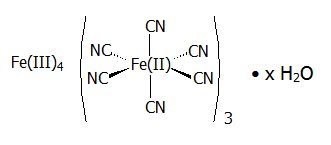
The crystal structure of prussian blue insoluble is a cubic lattice with the Fe II and Fe III atoms occupying the corners of the cube and the cyanide groups positioned on the sides.
CLINICAL PHARMACOLOGY
Mechanism of Action
Prussian blue insoluble, ferric hexacyanoferrate(II), acts by ion-exchange, adsorption, and mechanical trapping within the crystal structure, and has a high affinity for radioactive and non-radioactive cesium and thallium.
Prussian blue insoluble binds cesium and thallium isotopes in the gastrointestinal tract after these isotopes are ingested or excreted in the bile by the liver, thereby reducing gastrointestinal reabsorption (enterohepatic circulation). The rate of cesium and thallium elimination is proportional to the duration and dose of prussian blue insoluble.
Pharmacodynamics
Cesium-137 ( 137 Cs) 137 Cs has a physical half-life of 30 years, with a beta energy peak at 174.0 keV. Following entry into the blood, it is distributed uniformly through all body tissues. Approximately 10% of 137 Cs is eliminated rapidly with a biological half-life of 2 days; 90% is eliminated more slowly, with a biological half-life of 110 days; and less than 1% of the 137 Cs is retained with a biological half-life of about 500 days. 137 Cs follows the movement of potassium and is excreted into the intestine, reabsorbed from the gastrointestinal (GI) tract into the blood, then to the bile, where it is excreted again into the GI tract by bile via enterohepatic circulation. Without Radiogardase treatment, about 80% of 137 Cs is excreted through the kidneys and about 20% in the feces.
Thallium-201 ( 201 Tl) Radioactive thallium ( 201 Tl) has a physical half-life of 3 days with electron and photon emissions with a gamma energy peak at 167.4 keV. Non-radioactive thallium has a biological half-life of
8 – 10 days.The physiologic transport of thallium follows the same route as potasium and is excreted by bile in enterohepatic circulation. Without Radiogardase treatment, the fecal to urine excretion ratio of thallium is approximately 2:1.
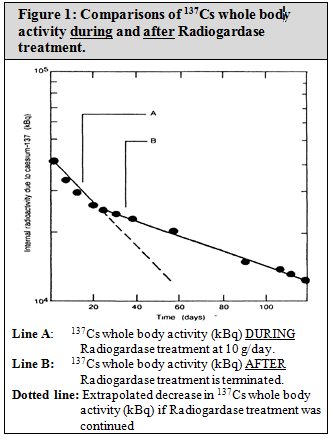
The results of fecal analysis from patients contaminated with 137 Cs and treated with Radiogardase showed higher activities of 137 Cs in feces, and the associated whole body radioactivity counts showed a more rapid rate of elimination from the body. The effectiveness of Radiogardase for one patient is shown in Figure 1. The whole body content of radioactive material of 137 Cs in kilo-Bequerels (kBq) is shown on the y-axis. Time in days is on the x-axis. Line “A” represents the whole body activity of 137 Cs during prussian blue insoluble treatment at 10 g/day. The dotted line represents extrapolation of the whole body activity if treatment was continued. Line “B” represents the whole body activity of 137 Cs, after prussian blue insoluble was stopped.
Pharmacokinetics
Absorption/Elimination : Prussian blue insoluble is not absorbed through the intact gastrointestinal wall. Its clearance from the body depends on the gastrointestinal tract transit time.
Food Effects : Food effect studies have not been conducted. In animal studies, Prussian blue insoluble was not significantly absorbed. Food may increase the effectiveness of prussian blue insoluble by stimulating bile secretion.
NONCLINICAL TOXICOLOGY
Carcinogenesis, Mutagenesis, Impairment of Fertility
Animal studies have not been performed to evaluate the carcinogenic or mutagenic potential of prussian blue insoluble. No study on impairment of male or female fertility and reproductive performance has been conducted in animals.
Animal Toxicology and/or Pharmacology
Absorption/Elimination In an animal study (pigs, n =38), after a single dose of 40 mg of labeled prussian blue insoluble, 99% of the administered prussian blue dose was excreted unchanged in feces. Absorption from multiple doses has not been studied.
In a study using rats (n = 40, mean body weight range of 188 – 219 grams) injected with 137 Cs, a dose response relationship was demonstrated for the amount of radiation elimination with prussian blue insoluble at doses of 1 to 50 mg/day (Table 1). There is little difference in radiation elimination rate between prussian blue insoluble at doses of 50 to 100 mg/day. In Table 1, the % of Injected Radiation Dose Remaining is defined as the percentage of the total injected dose of 137 Cs remaining in the body at 96 hours post administration.
Table 1: Dose Response Relationship in Rats at 96 Hours | |
Prussian blue insoluble dose (mg/day) | % Injected 137 Cs dose remaining (Range) |
Untreated | 58.1 (63.3 – 53.4) |
1 | 9.42 (13.2 – 6.72) |
10 | 1.17 (1.64 – 0.84) |
50 | 0.57 (0.80 – 0.41) |
100 | 0.52 (0.73 – 0.37) |
In studies of rats, pigs, and dogs that were internally contaminated with cesium and thallium, the presence of the insoluble complexes in the gastrointestinal lumen changed the primary elimination route from the kidney to the feces and increased the rate of elimination of these two contaminants.
CLINICAL STUDIES
Cesium-137 Contamination
In literature reports, 72 people received Radiogardase after exposure to radioactive cesium ( 137 Cs):
- 46 patients with 137Cs contamination
- 19 patients 137Cs contamination in other incidents
- 7 healthy human subjects who voluntarily ingested trace doses of 137Cs
In a 1987 incident in Goiânia, Brazil, 46 patients with heavy internal contamination with 137Cs were treated with Radiogardase (Table 2). Data on the whole body effective half-life of 137Cs, during and after Radiogardase treatment, was completed on 33 of these 46 patients (see Table 2). Radiogardase reduced the mean whole-body effective half-life of 137Cs by 69%, 46%, and 43% in adults, adolescents, and younger children, respectively.
Table 2 shows the decrease in whole body effective half-life of 137Cs in patients during Radiogardase treatment compared to the half-life of 137Cs after Radiogardase discontinuation (after treatment).
Table 2: Cesium-137 Effective Half-life During and After Treatment with Radiogardase | ||||
Group | Age (years) | Radiogardase Dosage | 137 Cs Effective Half Life | |
During Radiogardase Treatment | After Radiogardase Treatment | |||
Adults (n=5) | > 18 | 10 grams/day | 26 ± 6 days | 80 ± 15 days (all 21 adult patients) |
Adults (n=10) | 6 grams/day | 25 ± 15 days | ||
Adults (n=6) | 3 grams/day | 25 ± 9 days | ||
Adolescents (n=5) | 12 -14 | < 10 grams/day | 30 ± 12 days | 62 ± 14 days |
Children (n=7) | 4 – 9 | < 3 grams/day | 24 ± 3 days | 42 ± 4 days |
Data from additional literature articles including 19 patients contaminated with 137 Cs in other incidents and a study of 7 human subjects who voluntarily ingested trace doses of 137 Cs showed a similar reduction in whole body effective half-life with Radiogardase treatment.
Thallium Contamination
Thirty-four patients treated with Radiogardase for non-radioactive thallium poisoning have been reported in the literature. Radiogardase treatment reduced the mean serum biologic half-life of thallium from 8 days to 3 days.
HOW SUPPLIED/STORAGE AND HANDLING
Radiogardase is supplied as gelatin capsules containing 0.5 grams of prussian blue insoluble for oral administration. The dark blue capsule is imprinted with the light blue inscription:  PB. It is packaged in white plastic containers with a child-resistant tamper-evident closure. Each container contains 36 capsules.
- NDC: 58060-002-02
Storage
Store at 20 °C to 25 °C (68 °F to 77 °F), excursions permitted between 15 °C and 30°C (between 59 °F and 86 °F). Brief exposure to temperatures up to 40 °C (104 °F) may be tolerated, provided the mean kinetic temperature does not exceed 25 °C (77 °F); however, minimize such exposure. [see USP Controlled Room Temperature]
Mechanism of Action
Prussian blue insoluble, ferric hexacyanoferrate(II), acts by ion-exchange, adsorption, and mechanical trapping within the crystal structure, and has a high affinity for radioactive and non-radioactive cesium and thallium.
Prussian blue insoluble binds cesium and thallium isotopes in the gastrointestinal tract after these isotopes are ingested or excreted in the bile by the liver, thereby reducing gastrointestinal reabsorption (enterohepatic circulation). The rate of cesium and thallium elimination is proportional to the duration and dose of prussian blue insoluble.
