Get your patient on Quinidine Gluconate - Quinidine Gluconate tablet, Extended Release (Quinidine Gluconate)
Quinidine Gluconate - Quinidine Gluconate tablet, Extended Release prescribing information

In many trials of antiarrhythmic therapy for non-life-threatening arrhythmias, active antiarrhythmic therapy has resulted in increased mortality; the risk of active therapy is probably greatest in patients with structural heart disease.
In the case of quinidine used to prevent or defer recurrence of atrial flutter/fibrillation, the best available data come from a meta-analysis described under CLINICAL PHARMACOLOGY/Clinical Effects above. In the patients studied in the trials there analyzed, the mortality associated with the use of quinidine was more than three times as great as the mortality associated with the use of placebo.
Another meta-analysis, also described under CLINICAL PHARMACOLOGY/Clinical Effects , showed that in patients with various non-life-threatening ventricular arrhythmias, the mortality associated with the use of quinidine was consistently greater than that associated with the use of any of a variety of alternative antiarrhythmics.
INDICATIONS AND USAGE
Conversion of atrial fibrillation/flutter
In patients with symptomatic atrial fibrillation/flutter whose symptoms are not adequately controlled by measures that reduce the rate of ventricular response, quinidine gluconate is indicated as a means of restoring normal sinus rhythm. If this use of quinidine gluconate does not restore sinus rhythm within a reasonable time (see DOSAGE AND ADMINISTRATION ), then quinidine gluconate should be discontinued.
Reduction of frequency of relapse into atrial fibrillation/flutter
Chronic therapy with quinidine gluconate is indicated for some patients at high risk of symptomatic atrial fibrillation/flutter, generally patients who have had previous episodes of atrial fibrillation/flutter that were so frequent and poorly tolerated as to outweigh, in the judgment of the physician and the patient, the risks of prophylactic therapy with quinidine gluconate. The increased risk of death should specifically be considered. Quinidine gluconate should be used only after alternative measures (e.g., use of other drugs to control the ventricular rate) have been found to be inadequate.
In patients with histories of frequent symptomatic episodes of atrial fibrillation/flutter, the goal of therapy should be an increase in the average time between episodes. In most patients, the tachyarrhythmia will recur during therapy, and a single recurrence should not be interpreted as therapeutic failure.
Suppression of ventricular arrhythmias
Quinidine gluconate is also indicated for the suppression of recurrent documented ventricular arrhythmias, such as sustained ventricular tachycardia, that in the judgment of the physician are life-threatening. Because of the proarrhythmic effects of quinidine, its use with ventricular arrhythmias of lesser severity is generally not recommended, and treatment of patients with asymptomatic ventricular premature contractions should be avoided. Where possible, therapy should be guided by the results of programmed electrical stimulation and/or Holter monitoring with exercise.
Antiarrhythmic drugs (including quinidine gluconate) have not been shown to enhance survival in patients with ventricular arrhythmias.
DOSAGE AND ADMINISTRATION
The dose of quinidine delivered by quinidine gluconate extended-release tablets may be titrated by breaking a tablet in half. If tablets are crushed or chewed, their extended-release properties will be lost.
The dosage of quinidine varies considerably depending upon the general condition and the cardiovascular state of the patient.
Conversion of atrial fibrillation/flutter to sinus rhythm
Especially in patients with known structural heart disease or other risk factors for toxicity, initiation or dose-adjustment of treatment with quinidine gluconate should generally be performed in a setting where facilities and personnel for monitoring and resuscitation are continuously available. Patients with symptomatic atrial fibrillation/flutter should be treated with quinidine gluconate only after ventricular rate control (e.g., with digitalis or β-blockers) has failed to provide satisfactory control of symptoms.
Adequate trials have not identified an optimal regimen of quinidine gluconate for conversion of atrial fibrillation/flutter to sinus rhythm. In one reported regimen, the patient first receives two tablets (648 mg; 403 mg of quinidine base) of quinidine gluconate every eight hours. If this regimen has not resulted in conversion after 3 or 4 doses, then the dose is cautiously increased. If, at any point during administration, the QRS complex widens to 130% of its pre-treatment duration; the QT c interval widens to 130% of its pre-treatment duration and is then longer than 500 ms; P waves disappear; or the patient develops significant tachycardia, symptomatic bradycardia, or hypotension, then quinidine gluconate is discontinued, and other means of conversion (e.g., direct-current cardioversion) are considered.
In another regimen sometimes used, the patient receives one tablet (324 mg; 202 mg of quinidine base) every eight hours for two days; then two tablets every twelve hours for two days; and finally two tablets every eight hours for up to four days. The four-day stretch may come at one of the lower doses if, in the judgment of the physician, the lower dose is the highest one that will be tolerated. The criteria for discontinuation of treatment with quinidine gluconate are the same as in the other regimen.
Reduction in the frequency of relapse into atrial fibrillation/flutter
In a patient with a history of frequent symptomatic episodes of atrial fibrillation/flutter, the goal of therapy with quinidine gluconate should be an increase in the average time between episodes. In most patients, the tachyarrhythmia will recur during therapy with quinidine gluconate, and a single recurrence should not be interpreted as therapeutic failure.
Especially in patients with known structural heart disease or other risk factors for toxicity, initiation or dose-adjustment of treatment with quinidine gluconate should generally be performed in a setting where facilities and personnel for monitoring and resuscitation are continuously available. Monitoring should be continued for two or three days after initiation of the regimen on which the patient will be discharged.
Therapy with quinidine gluconate should be begun with one tablet (324 mg; 202 mg of quinidine base) every eight or twelve hours. If this regimen is well tolerated, if the serum quinidine level is still well within the laboratory's therapeutic range, and if the average time between arrhythmic episodes has not been satisfactorily increased, then the dose may be cautiously raised. The total daily dosage should be reduced if the QRS complex widens to 130% of its pre-treatment duration; the QT c interval widens to 130% of its pre-treatment duration and is then longer than 500 ms; P waves disappear; or the patient develops significant tachycardia, symptomatic bradycardia, or hypotension.
Suppression of life-threatening ventricular arrhythmias
Dosing regimens for the use of quinidine gluconate in suppressing life-threatening ventricular arrhythmias have not been adequately studied. Described regimens have generally been similar to the regimen described just above for the prophylaxis of symptomatic atrial fibrillation/flutter. Where possible, therapy should be guided by the results of programmed electrical stimulation and/or Holter monitoring with exercise.
CONTRAINDICATIONS
Quinidine is contraindicated in patients who are known to be allergic to it, or who have a history of immune thrombocytopenia or have developed thrombocytopenic purpura during prior therapy with quinidine or quinine (see WARNINGS ).
In the absence of a functioning artificial pacemaker, quinidine is also contraindicated in any patient whose cardiac rhythm is dependent upon a junctional or idioventricular pacemaker, including patients in complete atrioventricular block.
Quinidine is also contraindicated in patients who, like those with myasthenia gravis, might be adversely affected by an anticholinergic agent.
ADVERSE REACTIONS
Quinidine preparations have been used for many years, but there are only sparse data from which to estimate the incidence of various adverse reactions. The adverse reactions most frequently reported have consistently been gastrointestinal, including diarrhea, nausea, vomiting, and heartburn/esophagitis.
In the reported study that was closest in character to the predominant approved use of quinidine gluconate, 86 adult outpatients with atrial fibrillation were followed for six months while they received slow-release quinidine bisulfate tablets, 600 mg (approximately 400 mg of quinidine base) twice daily. The incidences of adverse experiences reported more than once were as shown in the table below. The most serious quinidine-associated adverse reactions are described above under WARNINGS .
| Incidence | (%) | |
|---|---|---|
diarrhea | 21 | (24%) |
fever | 5 | (6%) |
rash | 5 | (6%) |
arrhythmia | 3 | (3%) |
abnormal electrocardiogram | 3 | (3%) |
nausea/vomiting | 3 | (3%) |
dizziness | 3 | (3%) |
headache | 3 | (3%) |
asthenia | 2 | (2%) |
cerebral ischemia | 2 | (2%) |
Vomiting and diarrhea can occur as isolated reactions to therapeutic levels of quinidine, but they may also be the first signs of cinchonism , a syndrome that may also include tinnitus, reversible high-frequency hearing loss, deafness, vertigo, blurred vision, diplopia, photophobia, headache, confusion, and delirium. Cinchonism is most often a sign of chronic quinidine toxicity, but it may appear in sensitive patients after a single moderate dose.
A few cases of hepatotoxicity , including granulomatous hepatitis, have been reported in patients receiving quinidine. All of these have appeared during the first few weeks of therapy, and most (not all) have remitted once quinidine was withdrawn.
Drug and Diet Interactions
Altered pharmacokinetics of quinidine: Diltiazem significantly decreases the clearance and increases the t ½ of quinidine, but quinidine does not alter the kinetics of diltiazem.
Drugs that alkalinize the urine ( carbonic-anhydrase inhibitors , sodium bicarbonate , thiazide diuretics ) reduce renal elimination of quinidine.
By pharmacokinetic mechanisms that are not well understood, quinidine levels are increased by coadministration of amiodarone or cimetidine . Very rarely, and again by mechanisms not understood, quinidine levels are decreased by coadministration of nifedipine .
Hepatic elimination of quinidine may be accelerated by coadministration of drugs ( phenobarbital , phenytoin , rifampin ) that induce production of cytochrome P450 IIIA4 .
Perhaps because of competition for the P450 IIIA4 metabolic pathway, quinidine levels rise when ketoconazole is coadministered.
Coadministration of propranolol usually does not affect quinidine pharmacokinetics, but in some studies the β-blocker appeared to cause increases in the peak serum levels of quinidine, decreases in quinidine's volume of distribution, and decreases in total quinidine clearance. The effects (if any) of coadministration of other β-blockers on quinidine pharmacokinetics have not been adequately studied.
Hepatic clearance of quinidine is significantly reduced during coadministration of verapamil , with corresponding increases in serum levels and half-life.
Grapefruit juice: Grapefruit juice inhibits P450 3A4-mediated metabolism of quinidine to 3-hydroxyquinidine. Although the clinical significance of this interaction is unknown, grapefruit juice should be avoided.
Dietary salt: The rate and extent of quinidine absorption may be affected by changes in dietary salt intake; a decrease in dietary salt intake may lead to an increase in plasma quinidine concentrations.
Altered pharmacokinetics of other drugs: Quinidine slows the elimination of digoxin and simultaneously reduces digoxin's apparent volume of distribution. As a result, serum digoxin levels may be as much as doubled. When quinidine and digoxin are coadministered, digoxin doses usually need to be reduced. Serum levels of digitoxin are also raised when quinidine is coadministered, although the effect appears to be smaller.
By a mechanism that is not understood, quinidine potentiates the anticoagulatory action of warfarin , and the anticoagulant dosage may need to be reduced.
Cytochrome P450 IID6 is an enzyme critical to the metabolism of many drugs, notably including mexiletine , some phenothiazines , and most polycyclic antidepressants . Constitutional deficiency of cytochrome P450 IID6 is found in less than 1% of Orientals, in about 2% of American blacks, and in about 8% of American whites. Testing with debrisoquine is sometimes used to distinguish the P450 IID6 -deficient "poor metabolizers" from the majority-phenotype "extensive metabolizers".
When drugs whose metabolism is P450 IID6 -dependent are given to poor metabolizers, the serum levels achieved are higher, sometimes much higher, than the serum levels achieved when identical doses are given to extensive metabolizers. To obtain similar clinical benefit without toxicity, doses given to poor metabolizers may need to be greatly reduced. In the case of prodrugs whose actions are actually mediated by P450 IID6 -produced metabolites (for example, codeine and hydrocodone, whose analgesic and antitussive effects appear to be mediated by morphine and hydromorphone, respectively), it may not be possible to achieve the desired clinical benefits in poor metabolizers.
Quinidine is not metabolized by cytochrome P450 IID6 , but therapeutic serum levels of quinidine inhibit the action of cytochrome P450 IID6 , effectively converting extensive metabolizers into poor metabolizers. Caution must be exercised whenever quinidine is prescribed together with drugs metabolized by cytochrome P450 IID6 .
Perhaps by competing for pathways of renal clearance, coadministration of quinidine causes an increase in serum levels of procainamide .
Serum levels of haloperidol are increased when quinidine is coadministered.
Presumably because both drugs are metabolized by cytochrome P450 IIIA4 , coadministration of quinidine causes variable slowing of the metabolism of nifedipine . Interactions with other dihydropyridine calcium channel blockers have not been reported, but these agents (including felodipine , nicardipine , and nimodipine ) are all dependent upon P450 IIIA4 for metabolism, so similar interactions with quinidine should be anticipated.
Altered pharmacodynamics of other drugs: Quinidine's anticholinergic, vasodilating, and negative inotropic actions may be additive to those of other drugs with these effects, and antagonistic to those of drugs with cholinergic, vasoconstricting, and positive inotropic effects. For example, when quinidine and verapamil are coadministered in doses that are each well tolerated as monotherapy, hypotension attributable to additive peripheral α-blockade is sometimes reported.
Quinidine potentiates the actions of depolarizing (succinylcholine, decamethonium) and nondepolarizing ( d -tubocurarine, pancuronium) neuromuscular blocking agents . These phenomena are not well understood, but they are observed in animal models as well as in humans. In addition, in vitro addition of quinidine to the serum of pregnant women reduces the activity of pseudocholinesterase, an enzyme that is essential to the metabolism of succinylcholine.
Non-interactions of quinidine with other drugs: Quinidine has no clinically significant effect on the pharmacokinetics of diltiazem , flecainide , mephenytoin , metoprolol , propafenone , propranolol , quinine , timolol , or tocainide .
Conversely, the pharmacokinetics of quinidine are not significantly affected by caffeine , ciprofloxacin , digoxin , felodipine , omeprazole , or quinine . Quinidine's pharmacokinetics are also unaffected by cigarette smoking.
DESCRIPTION
Quinidine is an antimalarial schizonticide and an antiarrhythmic agent with Class Ia activity; it is the d-isomer of quinine, and its molecular weight is 324.43. Quinidine gluconate is the gluconate salt of quinidine; its chemical name is cinchonan-9-ol, 6'-methoxy-, (9S)-, mono-D-gluconate; its structural formula is:
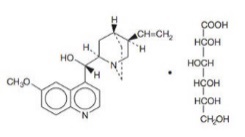
Its empirical formula is C 20 H 24 N 2 O 2 • C 6 H 12 O 7 , and its molecular weight is 520.58, of which 62.3% is quinidine base.
Each quinidine gluconate extended-release tablet contains 324 mg of quinidine gluconate (202 mg of quinidine base) in a matrix to provide extended-release; the inactive ingredients include corn starch, hydroxypropyl methylcellulose, magnesium stearate, microcrystalline cellulose, povidone, silicon dioxide, and sodium alginate.
This product complies with USP Drug Release Test 5.
CLINICAL PHARMACOLOGY
Pharmacokinetics and Metabolism
The absolute bioavailability of quinidine from quinidine gluconate is 70 to 80%. Relative to a solution of quinidine sulfate, the bioavailability of quinidine from quinidine gluconate is reported to be 1.03. The less-than-complete bioavailability is thought to be due to first-pass elimination by the liver. Peak serum levels generally appear 3 to 5 hours after dosing; when the drug is taken with food, absorption is increased in both rate (27%) and extent (17%). The rate and extent of absorption of quinidine from quinidine gluconate are not significantly affected by the coadministration of an aluminum-hydroxide antacid. The rate of absorption of quinidine following the ingestion of grapefruit juice may be decreased.
The volume of distribution of quinidine is 2 to 3 L/kg in healthy young adults, but this may be reduced to as little as 0.5 L/kg in patients with congestive heart failure, or increased to 3 to 5 L/kg in patients with cirrhosis of the liver. At concentrations of 2 to 5 mg/L (6.5 to 16.2 µmol/L), the fraction of quinidine bound to plasma proteins (mainly to α 1 -acid glycoprotein and to albumin) is 80 to 88% in adults and older children, but it is lower in pregnant women, and in infants and neonates it may be as low as 50 to 70%. Because α 1 -acid glycoprotein levels are increased in response to stress, serum levels of total quinidine may be greatly increased in settings such as acute myocardial infarction, even though the serum content of unbound (active) drug may remain normal. Protein binding is also increased in chronic renal failure, but binding abruptly descends toward or below normal when heparin is administered for hemodialysis.
Quinidine clearance typically proceeds at 3 to 5 mL/min/kg in adults, but clearance in children may be twice or three times as rapid. The elimination half-life is 6 to 8 hours in adults and 3 to 4 hours in children. Quinidine clearance is unaffected by hepatic cirrhosis, so the increased volume of distribution seen in cirrhosis leads to a proportionate increase in the elimination half-life.
Most quinidine is eliminated hepatically via the action of cytochrome P450 IIIA4 ; there are several different hydroxylated metabolites, and some of these have antiarrhythmic activity.
The most important of quinidine's metabolites is 3-hydroxy-quinidine (3HQ), serum levels of which can approach those of quinidine in patients receiving conventional doses of quinidine gluconate. The volume of distribution of 3HQ appears to be larger than that of quinidine, and the elimination half-life of 3HQ is about 12 hours.
As measured by antiarrhythmic effects on animals, by QT c prolongation in human volunteers, or by various in vitro techniques, 3HQ has at least half the antiarrhythmic activity of the parent compound, so it may be responsible for a substantial fraction of the effect of quinidine gluconate in chronic use.
When the urine pH is less than 7, about 20% of administered quinidine appears unchanged in the urine, but this fraction drops to as little as 5% when the urine is more alkaline. Renal clearance involves both glomerular filtration and active tubular secretion, moderated by (pH-dependent) tubular reabsorption. The net renal clearance is about 1 mL/min/kg in healthy adults. When renal function is taken into account, quinidine clearance is apparently independent of patient age.
Assays of serum quinidine levels are widely available, but the results of modern assays may not be consistent with results cited in the older medical literature. The serum levels of quinidine cited in this package insert are those derived from specific assays, using either benzene extraction or (preferably) reverse-phase high-pressure liquid chromatography. In matched samples, older assays might unpredictably have given results that were as much as two or three times higher. A typical "therapeutic" concentration range is 2 to 6 mg/L (6.2 to 18.5 µmol/L).
Mechanisms of action
In patients with malaria, quinidine acts primarily as an intra-erythrocytic schizonticide, with little effect upon sporozites or upon pre-erythrocytic parasites. Quinidine is gametocidal to Plasmodium vivax and P. malariae , but not to P. falciparum .
In cardiac muscle and in Purkinje fibers, quinidine depresses the rapid inward depolarizing sodium current, thereby slowing phase-0 depolarization and reducing the amplitude of the action potential without affecting the resting potential. In normal Purkinje fibers, it reduces the slope of phase-4 depolarization, shifting the threshold voltage upward toward zero. The result is slowed conduction and reduced automaticity in all parts of the heart, with increase of the effective refractory period relative to the duration of the action potential in the atria, ventricles, and Purkinje tissues. Quinidine also raises the fibrillation thresholds of the atria and ventricles, and it raises the ventricular de fibrillation threshold as well. Quinidine's actions fall into Class Ia in the Vaughn-Williams classification.
By slowing conduction and prolonging the effective refractory period, quinidine can interrupt or prevent reentrant arrhythmias and arrhythmias due to increased automaticity, including atrial flutter, atrial fibrillation, and paroxysmal supraventricular tachycardia.
In patients with sick sinus syndrome, quinidine can cause marked sinus node depression and bradycardia. In most patients, however, use of quinidine is associated with an increase in the sinus rate.
Like other antiarrhythmic drugs with Class Ia activity, quinidine prolongs the QT interval in a dose-related fashion. This may lead to increased ventricular automaticity and polymorphic ventricular tachycardias, including torsades de pointes (see WARNINGS ).
In addition, quinidine has anticholinergic activity, it has negative inotropic activity, and it acts peripherally as an α-adrenergic antagonist (that is, as a vasodilator).
Clinical Effects
Maintenance of sinus rhythm after conversion from atrial fibrillation: In six clinical trials (published between 1970 and 1984) with a total of 808 patients, quinidine (418 patients) was compared to nontreatment (258 patients) or placebo (132 patients) for the maintenance of sinus rhythm after cardioversion from chronic atrial fibrillation. Quinidine was consistently more efficacious in maintaining sinus rhythm, but a meta-analysis found that mortality in the quinidine-exposed patients (2.9%) was significantly greater than mortality in the patients who had not been treated with active drug (0.8%). Suppression of atrial fibrillation with quinidine has theoretical patient benefits (e.g., improved exercise tolerance; reduction in hospitalization for cardioversion; lack of arrhythmia-related palpitations, dyspnea and chest pain; reduced incidence of systemic embolism and/or stroke), but these benefits have never been demonstrated in clinical trials. Some of these benefits (e.g., reduction in stroke incidence) may be achievable by other means (anticoagulation).
By slowing the atrial rate in atrial flutter/fibrillation, quinidine can decrease the degree of atrioventricular block and cause an increase, sometimes marked, in the rate at which supraventricular impulses are successfully conducted by the atrioventricular node, with a resultant paradoxical increase in ventricular rate (see WARNINGS ).
Non-life-threatening ventricular arrhythmias: In studies of patients with a variety of ventricular arrhythmias (mainly frequent ventricular premature beats and non-sustained ventricular tachycardia, quinidine (total n=502) has been compared with flecainide (n=141), mexiletine (n=246), propafenone (n=53), and tocainide (n=67). In each of these studies, the mortality in the quinidine group was numerically greater than the mortality in the comparator group. When the studies were combined in a meta-analysis, quinidine was associated with a statistically significant threefold relative risk of death.
At therapeutic doses, quinidine's only consistent effect upon the surface electrocardiogram is an increase in the QT interval. This prolongation can be monitored as a guide to safety, and it may provide better guidance than serum drug levels (see WARNINGS ).
Clinical Effects
Maintenance of sinus rhythm after conversion from atrial fibrillation: In six clinical trials (published between 1970 and 1984) with a total of 808 patients, quinidine (418 patients) was compared to nontreatment (258 patients) or placebo (132 patients) for the maintenance of sinus rhythm after cardioversion from chronic atrial fibrillation. Quinidine was consistently more efficacious in maintaining sinus rhythm, but a meta-analysis found that mortality in the quinidine-exposed patients (2.9%) was significantly greater than mortality in the patients who had not been treated with active drug (0.8%). Suppression of atrial fibrillation with quinidine has theoretical patient benefits (e.g., improved exercise tolerance; reduction in hospitalization for cardioversion; lack of arrhythmia-related palpitations, dyspnea and chest pain; reduced incidence of systemic embolism and/or stroke), but these benefits have never been demonstrated in clinical trials. Some of these benefits (e.g., reduction in stroke incidence) may be achievable by other means (anticoagulation).
By slowing the atrial rate in atrial flutter/fibrillation, quinidine can decrease the degree of atrioventricular block and cause an increase, sometimes marked, in the rate at which supraventricular impulses are successfully conducted by the atrioventricular node, with a resultant paradoxical increase in ventricular rate (see WARNINGS ).
Non-life-threatening ventricular arrhythmias: In studies of patients with a variety of ventricular arrhythmias (mainly frequent ventricular premature beats and non-sustained ventricular tachycardia, quinidine (total n=502) has been compared with flecainide (n=141), mexiletine (n=246), propafenone (n=53), and tocainide (n=67). In each of these studies, the mortality in the quinidine group was numerically greater than the mortality in the comparator group. When the studies were combined in a meta-analysis, quinidine was associated with a statistically significant threefold relative risk of death.
At therapeutic doses, quinidine's only consistent effect upon the surface electrocardiogram is an increase in the QT interval. This prolongation can be monitored as a guide to safety, and it may provide better guidance than serum drug levels (see WARNINGS ).
HOW SUPPLIED
Quinidine gluconate extended-release tablets, 324 mg are white to off-white, round, unscored, debossed MP 66.
Bottles of 100 NDC 54738-901-01
Bottles of 500 NDC 54738-901-02
Store at 20° to 25°C (68° to 77°F).
[See USP Controlled Room Temperature]
DISPENSE IN TIGHT, LIGHT-RESISTANT CONTAINER.
Mechanisms of action
In patients with malaria, quinidine acts primarily as an intra-erythrocytic schizonticide, with little effect upon sporozites or upon pre-erythrocytic parasites. Quinidine is gametocidal to Plasmodium vivax and P. malariae , but not to P. falciparum .
In cardiac muscle and in Purkinje fibers, quinidine depresses the rapid inward depolarizing sodium current, thereby slowing phase-0 depolarization and reducing the amplitude of the action potential without affecting the resting potential. In normal Purkinje fibers, it reduces the slope of phase-4 depolarization, shifting the threshold voltage upward toward zero. The result is slowed conduction and reduced automaticity in all parts of the heart, with increase of the effective refractory period relative to the duration of the action potential in the atria, ventricles, and Purkinje tissues. Quinidine also raises the fibrillation thresholds of the atria and ventricles, and it raises the ventricular de fibrillation threshold as well. Quinidine's actions fall into Class Ia in the Vaughn-Williams classification.
By slowing conduction and prolonging the effective refractory period, quinidine can interrupt or prevent reentrant arrhythmias and arrhythmias due to increased automaticity, including atrial flutter, atrial fibrillation, and paroxysmal supraventricular tachycardia.
In patients with sick sinus syndrome, quinidine can cause marked sinus node depression and bradycardia. In most patients, however, use of quinidine is associated with an increase in the sinus rate.
Like other antiarrhythmic drugs with Class Ia activity, quinidine prolongs the QT interval in a dose-related fashion. This may lead to increased ventricular automaticity and polymorphic ventricular tachycardias, including torsades de pointes (see WARNINGS ).
In addition, quinidine has anticholinergic activity, it has negative inotropic activity, and it acts peripherally as an α-adrenergic antagonist (that is, as a vasodilator).
