Get your patient on Propranolol Hydrochloride - Propranolol Hydrochloride tablet (Propranolol Hydrochloride)
Propranolol Hydrochloride - Propranolol Hydrochloride tablet prescribing information

INDICATIONS AND USAGE
Hypertension
Propranolol hydrochloride tablets, USP are indicated in the management of hypertension. They may be used alone or used in combination with other antihypertensive agents, particularly a thiazide diuretic. Propranolol hydrochloride tablets, USP are not indicated in the management of hypertensive emergencies.
Angina Pectoris Due to Coronary Atherosclerosis
Propranolol hydrochloride tablets, USP are indicated to decrease angina frequency and increase exercise tolerance in patients with angina pectoris.
Atrial Fibrillation
Propranolol hydrochloride tablets, USP are indicated to control ventricular rate in patients with atrial fibrillation and a rapid ventricular response.
Myocardial Infarction
Propranolol hydrochloride tablets, USP are indicated to reduce cardiovascular mortality in patients who have survived the acute phase of myocardial infarction and are clinically stable.
Migraine
Propranolol hydrochloride tablets, USP are indicated for the prophylaxis of common migraine headache. The efficacy of propranolol in the treatment of a migraine attack that has started has not been established, and propranolol is not indicated for such use.
Essential Tremor
Propranolol hydrochloride tablets, USP are indicated in the management of familial or hereditary essential tremor. Familial or essential tremor consists of involuntary, rhythmic, oscillatory movements, usually limited to the upper limbs. It is absent at rest, but occurs when the limb is held in a fixed posture or position against gravity and during active movement. Propranolol hydrochloride causes a reduction in the tremor amplitude, but not in the tremor frequency. Propranolol hydrochloride tablets, USP are not indicated for the treatment of tremor associated with Parkinsonism.
Hypertrophic Subaortic Stenosis
Propranolol hydrochloride tablets, USP improves NYHA functional class in symptomatic patients with hypertrophic subaortic stenosis.
Pheochromocytoma
Propranolol hydrochloride tablets, USP are indicated as an adjunct to alpha-adrenergic blockade to control blood pressure and reduce symptoms of catecholamine-secreting tumors.
DOSAGE AND ADMINISTRATION
General
Because of the variable bioavailability of propranolol, the dose should be individualized based on response.
Hypertension
The usual initial dosage is 40 mg propranolol hydrochloride twice daily, whether used alone or added to a diuretic. Dosage may be increased gradually until adequate blood pressure control is achieved. The usual maintenance dosage is 120 mg to 240 mg per day. In some instances a dosage of 640 mg a day may be required. The time needed for full antihypertensive response to a given dosage is variable and may range from a few days to several weeks.
While twice-daily dosing is effective and can maintain a reduction in blood pressure throughout the day, some patients, especially when lower doses are used, may experience a modest rise in blood pressure toward the end of the 12 hour dosing interval. This can be evaluated by measuring blood pressure near the end of the dosing interval to determine whether satisfactory control is being maintained throughout the day. If control is not adequate, a larger dose, or 3 times daily therapy may achieve better control.
Angina Pectoris
Total daily doses of 80 mg to 320 mg propranolol hydrochloride, when administered orally, twice a day, three times a day, or four times a day, have been shown to increase exercise tolerance and to reduce ischemic changes in the ECG. If treatment is to be discontinued, reduce dosage gradually over a period of several weeks (see WARNINGS ).
Atrial Fibrillation
The recommended dose is 10 mg to 30 mg propranolol hydrochloride three or four times daily before meals and at bedtime.
Myocardial Infarction
In the Beta-Blocker Heart Attack Trial (BHAT), the initial dose was 40 mg t.i.d., with titration after 1 month to 60 mg to 80 mg t.i.d. as tolerated. The recommended daily dosage is 180 mg to 240 mg propranolol hydrochloride per day in divided doses. Although a t.i.d. regimen was used in the BHAT and a q.i.d. regimen in the Norwegian Multicenter Trial, there is a reasonable basis for the use of either a t.i.d. or b.i.d. regimen (see PHARMACODYNAMICS AND CLINICAL EFFECTS ). The effectiveness and safety of daily dosages greater than 240 mg for prevention of cardiac mortality have not been established. However, higher dosages may be needed to effectively treat coexisting diseases such as angina or hypertension (see above).
Migraine
The initial dose is 80 mg propranolol hydrochloride daily in divided doses. The usual effective dose range is 160 mg to 240 mg per day. The dosage may be increased gradually to achieve optimum migraine prophylaxis. If a satisfactory response is not obtained within four to six weeks after reaching the maximum dose, propranolol hydrochloride therapy should be discontinued. It may be advisable to withdraw the drug gradually over a period of several weeks.
Essential Tremor
The initial dosage is 40 mg propranolol hydrochloride twice daily. Optimum reduction of essential tremor is usually achieved with a dose of 120 mg per day.
Occasionally, it may be necessary to administer 240 mg to 320 mg per day.
Hypertrophic Subaortic Stenosis
The usual dosage is 20 mg to 40 mg propranolol hydrochloride three or four times daily before meals and at bedtime.
Pheochromocytoma
The usual dosage is 60 mg propranolol hydrochloride daily in divided doses for three days prior to surgery as adjunctive therapy to alpha-adrenergic blockade. For the management of inoperable tumors, the usual dosage is 30 mg daily in divided doses as adjunctive therapy to alpha-adrenergic blockade.
CONTRAINDICATIONS
Propranolol is contraindicated in 1) cardiogenic shock; 2) sinus bradycardia and greater than first degree block; 3) bronchial asthma; and 4) in patients with known hypersensitivity to propranolol hydrochloride.
ADVERSE REACTIONS
The following adverse events were observed and have been reported in patients using propranolol.
Cardiovascular
Bradycardia; congestive heart failure; intensification of AV block; hypotension; paresthesia of hands; thrombocytopenic purpura; arterial insufficiency, usually of the Raynaud type.
Central Nervous System
Light-headedness, mental depression manifested by insomnia, lassitude, weakness, fatigue; catatonia; visual disturbances; hallucinations; vivid dreams; an acute reversible syndrome characterized by disorientation for time and place, short-term memory loss, emotional lability, slightly clouded sensorium, and decreased performance on neuropsychometrics. For immediate- release formulations, fatigue, lethargy, and vivid dreams appear dose-related.
Gastrointestinal
Nausea, vomiting, epigastric distress, abdominal cramping, diarrhea, constipation, mesenteric arterial thrombosis, ischemic colitis.
Allergic
Hypersensitivity reactions, including anaphylactic/anaphylactoid reactions, pharyngitis and agranulocytosis; erythematous rash, fever combined with aching and sore throat; laryngospasm, and respiratory distress.
Respiratory
Bronchospasm
Hematologic
Agranulocytosis, nonthrombocytopenic purpura, thrombocytopenic purpura.
Autoimmune
Systemic lupus erythematosus (SLE).
Skin and mucous membranes
Stevens-Johnson syndrome, toxic epidermal necrolysis, dry eyes, exfoliative dermatitis, erythema multiforme, urticaria, alopecia, SLE-like reactions, and psoriasiform rashes. Oculomucocutaneous syndrome involving the skin, serous membranes and conjunctivae reported for a beta blocker (practolol) have not been associated with propranolol.
Genitourinary
Male impotence; Peyronie’s disease.
To report SUSPECTED ADVERSE REACTIONS, contact Innogenix, LLC. at 1-844-466-6469 or FDA at 1-800-FDA-1088 or www.fda.gov/medwatch.
DESCRIPTION
Propranolol hydrochloride, USP is a synthetic beta-adrenergic receptor blocking agent chemically described as 2-Propanol, 1-[(1-methylethyl)amino]-3-(1-naphthalenyloxy)-, hydrochloride,(±)-.
Its structural formula is:
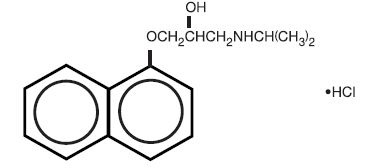
C 16 H 21 NO 2 HCl M.W. 295.80
Propranolol hydrochloride, USP is a stable, white, crystalline solid which is readily soluble in water and in ethanol.
Propranolol hydrochloride tablets, USP are available as tablets for oral administration containing either 10 mg, 20 mg, 40 mg, 60 mg, or 80 mg of propranolol hydrochloride, USP.
Propranolol hydrochloride tablets, USP also contain colloidal silicon dioxide, croscarmellose sodium, lactose monohydrate, magnesium stearate, microcrystalline cellulose. Color additives include FD&C Yellow no. 6 aluminum lake (10 mg and 80 mg), D&C Yellow no. 10 aluminum lake (40 mg and 80 mg), FD&C Blue no. 1 aluminum lake (20 mg and 40 mg) and FD&C Red no. 40 aluminum lake (60 mg).
CLINICAL PHARMACOLOGY
General
Propranolol is a nonselective beta-adrenergic receptor blocking agent possessing no other autonomic nervous system activity. It specifically competes with beta-adrenergic receptor agonist agents for available receptor sites. When access to beta-receptor sites is blocked by propranolol, the chronotropic, inotropic, and vasodilator responses to beta-adrenergic stimulation are decreased proportionately. At dosages greater than required for beta-blockade, propranolol also exerts a quinidine-like or anesthetic-like membrane action, which affects the cardiac action potential. The significance of the membrane action in the treatment of arrhythmias is uncertain.
Mechanism of Action
The mechanism of the antihypertensive effect of propranolol has not been established. Factors that may contribute to the antihypertensive action include: (1) decreased cardiac output, (2) inhibition of renin release by the kidneys, and (3) diminution of tonic sympathetic nerve outflow from vasomotor centers in the brain. Although total peripheral resistance may increase initially, it readjusts to or below the pretreatment level with chronic use of propranolol. Effects of propranolol on plasma volume appear to be minor and somewhat variable.
In angina pectoris, propranolol generally reduces the oxygen requirement of the heart at any given level of effort by blocking the catecholamine-induced increases in the heart rate, systolic blood pressure, and the velocity and extent of myocardial contraction. Propranolol may increase oxygen requirements by increasing left ventricular fiber length, end diastolic pressure, and systolic ejection period. The net physiologic effect of beta-adrenergic blockade is usually advantageous and is manifested during exercise by delayed onset of pain and increased work capacity.
Propranolol exerts its antiarrhythmic effects in concentrations associated with beta-adrenergic blockade, and this appears to be its principal antiarrhythmic mechanism of action. In dosages greater than required for beta-blockade, propranolol also exerts a quinidine-like or anesthetic-like membrane action, which affects the cardiac action potential. The significance of the membrane action in the treatment of arrhythmias is uncertain.
The mechanism of the antimigraine effect of propranolol has not been established. Beta-adrenergic receptors have been demonstrated in the pial vessels of the brain.
The specific mechanism of propranolol’s antitremor effects has not been established, but beta-2 (noncardiac) receptors may be involved. A central effect is also possible. Clinical studies have demonstrated that propranolol hydrochloride is of benefit in exaggerated physiological and essential (familial) tremor.
HOW SUPPLIED
Propranolol Hydrochloride Tablets, USP
10 mg – Orange, round biconvex scored tablets with “I” “156” on one side and other side plain. They are available as follows:
Bottles of 100 Tablets NDC 69292-530-01
Bottles of 1000 Tablets NDC 69292-530-10
20 mg – Blue, round biconvex scored tablets with “I” “157” on one side and other side plain. They are available as follows:
Bottles of 100 Tablets NDC 69292-532-01
Bottles of 1000 Tablets NDC 69292-532-10
40 mg – Green, round biconvex scored tablets with “I” “159” on one side and other side plain. They are available as follows:
Bottles of 100 Tablets NDC 69292-534-01
Bottles of 1000 Tablets NDC 69292-534-10
60 mg – Pink, round biconvex scored tablets with “I” “160” on one side and other side plain. They are available as follows:
Bottles of 100 Tablets NDC 69292-536-01
Bottles of 1000 Tablets NDC 69292-536-10
80 mg – Yellow, round biconvex scored tablets with “I” “161” on one side and other side plain. They are available as follows:
Bottles of 100 Tablets NDC 69292-538-01
Bottles of 500 Tablets NDC 69292-538-50
Bottles of 1000 Tablets NDC 69292-538-10
Mechanism of Action
The mechanism of the antihypertensive effect of propranolol has not been established. Factors that may contribute to the antihypertensive action include: (1) decreased cardiac output, (2) inhibition of renin release by the kidneys, and (3) diminution of tonic sympathetic nerve outflow from vasomotor centers in the brain. Although total peripheral resistance may increase initially, it readjusts to or below the pretreatment level with chronic use of propranolol. Effects of propranolol on plasma volume appear to be minor and somewhat variable.
In angina pectoris, propranolol generally reduces the oxygen requirement of the heart at any given level of effort by blocking the catecholamine-induced increases in the heart rate, systolic blood pressure, and the velocity and extent of myocardial contraction. Propranolol may increase oxygen requirements by increasing left ventricular fiber length, end diastolic pressure, and systolic ejection period. The net physiologic effect of beta-adrenergic blockade is usually advantageous and is manifested during exercise by delayed onset of pain and increased work capacity.
Propranolol exerts its antiarrhythmic effects in concentrations associated with beta-adrenergic blockade, and this appears to be its principal antiarrhythmic mechanism of action. In dosages greater than required for beta-blockade, propranolol also exerts a quinidine-like or anesthetic-like membrane action, which affects the cardiac action potential. The significance of the membrane action in the treatment of arrhythmias is uncertain.
The mechanism of the antimigraine effect of propranolol has not been established. Beta-adrenergic receptors have been demonstrated in the pial vessels of the brain.
The specific mechanism of propranolol’s antitremor effects has not been established, but beta-2 (noncardiac) receptors may be involved. A central effect is also possible. Clinical studies have demonstrated that propranolol hydrochloride is of benefit in exaggerated physiological and essential (familial) tremor.
