Get your patient on Phendimetrazine Tartrate - Phendimetrazine Tartrate tablet (Phendimetrazine Tartrate)
Phendimetrazine Tartrate - Phendimetrazine Tartrate tablet prescribing information

INDICATIONS AND USAGE
Phendimetrazine tartrate tablets are indicated in the management of exogenous obesity as a short term adjunct (a few weeks) in a regimen of weight reduction based on caloric restriction. The limited usefulness of agents of this class (see CLINICAL PHARMACOLOGY ) should be measured against possible risk factors inherent in their use such as those described below.
DOSAGE AND ADMINISTRATION
Usual Adult Dose: 1 tablet (35 mg) b.i.d. or t.i.d., one hour before meals.
Dosage should be individualized to obtain an adequate response with the lowest effective dosage. In some cases 1/2 tablet (17.5 mg) per dose may be adequate. Dosage should not exceed 2 tablets t.i.d.
CONTRAINDICATIONS
Known hypersensitivity or idiosyncratic reactions to sympathomimetics.
Advanced arteriosclerosis, symptomatic cardiovascular disease, moderate and severe hypertension, hyperthyroidism and glaucoma.
Highly nervous or agitated patients.
Patients with a history of drug abuse.
Patients taking other CNS stimulants, including monoamine oxidase inhibitors.
ADVERSE REACTIONS
Cardiovascular: Palpitation, tachycardia, elevated blood pressure.
Central Nervous System: Overstimulation, restlessness, insomnia, agitation, flushing, tremor, sweating, dizziness, headache, psychotic state, blurring of vision.
Gastrointestinal: Dryness of the mouth, nausea, diarrhea, constipation, stomach pain.
Genitourinary: Urinary frequency, dysuria, changes in libido.
DESCRIPTION
Phendimetrazine tartrate, as the dextro isomer, has the chemical name of (2 s ,3 s ,)-3,4-dimethyl-2-phenylmorpholine L-(+)-tartrate (1:1).
The structural formula is as follows:
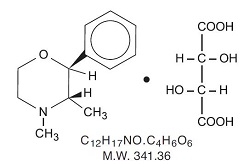
Phendimetrazine tartrate is a white, odorless crystalline powder. It is freely soluble in water; sparingly soluble in warm alcohol; insoluble in chloroform, acetone, ether and benzene.
Each tablet, for oral administration, contains 35 mg of phendimetrazine tartrate.
Inactive Ingredients: confectioner’s sugar (sucrose and corn starch), lactose monohydrate, povidone, pregelatinized starch, silicon dioxide and stearic acid. The yellow tablets also contain: FD&C yellow No. 5 (see PRECAUTIONS ).
CLINICAL PHARMACOLOGY
Phendimetrazine tartrate is a phenylalkylamine sympathomimetic amine with pharmacological activity similar to the prototype drugs of this class used in obesity, the amphetamines. Actions include central nervous system stimulation and elevation of blood pressure. Tachyphylaxis and tolerance have been demonstrated with all drugs of this class in which these phenomena have been looked for.
Drugs of this class used in obesity are commonly known as “anorectics” or “anorexigenics”. It has not been established, however, that the action of such drugs in treating obesity is primarily one of appetite suppression. Other central nervous system actions or metabolic effects, may be involved, for example.
Adult obese subjects instructed in dietary management and treated with “anorectic” drugs lose more weight on the average than those treated with placebo and diet, as determined in relatively short term clinical trials.
The magnitude of increased weight loss of drug-treated patients over placebo-treated patients is only a fraction of a pound a week. The rate of weight loss is greatest in the first weeks of therapy for both drug and placebo subjects and tends to decrease in succeeding weeks. The possible origins of the increased weight loss due to the various drug effects are not established. The amount of weight loss associated with the use of an anorectic drug varies from trial to trial and the increased weight loss appears to be related in part to variables other than the drug prescribed, such as the physician investigator, the population treated and the diet prescribed. Studies do not permit conclusions as to the relative importance of the drug and non-drug factors on weight loss.
The natural history of obesity is measured in years, whereas the studies cited are restricted to a few weeks duration, thus, the total impact of drug-induced weight loss over that of diet alone must be considered clinically limited.
HOW SUPPLIED
Phendimetrazine Tartrate Tablet 35 mg is a yellow, bisected, round tablet; imprinted “E 76”.
NDC 69543-410-10 bottles of 100 tablets NDC 69543-410-11 bottles of 1000 tablets
Storage
Store at 20° to 25°C (68° to 77°F) [see USP Controlled Room Temperature]. Protect from moisture.
Dispense in a tight, light-resistant, container as defined in the USP, with a child-resistant closure (as required).
To report SUSPECTED ADVERSE REACTIONS, contact Virtus Pharmaceuticals, LLC at 1-888-848-3593 or FDA at 1-800-FDA-1088 or www.fda.gov/medwatch.
Distributed by Virtus Pharmaceuticals, LLC Langhorne, PA 19047
Rev. 08/2023
MF4055REV08/23 OE2826
