Get your patient on Oxybutynin Chloride - Oxybutynin Chloride tablet (Oxybutynin Chloride)
Oxybutynin Chloride - Oxybutynin Chloride tablet prescribing information

INDICATIONS AND USAGE
Oxybutynin chloride tablets, USP are indicated for the relief of symptoms of bladder instability associated with voiding in patients with uninhibited neurogenic or reflex neurogenic bladder (i.e., urgency, frequency, urinary leakage, urge incontinence, dysuria).
DOSAGE AND ADMINISTRATION
Adults
The usual dose is one 5 mg tablet two to three times a day. The maximum recommended dose is one 5 mg tablet four times a day. A lower starting dose of 2.5 mg two or three times a day is recommended for the frail elderly.
Pediatric patients over 5 years of age
The usual dose is one 5 mg tablet two times a day. The maximum recommended dose is one 5 mg tablet three times a day.
CONTRAINDICATIONS
Oxybutynin chloride is contraindicated in patients with urinary retention, gastric retention and other severe decreased gastrointestinal motility conditions, uncontrolled narrow-angle glaucoma and in patients who are at risk for these conditions.
Oxybutynin chloride is also contraindicated in patients who have demonstrated hypersensitivity to the drug substance or other components of the product.
ADVERSE REACTIONS
The safety and efficacy of oxybutynin chloride was evaluated in a total of 199 patients in three clinical trials. These participants were treated with oxybutynin chloride 5 mg/day to 20 mg/day for up to 6 weeks. Table 3 shows the incidence of adverse events judged by investigators to be at least possibly related to treatment and reported by at least 5% of patients.
| Body System | Adverse Event | Oxybutynin Chloride (5 to 20 mg/day) (n=199) |
|---|---|---|
| Infections and Infestations | Urinary tract infection | 6.5% |
| Psychiatric Disorders | Insomnia | 5.5% |
| Nervousness | 6.5% | |
| Nervous System Disorders | Dizziness | 16.6% |
| Somnolence | 14.0% | |
| Headache | 7.5% | |
| Eye Disorders | Blurred vision | 9.6% |
| Gastrointestinal Disorders | Dry mouth | 71.4% |
| Constipation | 15.1% | |
| Nausea | 11.6% | |
| Dyspepsia | 6.0% | |
| Renal and Urinary Disorders | Urinary Hesitation | 8.5% |
| Urinary Retention | 6.0% |
The most common adverse events reported by patients receiving oxybutynin chloride 5 to 20 mg/day were the expected side effects of anticholinergic agents. The incidence of dry mouth was dose-related.
In addition, the following adverse events were reported by 1% to <5% of patients using oxybutynin chloride (5 to 20 mg/day) in all studies.
Infections and Infestations: nasopharyngitis, upper respiratory tract infection, bronchitis, cystitis, fungal infection
Metabolism and Nutrition Disorders: fluid retention
Psychiatric Disorders: confusional state
Nervous System Disorders: dysgeusia, sinus headache
Eye Disorders: keratoconjunctivitis sicca, eye irritation
Cardiac Disorders: palpitations, sinus arrhythmia
Vascular Disorders: flushing
Respiratory, Thoracic and Mediastinal Disorders: nasal dryness, cough, pharyngolaryngeal pain, dry throat, sinus congestion, hoarseness, asthma, nasal congestion
Gastrointestinal Disorders: diarrhea, abdominal pain, loose stools, flatulence, vomiting, abdominal pain upper, dysphagia, aptyalism, eructation, tongue coated
Skin and Subcutaneous Tissue Disorders: dry skin, pruritis
Musculoskeletal and Connective Tissue Disorders: back pain, arthralgia, pain in extremity, flank pain
Renal and Urinary Disorders: dysuria, pollakiuria
General Disorders and Administration Site Conditions: fatigue, edema peripheral, asthenia, pain, thirst, edema
Investigations: blood pressure increased, blood glucose increased, blood pressure decreased
Injury, Poisoning, and Procedural Complications : fall
Postmarketing Surveillance
Because postmarketing adverse events are reported voluntarily from a population of uncertain size, it is not always possible to reliably estimate their frequency or establish a causal relationship to drug exposure.
The following additional adverse events have been reported from worldwide postmarketing experience with oxybutynin chloride:
Psychiatric Disorders: psychotic disorder, agitation, hallucination, memory impairment
Nervous System Disorders: convulsions
Eye Disorders: cycloplegia, mydriasis, glaucoma
Cardiac Disorders: tachycardia, QT interval prolongation, chest discomfort
Gastrointestinal Disorders: decreased gastrointestinal motility, frequent bowel movement
Skin and Subcutaneous Tissue Disorders: rash, decreased sweating
Renal and Urinary Disorders: impotence
Reproductive System and Breast Disorders: suppression of lactation
General Disorders and Administration Site Conditions: hypersensitivity reactions, including angioedema with airway obstruction, urticaria, and face edema; rare anaphylactic reactions requiring hospitalization for emergency treatment
Metabolism and Nutrition Disorders: anorexia
Respiratory, Thoracic and Mediastinal Disorders: dysphonia
Drug Interactions
The concomitant use of oxybutynin with other anticholinergic drugs or with other agents which produce dry mouth, constipation, somnolence (drowsiness), and/or other anticholinergic-like effects may increase the frequency and/or severity of such effects.
Anticholinergic agents may potentially alter the absorption of some concomitantly administered drugs due to anticholinergic effects on gastrointestinal motility. This may be of concern for drugs with a narrow therapeutic index. Anticholinergic agents may also antagonize the effects of prokinetic agents, such as metoclopramide.
Mean oxybutynin chloride plasma concentrations were approximately 3 to 4 fold higher when oxybutynin chloride was administered with ketoconazole, a potent CYP3A4 inhibitor.
Other inhibitors of the cytochrome P450 3A4 enzyme system, such as antimycotic agents (e.g., itraconazole and miconazole) or macrolide antibiotics (e.g., erythromycin and clarithromycin), may alter oxybutynin mean pharmacokinetic parameters (i.e., C max and AUC). The clinical relevance of such potential interactions is not known. Caution should be used when such drugs are coadministered.
DESCRIPTION
Each scored oxybutynin chloride tablet, USP contains 5 mg of oxybutynin chloride. Chemically, oxybutynin chloride, USP is d,l (racemic) 4-diethylamino-2-butynyl phenylcyclohexylglycolate hydrochloride. The empirical formula of oxybutynin chloride is C 22 H 31 NO 3 ∙ HCl. The structural formula appears below:
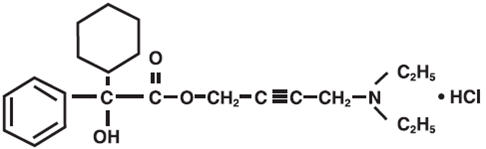
Oxybutynin chloride, USP is a white crystalline solid with a molecular weight of 393.9. It is readily soluble in water and acids, but relatively insoluble in alkalis.
Oxybutynin chloride tablets, USP also contain anhydrous lactose, calcium stearate, and microcrystalline cellulose.
Oxybutynin chloride tablets, USP are for oral administration.
Therapeutic Category: Antispasmodic, anticholinergic.
CLINICAL PHARMACOLOGY
Oxybutynin chloride exerts a direct antispasmodic effect on smooth muscle and inhibits the muscarinic action of acetylcholine on smooth muscle. Oxybutynin chloride exhibits only one fifth of the anticholinergic activity of atropine on the rabbit detrusor muscle, but four to ten times the antispasmodic activity. No blocking effects occur at skeletal neuromuscular junctions or autonomic ganglia (antinicotinic effects).
Oxybutynin chloride relaxes bladder smooth muscle. In patients with conditions characterized by involuntary bladder contractions, cystometric studies have demonstrated that oxybutynin chloride increases bladder (vesical) capacity, diminishes the frequency of uninhibited contractions of the detrusor muscle, and delays the initial desire to void. Oxybutynin chloride thus decreases urgency and the frequency of both incontinent episodes and voluntary urination. Antimuscarinic activity resides predominately in the R-isomer. A metabolite, desethyloxybutynin, has pharmacological activity similar to that of oxybutynin in in vitro studies.
Pharmacokinetics
Absorption
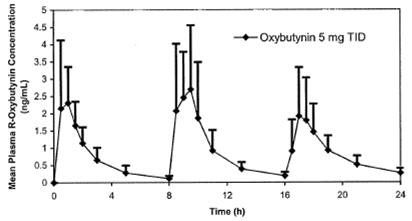
Following oral administration of oxybutynin chloride, oxybutynin is rapidly absorbed achieving C max within an hour, following which plasma concentration decreases with an effective half-life of approximately 2 to 3 hours. The absolute bioavailability of oxybutynin is reported to be about 6% (range 1.6% to 10.9%) for the tablets. Wide interindividual variation in pharmacokinetic parameters is evident following oral administration of oxybutynin.
The mean pharmacokinetic parameters for R- and S-oxybutynin are summarized in Table 1. The plasma concentration-time profiles for R- and S-oxybutynin are similar in shape; Figure 1 shows the profile for R-oxybutynin.
| Parameters (units) | R-Oxybutynin | S-Oxybutynin |
|---|---|---|
| C max (ng/mL) | 3.6 (2.2) | 7.8 (4.1) |
| T max (h) | 0.89 (0.34) | 0.65 (0.32) |
| AUC t (ng∙h/mL) | 22.6 (11.3) | 35.0 (17.3) |
| AUC inf (ng∙h/mL) | 24.3 (12.3) | 37.3 (18.7) |
Figure 1. Mean R-oxybutynin plasma concentrations following three doses of oxybutynin chloride 5 mg administered every 8 hours for 1 day in 23 healthy adult volunteers
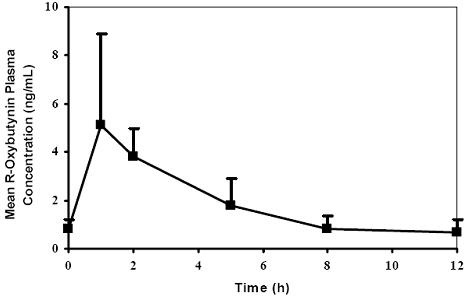
Oxybutynin chloride steady-state pharmacokinetics were also studied in 11 pediatric patients with detrusor overactivity associated with a neurological condition (e.g., spina bifida). These pediatric patients were on oxybutynin chloride tablets with total daily dose ranging from 7.5 mg to 15 mg (0.22 to 0.53 mg/kg). Overall, most patients (86.9%) were taking a total daily oxybutynin chloride dose between 10 mg and 15 mg. Sparse sampling technique was used to obtain serum samples. When all available data are normalized to an equivalent of 5 mg twice daily oxybutynin chloride, the mean pharmacokinetic parameters derived for R- and S-oxybutynin and R- and S-desethyloxybutynin are summarized in Table 2. The plasma-time concentration profiles for R- and S-oxybutynin are similar in shape; Figure 2 shows the profile for R-oxybutynin when all available data are normalized to an equivalent of 5 mg twice daily.
| R-Oxybutynin | S-Oxybutynin | R-Desethyloxybutynin | S-Desethyloxybutynin | |
|---|---|---|---|---|
| C max Reflects C max for pooled data (ng/mL) | 6.1 ± 3.2 | 10.1 ± 7.5 | 55.4 ± 17.9 | 28.2 ± 10.0 |
| T max (hr) | 1.0 | 1.0 | 2.0 | 2.0 |
| AUC AUC 0–end of dosing interval (ng.hr/mL) | 19.8 ± 7.4 | 28.4 ± 12.7 | 238.8 ± 77.6 | 119.5 ± 50.7 |
Figure 2. Mean steady-state (± SD) R-oxybutynin plasma concentrations following administration of total daily oxybutynin chloride tablet dose of 7.5 mg to 15 mg (0.22 mg/kg to 0.53 mg/kg) in children 5 to 15 years of age. – Plot represents all available data normalized to the equivalent of oxybutynin chloride 5 mg BID or TID at steady state
Food Effects
Data in the literature suggests that oxybutynin solution coadministered with food resulted in a slight delay in absorption and an increase in its bioavailability by 25% (n=18). 1
Distribution
Oxybutynin is widely distributed in body tissues following systemic absorption. The volume of distribution is 193 L after intravenous administration of 5 mg oxybutynin chloride. Both enantiomers of oxybutynin are highly bound (>99%) to plasma proteins. Both enantiomers of desethyloxybutynin are also highly bound (>97%) to plasma proteins. The major binding protein is alpha-1 acid glycoprotein.
Metabolism
Oxybutynin is metabolized primarily by the cytochrome P450 enzyme systems, particularly CYP3A4 found mostly in the liver and gut wall. Its metabolic products include phenylcyclohexylglycolic acid, which is pharmacologically inactive, and desethyloxybutynin, which is pharmacologically active.
Excretion
Oxybutynin is extensively metabolized by the liver, with less than 0.1% of the administered dose excreted unchanged in the urine. Also, less than 0.1% of the administered dose is excreted as the metabolite desethyloxybutynin.
CLINICAL STUDIES
Oxybutynin chloride was well tolerated in patients administered the drug in controlled studies of 30 days' duration and in uncontrolled studies in which some of the patients received the drug for 2 years.
HOW SUPPLIED
Oxybutynin chloride tablets, USP are supplied in the following form:
5 mg-round, white, 5/16" diameter, single-scored tablets, debossed 832 and 38
Bottles of 100 tablets with a child-resistant closure, NDC 0832‑0038‑00 Bottles of 500 tablets NDC, 0832‑0038‑50 Bottles of 1,000 tablets NDC, 0832‑0038‑10 Cartons of 100 (10 x 10) Unit-Dose Tablets, NDC 0832‑0038‑01 |
Dispense in a tight, light-resistant container as defined in the USP, with a child-resistant closure.
Store at 20° to 25°C (68° to 77°F); excursions permitted to 15° to 30°C (59° to 86°F) [See USP Controlled Room Temperature].
Keep out of reach of children.
