Oxazepam - Oxazepam capsule, Gelatin Coated prescribing information

WARNING: RISKS FROM CONCOMITANT USE WITH OPIOIDS; ABUSE, MISUSE, AND ADDICTION; and DEPENDENCE AND WITHDRAWAL REACTIONS
- Concomitant use of benzodiazepines and opioids may result in profound sedation, respiratory depression, coma, and death.
- Reserve concomitant prescribing of these drugs for use in patients for whom alternative treatment options are inadequate.
- Limit dosages and durations to the minimum required.
- Follow patients for signs and symptoms of respiratory depression and sedation [see WARNINGS and PRECAUTIONS ] .
- The use of benzodiazepines, including oxazepam, exposes users to risks of abuse, misuse, and addiction, which can lead to overdose or death. Abuse and misuse of benzodiazepines commonly involve concomitant use of other medications, alcohol, and/or illicit substances, which is associated with an increased frequency of serious adverse outcomes. Before prescribing oxazepam and throughout treatment, assess each patient’s risk for abuse, misuse, and addiction [see WARNINGS ] .
- The continued use of benzodiazepines, including oxazepam, may lead to clinically significant physical dependence. The risks of dependence and withdrawal increase with longer treatment duration and higher daily dose. Abrupt discontinuation or rapid dosage reduction of oxazepam after continued use may precipitate acute withdrawal reactions, which can be life-threatening. To reduce the risk of withdrawal reactions, use a gradual taper to discontinue oxazepam or reduce the dosage [see DOSAGE AND ADMINISTRATION and WARNINGS ].
INDICATIONS
Oxazepam capsules are indicated for the management of anxiety disorders or for the short-term relief of the symptoms of anxiety. Anxiety or tension associated with the stress of everyday life usually does not require treatment with an anxiolytic.
Anxiety associated with depression is also responsive to oxazepam therapy.
This product has been found particularly useful in the management of anxiety, tension, agitation and irritability in older patients.
Alcoholics with acute tremulousness, inebriation, or with anxiety associated with alcohol withdrawal are responsive to therapy.
The effectiveness of oxazepam in long-term use, that is, more than 4 months, has not been assessed by systematic clinical studies. The physician should periodically reassess the usefulness of the drug for the individual patient.
DOSAGE AND ADMINISTRATION
Because of the flexibility of this product and the range of emotional disturbances responsive to it, dosage should be individualized for maximum beneficial effects.
| Oxazepam | Usual Dose |
| Mild-to-moderate anxiety, with associated tension, irritability, agitation, or related symptoms of functional origin or secondary to organic disease. | 10 to 15 mg, 3 or 4 times daily |
| Severe anxiety syndromes, agitation, or anxiety associated with depression. | 15 to 30 mg, 3 or 4 times daily |
| Older patients with anxiety, tension, irritability and agitation. | Initial dosage: 10 mg, 3 times daily. If necessary, increase cautiously to 15 mg, 3 or 4 times daily. |
| Alcoholics with acute inebriation, tremulousness, or anxiety on withdrawal. | 15 to 30 mg, 3 or 4 times daily |
This product is not indicated in pediatric patients under 6 years of age. Absolute dosage for pediatric patients 6 to 12 years of age is not established.
Discontinuation or Dosage Reduction of Oxazepam
To reduce the risk of withdrawal reactions, use a gradual taper to discontinue oxazepam or reduce the dosage. If a patient develops withdrawal reactions, consider pausing the taper or increasing the dosage to the previous tapered dosage level. Subsequently decrease the dosage more slowly [see WARNINGS : Dependence and Withdrawal Reactions and DRUG ABUSE AND DEPENDENCE : Dependence ] .
CONTRAINDICATIONS
History of previous hypersensitivity reaction to oxazepam. Oxazepam is not indicated in psychoses.
ADVERSE REACTIONS
The necessity for discontinuation of therapy due to undesirable effects has been rare. Transient mild drowsiness is commonly seen in the first few days of therapy. If it persists, the dosage should be reduced. In few instances, dizziness, vertigo, headache and rarely syncope have occurred either alone or together with drowsiness. Mild paradoxical reactions; i.e., excitement, stimulation of affect, have been reported in psychiatric patients; these reactions may be secondary to relief of anxiety and usually appear in the first two weeks of therapy.
Other side effects occurring during oxazepam therapy include rare instances of minor diffuse skin rashes - morbilliform, urticarial, and maculopapular, nausea, lethargy, edema, slurred speech, tremor, and altered libido. Such side effects have been infrequent and are generally controlled with reduction of dosage. A case of an extensive fixed drug eruption also has been reported.
Although rare, leukopenia and hepatic dysfunction including jaundice have been reported during therapy. Periodic blood counts and liver-function tests are advisable.
Ataxia with oxazepam has been reported in rare instances and does not appear to be specifically related to dose or age.
Although the following side reactions have not as yet been reported with oxazepam, they have occurred with related compounds (chlordiazepoxide and diazepam): paradoxical excitation with severe rage reactions, hallucinations, menstrual irregularities, change in EEG pattern, blood dyscrasias including agranulocytosis, blurred vision, diplopia, incontinence, stupor, disorientation, fever and euphoria.
Transient amnesia or memory impairment has been reported in association with the use of benzodiazepines.
To report SUSPECTED ADVERSE EVENTS, contact Teva at 1-888-838-2872 or FDA at 1-800-FDA-1088 or http://www.fda.gov/medwatch for voluntary reporting of adverse reactions.
DESCRIPTION
Oxazepam, USP is the first of a chemical series of compounds known as the 3-hydroxybenzodiazepinones. A therapeutic agent providing versatility and flexibility in control of common emotional disturbances, this product exerts prompt action in a wide variety of disorders associated with anxiety, tension, agitation, and irritability, and anxiety associated with depression. In tolerance and toxicity studies on several animal species, this product reveals significantly greater safety factors than related compounds (chlordiazepoxide and diazepam) and manifests a wide separation of effective doses and doses inducing side effects.
Oxazepam capsules, USP contain 10 mg, 15 mg or 30 mg oxazepam, USP and the following inactive ingredients: corn starch, croscarmellose sodium, hypromellose 2910, lactose monohydrate, magnesium stearate, and sodium lauryl sulfate. The capsule shells contain gelatin, methylparaben, propylparaben, and titanium dioxide. In addition, the 10 mg capsule shells contain D&C Red No. 28 and FD&C Red No. 40, the 15 mg capsule shells contain D&C Yellow No. 10 and FD&C Red No. 40, and the 30 mg capsule shells contain D&C Red No. 28, FD&C Blue No. 1, and FD&C Red No. 40. The imprinting ink, for the 10 mg and 15 mg capsules, contains black iron oxide, FD&C Blue No. 1 Brilliant Blue FCF Aluminum Lake, FD&C Blue No. 2 Indigo Carmine Aluminum Lake, FD&C Red No. 40 Allura Red AC Aluminum Lake, D&C Yellow No. 10 Aluminum Lake, shellac, and may also contain propylene glycol. The imprinting ink, for the 30 mg capsules, contains ethyl acetate, FD&C Blue No. 1 Aluminum Lake, and shellac.
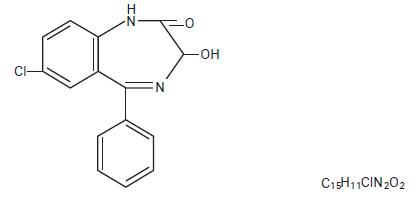
Oxazepam, USP is 7-chloro-1,3-dihydro-3-hydroxy-5-phenyl-2 H- 1,4-benzodiazepin-2-one. A white crystalline powder with a molecular weight of 286 . 72, its structural formula is as follows:
CLINICAL PHARMACOLOGY
Pharmacokinetic testing in 12 volunteers demonstrated that a single 30 mg dose of a capsule, tablet or suspension will result in an equivalent extent of absorption. For the capsule and tablet, peak plasma levels averaged 450 mg/mL and were observed to occur about 3 hours after dosing. The mean elimination half-life for oxazepam was approximately 8.2 hours (range 5.7 to 10.9 hours).
This product has a single, major inactive metabolite in man, a glucuronide excreted in the urine.
Age (less than 80 years old) does not appear to have a clinically significant effect on oxazepam kinetics. A statistically significant increase in elimination half-life in the very elderly (greater than 80 years of age) as compared to younger subjects has been reported, due to a 30% increase in volume of distribution, as well as a 50% reduction in unbound clearance of oxazepam in the very elderly [see PRECAUTIONS: Geriatric Use ].
HOW SUPPLIED
Oxazepam capsules, USP are available as follows:
10 mg — Each pink opaque gelatin #4 capsule printed with  and 067 in black ink on both cap and body contains 10 mg of Oxazepam, USP. Capsules are supplied in bottles of 100 (NDC 0228-2067-10).
15 mg — Each red opaque gelatin #4 capsule printed with  and 069 in black ink on both cap and body contains 15 mg of Oxazepam, USP. Capsules are supplied in bottles of 100 (NDC 0228-2069-10).
30 mg — Each maroon opaque gelatin #4 capsule printed with  and 073 in blue ink on both cap and body contains 30 mg of Oxazepam, USP. Capsules are supplied in bottles of 100 (NDC 0228-2073-10).
Keep tightly closed.
Dispense in a tight, light-resistant container as defined in the USP.
Store at 25ºC (77ºF); excursions permitted to 15ºC to 30ºC (59ºF to 86ºF).
