Get your patient on Nicardipine Hydrochloride - Nicardipine Hydrochloride injection (Nicardipine Hydrochloride)
Nicardipine Hydrochloride - Nicardipine Hydrochloride injection prescribing information

INDICATIONS AND USAGE
Nicardipine hydrochloride injection is a calcium channel blocker indicated for the short-term treatment of hypertension when oral therapy is not feasible.
DOSAGE AND ADMINISTRATION
- Individualize dosage based upon the severity of hypertension and response of the patient during dosing (2.1 ).
- Single dose vials must be diluted before use (2.2 ).
- When substituting for oral nicardipine therapy, use the intravenous infusion rate as follows (2.3 ):
Oral Nicardipine Dose | Equivalent IV Infusion Rate |
20 mg q8h | 0.5 mg/hr |
30 mg q8h | 1.2 mg/hr |
40 mg q8h | 2.2 mg/hr |
- In a drug-free patient, initiate therapy at 5 mg/hr. Increase the infusion rate by 2.5 mg/hr to a maximum of 15 mg/hr until desired blood pressure reduction is achieved. For a gradual blood pressure reduction the rate can be increased every 15 minutes, for a rapid reduction, every 5 minutes (2.4 ).
- If hypotension or tachycardia ensues, discontinue the infusion. After stabilized, patient can be restarted at low doses such as 3 to 5 mg/hr (2.5 ).
DOSAGE FORMS AND STRENGTHS
- 25 mg/10 mL (2.5 mg/mL) single-dose vial (3 )
CONTRAINDICATIONS
- Do not use in patients with advanced aortic stenosis (4.1 ).
WARNINGS AND PRECAUTIONS
- To reduce the possibility of venous thrombosis, phlebitis, and vascular impairment, do not use small veins, such as those on the dorsum of the hand or wrist. Avoid intraarterial administration or extravasation (5.7 ).
- To minimize the risk of peripheral venous irritation, change the site of infusion of nicardipine every 12 hours (5.7 ).
- Nicardipine is not a beta-blocker and therefore gives no protection against the dangers of abrupt beta-blocker withdrawal. Withdraw beta-blockers gradually (5.8 ).
- Closely monitor response in patients with angina (5.3 ), congestive heart failure (5.4 ), impaired hepatic function (5.5 ), portal hypertension (5.5 ), and renal impairment (5.6 ) and pheochromocytoma (5.9 ).
ADVERSE REACTIONS
Most common adverse reactions are headache (13%), hypotension (5%), tachycardia (4%) and nausea/vomiting (4%).
To report SUSPECTED ADVERSE REACTIONS, contact Chengdu Shuode Pharmaceutical Co., Ltd at +86-286-523-8888 or the FDA at 1-800-FDA- 1088 or www.fda.gov/medwatch.
DESCRIPTION
Nicardipine hydrochloride is a calcium ion influx inhibitor (slow channel blocker or calcium channel blocker). Nicardipine hydrochloride for intravenous administration contains 2.5 mg/mL of nicardipine hydrochloride. Nicardipine hydrochloride is a dihydropyridine derivative with IUPAC (International Union of Pure and Applied Chemistry) chemical name (±)-2-(benzyl-methyl amino) ethyl methyl 1,4-dihydro-2, 6-dimethyl-4- (m-nitrophenyl)-3,5-pyridinedicarboxylate monohydrochloride and has the following structure:
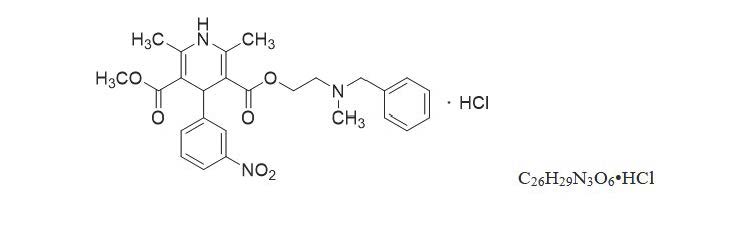
Nicardipine hydrochloride is a pale yellow to yellow, odorless, powder or crystalline powder that has a melting point range of 179- 188 o C (Melt with decomposition). It is soluble in methanol and glacial acetic acid, sparingly soluble in ethanol and chloroform, practically insoluble in ethyl ether and water. It has a molecular weight of 515.99.
Nicardipine hydrochloride injection is available as a sterile, non-pyrogenic, clear, yellow solution in 10 mL vials for intravenous infusion after dilution. Each mL contains 2.5 mg nicardipine hydrochloride, 0.305 mg benzoic acid, USP and 7.5 mg sodium chloride, USP, in Water for Injection, USP. Sodium hydroxide, NF, (q.s.) may have been added to adjust pH to 3.2 - 4.2.
CLINICAL PHARMACOLOGY
Mechanism of Action
Nicardipine inhibits the transmembrane influx of calcium ions into cardiac muscle and smooth muscle without changing serum calcium concentrations. The contractile processes of cardiac muscle and vascular smooth muscle are dependent upon the movement of extracellular calcium ions into these cells through specific ion channels. The effects of nicardipine are more selective to vascular smooth muscle than cardiac muscle. In animal models, nicardipine produced relaxation of coronary vascular smooth muscle at drug levels which cause little or no negative inotropic effect.
Pharmacodynamics
Hemodynamics
Nicardipine produces significant decreases in systemic vascular resistance. In a study of intra-arterially administered nicardipine, the degree of vasodilation and the resultant decrease in blood pressure were more prominent in hypertensive patients than in normotensive volunteers. Administration of nicardipine to normotensive volunteers at dosages of 0.25 to 3 mg/hr for eight hours produced changes of less than 5 mmHg in systolic blood pressure and less than 3 mmHg in diastolic blood pressure.
An increase in heart rate is a normal response to vasodilation and decrease in blood pressure; in some patients these increases in heart rate may be pronounced. In placebo-controlled trials, the mean increases in heart rate were 7 ± 1 bpm in postoperative patients and 8 ± 1 bpm in patients with severe hypertension at the end of the maintenance period.
Hemodynamic studies following intravenous dosing in patients with coronary artery disease and normal or moderately abnormal left ventricular function have shown significant increases in ejection fraction and cardiac output with no significant change, or a small decrease, in left ventricular end-diastolic pressure (LVEDP). There is evidence that nicardipine increases blood flow. Coronary dilatation induced by nicardipine improves perfusion and aerobic metabolism in areas with chronic ischemia, resulting in reduced lactate production and augmented oxygen consumption. In patients with coronary artery disease, nicardipine, administered after beta-blockade, significantly improved systolic and diastolic left ventricular function.
In congestive heart failure patients with impaired left ventricular function, nicardipine increased cardiac output both at rest and during exercise. Decreases in left ventricular end-diastolic pressure were also observed. However, in some patients with severe left ventricular dysfunction, it may have a negative inotropic effect and could lead to worsened failure.
“Coronary steal” has not been observed during treatment with nicardipine (Coronary steal is the detrimental redistribution of coronary blood flow in patients with coronary artery disease from underperfused areas toward better perfused areas.) Nicardipine has been shown to improve systolic shortening in both normal and hypokinetic segments of myocardial muscle. Radionuclide angiography has confirmed that wall motion remained improved during increased oxygen demand. (Occasional patients have developed increased angina upon receiving nicardipine capsules. Whether this represents coronary steal in these patients, or is the result of increased heart rate and decreased diastolic pressure, is not clear.)
In patients with coronary artery disease, nicardipine improves left ventricular diastolic distensibility during the early filling phase, probably due to a faster rate of myocardial relaxation in previously underperfused areas. There is little or no effect on normal myocardium, suggesting the improvement is mainly by indirect mechanisms such as afterload reduction and reduced ischemia. Nicardipine has no negative effect on myocardial relaxation at therapeutic doses. The clinical benefits of these properties have not yet been demonstrated.
Electrophysiologic Effects
In general, no detrimental effects on the cardiac conduction system have been seen with nicardipine. During acute electrophysiologic studies, it increased heart rate and prolonged the corrected QT interval to a minor degree. It did not affect sinus node recovery or SA conduction times. The PA, AH, and HV intervals• or the functional and effective refractory periods of the atrium were not prolonged. The relative and effective refractory periods of the His-Purkinje system were slightly shortened.
•PA = conduction time from high to low right atrium; AH = conduction time from low right atrium to His bundle deflection, or AV nodal conduction time; HV = conduction time through the His bundle and the bundle branch-Purkinje system.
Hepatic Function
Because nicardipine is extensively metabolized by the liver, plasma concentrations are influenced by changes in hepatic function. In a clinical study with nicardipine capsules in patients with severe liver disease, plasma concentrations were elevated and the half-life was prolonged [see Warnings and Precautions (5.5) ] . Similar results were obtained in patients with hepatic disease when nicardipine hydrochloride was administered for 24 hours at 0.6 mg/hr.
Renal Function
When nicardipine was given to mild-to-moderate hypertensive patients with moderate degrees of renal impairment, significant reduction in glomerular filtration rate (GFR) and effective renal plasma flow (RPF) were observed. No significant differences in liver blood flow were observed in these patients. A significantly lower systemic clearance and higher area under the curve (AUC) were observed.
When nicardipine capsules (20 or 30 mg TID) were given to hypertensive patients with impaired renal function, mean plasma concentrations, AUC, and C max were approximately two-fold higher than in healthy controls. There was a transient increase in electrolyte excretion, including sodium [see Warnings and Precautions (5.6) ] .
Acute bolus administration of nicardipine hydrochloride injection (2.5 mg) in healthy volunteers decreased mean arterial pressure and renal vascular resistance; glomerular filtration rate (GFR), renal plasma flow (RPF), and the filtration fraction were unchanged. In healthy patients undergoing abdominal surgery, nicardipine hydrochloride injection (10 mg over 20 minutes) increased GFR with no change in RPF when compared with placebo. In hypertensive type ll diabetic patients with nephropathy, nicardipine capsules (20 mg TID) did not change RPF and GFR, but reduced renal vascular resistance.
Pulmonary Function
In two well-controlled studies of patients with obstructive airway disease treated with nicardipine capsules, no evidence of increased bronchospasm was seen. In one of the studies, nicardipine capsules improved forced expiratory volume 1 second (FEV 1 ) and forced vital capacity (FVC) in comparison with metoprolol. Adverse reactions reported in a limited number of patients with asthma, reactive airway disease, or obstructive airway disease were similar to reactions in other patients treated with nicardipine capsules.
Pharmacokinetics
Distribution
A rapid dose-related increase in nicardipine plasma concentrations is seen during the first two hours after the start of an infusion of nicardipine. Plasma concentrations increase at a much slower rate after the first few hours, and approach steady state at 24 to 48 hours. The steady-state pharmacokinetics of nicardipine are similar in elderly hypertensive patients (greater than 65 years) and young healthy adults. On termination of the infusion, nicardipine concentrations decrease rapidly, with at least a 50% decrease during the first two hours post-infusion. The effects of nicardipine on blood pressure significantly correlate with plasma concentrations. Nicardipine is highly protein bound (greater than 95%) in human plasma over a wide concentration range.
Following infusion, nicardipine plasma concentrations decline triexponentially, with a rapid early distribution phase (α- half-life of 3 minutes), an intermediate phase (ß-half-life of 45 minutes), and a slow terminal phase (ƴ-half-life of 14 hours) that can only be detected after long-term infusions. Total plasma clearance (Cl) is 0.4 L/hr•kg, and the apparent volume of distribution (Vd) using a non-compartment model is 8.3 L/kg. The pharmacokinetics of nicardipine is linear over the dosage range of 0.5 mg/hr to 40 mg/hr.
Metabolism and Excretion
Nicardipine has been shown to be rapidly and extensively metabolized by the hepatic cytochrome P450 enzymes, CYP2C8, 2D6, and 3A4. Nicardipine does not induce or inhibit its own metabolism; however, nicardipine has been shown to inhibit certain cytochrome P450 enzymes (including CYP3A4, CYP2D6, CYP2C8, and CYP2C19). Inhibition of these enzymes may result in increased plasma levels of certain drugs, including cyclosporine and tacrolimus [see Drug Interactions (7.5 , 7.6 )]. The altered pharmacokinetics may necessitate dosage adjustment of the affected drug or discontinuation of treatment.
After coadministration of a radioactive intravenous dose of nicardipine with an oral 30 mg dose given every 8 hours, 49% of the radioactivity was recovered in the urine and 43% in the feces within 96 hours. None of the dose was recovered as unchanged nicardipine.
NONCLINICAL TOXICOLOGY
Carcinogenesis, Mutagenesis, Impairment of Fertility
Rats treated with nicardipine in the diet (at concentrations calculated to provide daily dosage levels of 5, 15, or 45 mg/kg/day) for two years showed a dose-dependent increase in thyroid hyperplasia and neoplasia (follicular adenoma/carcinoma). One-month and three-month studies in the rat have suggested that these results are linked to a nicardipine-induced reduction in plasma thyroxine (T4) levels with a consequent increase in plasma levels of thyroid stimulating hormone (TSH). Chronic elevation of TSH is known to cause hyperstimulation of the thyroid.
In rats on an iodine deficient diet, nicardipine administration for one month was associated with thyroid hyperplasia that was prevented by T4 supplementation. Mice treated with nicardipine in the diet (at concentrations calculated to provide daily dosage levels of up to 100 mg/kg/day) for up to 18 months showed no evidence of neoplasia of any tissue and no evidence of thyroid changes.
There was no evidence of thyroid pathology in dogs treated with up to 25 mg nicardipine/kg/day for one year and no evidence of effects of nicardipine on thyroid function (plasma T4 and TSH) in man.
There was no evidence of a mutagenic potential of nicardipine in a battery of genotoxicity tests conducted on microbial indicator organisms, in micronucleus tests in mice and hamsters, or in a sister chromatid exchange study in hamsters.
No impairment of fertility was seen in male or female rats administered nicardipine at oral doses as high as 100 mg/kg/day (human equivalent dose about 16 mg/kg/day, 8 times the maximum recommended human oral dose).
Reproductive and Developmental Toxicology
Embryolethality, but no teratogenicity, was seen at intravenous doses of 10 mg nicardipine/kg/day in rats and 1 mg/kg/day in rabbits. These doses in the rat and rabbit are equivalent to human intravenous doses of about 1.6 and 0.32 mg/kg/day, respectively. (The total daily human dose delivered by a continuous intravenous infusion ranges from 1.2 to 6 mg/kg/day, depending on duration at different infusion rates ranging from 3 to 15 mg/hr as individual patients are titrated for optimal results.) Nicardipine was also embryocidal when administered orally to pregnant Japanese White rabbits, during organogenesis, at 150 mg/kg/day (a dose associated with marked body weight gain suppression in the treated doe), but not at 50 mg/kg/day (human equivalent dose about 16 mg/kg/day or about 8 times the maximum recommended human oral dose). No adverse effects on the fetus were observed when New Zealand albino rabbits were treated orally, during organogenesis, with up to 100 mg/kg/day (a dose associated with significant mortality in the treated doe). In pregnant rats administered nicardipine orally at doses of up to 100 mg/kg/day (human equivalent dose about 16 mg/kg/day) there was no evidence of embryolethality or teratogenicity. However, dystocia, reduced birth weight, reduced neonatal survival and reduced neonatal weight gain were noted.
CLINICAL STUDIES
Effects in Hypertension
In patients with mild-to-moderate chronic stable essential hypertension, nicardipine hydrochloride injection (0.5 to 4 mg/hr) produced dose-dependent decreases in blood pressure, although only the decreases at 4 mg/hr were statistically different from placebo. At the end of a 48-hour infusion at 4 mg/hr, the decreases were 26 mmHg (17%) in systolic blood pressure and 21 mmHg (20%) in diastolic blood pressure. In other settings (e.g., patients with severe or postoperative hypertension), nicardipine hydrochloride injection (5 to 15 mg/hr) produced dose-dependent decreases in blood pressure. Higher infusion rates produced therapeutic responses more rapidly. The mean time to therapeutic response for severe hypertension, defined as diastolic blood pressure less than or equal to 95 mmHg or greater or equal to 25 mmHg decrease and systolic blood pressure less than or equal to 160 mmHg, was 77 ± 5 minutes. The average maintenance dose was 8.0 mg/hr. The mean time to therapeutic response for postoperative hypertension, defined as greater than or equal to 15% reduction in diastolic or systolic blood pressure, was 12 minutes. The average maintenance dose was 3 mg/hr.
HOW SUPPLIED/STORAGE AND HANDLING
How Supplied
Nicardipine Hydrochloride Injection is available in packages as follows:
| NDC | Strength | Packaged |
82432-103-01 82432-103-02 | 25 mg/10 mL Single Dose Vial (2.5 mg/mL) | 1 vial of 10 mL 10 vials of 10 mL |
Storage and Handling
Store at 20° to 25°C (68° to 77°F) [See USP Controlled Room Temperature].
Freezing does not adversely affect the product, but exposure to elevated temperatures should be avoided. Protect from light. Store vials in carton until used.
Manufactured by:
Chengdu Shuode Pharmaceutical Co., Ltd
No. 9 Lekang Road, Shuangliu District, Chengdu, Sichuan 610200, China (CHN)
Revised: 07/2025
