Get your patient on Methscopolamine Bromide - Methscopolamine Bromide tablet (Methscopolamine Bromide)
Methscopolamine Bromide - Methscopolamine Bromide tablet prescribing information

INDICATIONS AND USAGE
Adjunctive therapy for the treatment of peptic ulcer.
METHSCOPOLAMINE BROMIDE HAS NOT BEEN SHOWN TO BE EFFECTIVE IN CONTRIBUTING TO THE HEALING OF PEPTIC ULCER, DECREASING THE RATE OF RECURRENCE OR PREVENTING COMPLICATIONS.
DOSAGE AND ADMINISTRATION
The average dosage of Methscopolamine Bromide Tablets, USP is 2.5 mg one-half hour before meals and 2.5 to 5 mg at bedtime. A starting dose of 12.5 mg daily will be clinically effective in most patients without the production of appreciable side effects.
If the patient is experiencing symptoms such as severe abdominal pain or cramping which demand prompt relief, the drug may be started on a daily dosage of 20 mg, administered in doses of 5 mg one-half hour before meals and at bedtime. If very unpleasant side effects develop promptly, the daily dosage should be reduced. If neither symptomatic relief nor side effects appear, the daily dosage may be increased. Some patients have tolerated 30 mg daily with no unpleasant reactions.
Patients whose dosage has been reduced to eliminate or modify side effects often continue to show adequate response both subjectively in relief of symptoms and objectively as measured by antisecretory effects.
The ultimate aim of therapy is to arrive at a dosage which provides maximal clinical effectiveness with a minimum of unpleasant side effects. Many patients report no side effects on a dosage which gives complete relief of symptoms. On the other hand, some patients have reported severe side effects without appreciable symptomatic relief. Such patients must be considered unsuited for this therapy. Usually they have been or will prove to be similarly intolerant to other anticholinergic drugs. If methscopolamine bromide is to be used in a patient who gives a history of such intolerance, it should be started at a low dosage.
CONTRAINDICATIONS
Glaucoma; obstructive uropathy (e.g., bladder neck obstruction due to prostatic hypertrophy); obstructive disease of the gastrointestinal tract (e.g., pyloroduodenal stenosis); paralytic ileus; intestinal atony of the elderly or debilitated patient; unstable cardiovascular status in acute hemorrhage; severe ulcerative colitis; toxic megacolon complicating ulcerative colitis; myasthenia gravis.
Methscopolamine Bromide Tablets, USP 2.5 mg and 5 mg is contraindicated in patients who are hypersensitive to methscopolamine bromide or related drugs.
ADVERSE REACTIONS
The following adverse reactions have been observed, but there is not enough data to support an estimate of frequency.
Cardiovascular: Tachycardia, palpitation.
Allergic: Severe allergic reaction or drug idiosyncrasies including anaphylaxis.
CNS: Headaches, nervousness, mental confusion, drowsiness, dizziness.
Special Senses: Blurred vision, dilation of the pupil, cycloplegia, increased ocular tension, loss of taste.
Renal: Urinary hesitancy and retention.
Gastrointestinal: Nausea, vomiting, constipation, bloated feeling.
Dermatologic: Decreased sweating, urticaria and other dermal manifestations.
Miscellaneous: Xerostomia, weakness, insomnia, impotence, suppression of lactation.
DESCRIPTION
Methscopolamine Bromide Tablets, USP 2.5 mg and 5 mg contain methscopolamine bromide USP, an anticholinergic, which occurs as white crystals, or as a white odorless crystalline powder. Methscopolamine bromide melts at about 225°C with decomposition. The drug is freely soluble in water, slightly soluble in alcohol, and insoluble in acetone and in chloroform.
The chemical name for methscopolamine bromide is 3-Oxa-9-azoniatricyclo [3.3.1.0 2, 4 ]nonane, 7-(3-hydroxy-1-oxo-2-phenylpropoxy)-9, 9-dimethyl-, bromide, [7(s)-(1α, 2β, 4β, 5α, 7β)]- and the molecular weight is 398.30.
The structural formula is represented below:
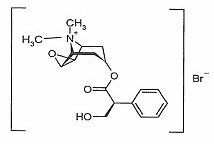
Methscopolamine Bromide Tablets, USP 2.5 mg for oral administration contain 2.5 mg of methscopolamine bromide USP. Methscopolamine Bromide Tablets, USP 5 mg for oral administration contain 5 mg of methscopolamine bromide USP.
Inactive ingredients: microcrystalline cellulose NF, pregelatinized starch NF, colloidal silicon dioxide NF, magnesium stearate NF.
Contains no lactose.
CLINICAL PHARMACOLOGY
Methscopolamine bromide is an anticholinergic agent which possesses most of the pharmacologic actions of that drug class. These include reduction in volume and total acid content of gastric secretion, inhibition of gastrointestinal motility, inhibition of salivary excretion, dilation of the pupil and inhibition of accommodation with resulting blurring of vision. Large doses may result in tachycardia.
PHARMACOKINETICS
Methscopolamine bromide is a quaternary ammonium derivative of scopolamine. As a class, these agents are poorly and unreliably absorbed. 1, 2 Total absorption of quaternary ammonium derivatives of the alkaloids is 10 to 25%. Rate of absorption is not available. Quaternary ammonium salts have limited absorption from intact skin, and conjunctival penetration is poor. 1 Little is known of the fate and excretion of most of these agents. 1 Following oral administration, drug effects appear in about one hour and persist for 4 to 6 hours. 2 Methscopolamine bromide has limited ability to cross the blood-brain barrier. 3,4,5 The drug is excreted primarily in the urine and bile, or as unabsorbed drug in feces. 2 There is no data on the presence of methscopolamine in breast milk; traces of atropine have been found after administration of atropine. 1
HOW SUPPLIED
Methscopolamine Bromide Tablets, USP 2.5 mg are available as white, round tablets, debossed with "BY1" on one side and plain on the other side, in the following package size:
Bottles of 100 (NDC 76385-100-01)
Methscopolamine Bromide Tablets, USP 5 mg are available as white, oval tablets, debossed with "BY2" on one side and plain on the other side, in the following package size:
Bottles of 60 (NDC 76385-101-60)
Store at 20° to 25°C (68° to 77°F) [see USP Controlled Room Temperature]. Dispense in a tight, light-resistant container as defined in the USP, with a child-resistant closure (as required).
KEEP THIS AND ALL MEDICATIONS OUT OF THE REACH OF CHILDREN.
