Get your patient on Levonorgestrel And Ethinyl Estradiol - Levonorgestrel And Ethinyl Estradiol (Levonorgestrel And Ethinyl Estradiol)
Levonorgestrel And Ethinyl Estradiol - Levonorgestrel And Ethinyl Estradiol prescribing information

WARNING: CIGARETTE SMOKING AND SERIOUS CARDIOVASCULAR EVENTS
Cigarette smoking increases the risk of serious cardiovascular events from combination oral contraceptive (COC) use. This risk increases with age, particularly in women over 35 years of age, and with the number of cigarettes smoked. For this reason, COCs, including levonorgestrel and ethinyl estradiol tablets, are contraindicated in women who are over 35 years of age and smoke [see CONTRAINDICATIONS and WARNINGS (1) ].
INDICATIONS AND USAGE
Levonorgestrel and ethinyl estradiol tablets are indicated for use by females of reproductive potential to prevent pregnancy.
CONTRAINDICATIONS
Levonorgestrel and ethinyl estradiol tablets are contraindicated in females who are known to have the following conditions:
- A high risk of arterial or venous thrombotic diseases. Examples include women who are known to: - Smoke, if over age 35 [see BOXED WARNING and WARNINGS (1) ]. - Have current or history of deep vein thrombosis or pulmonary embolism [see WARNINGS (1) ]. - Have cerebrovascular disease [see WARNINGS (1) ]. - Have coronary artery disease [see WARNINGS (1) ]. - Have thrombogenic valvular or thrombogenic rhythm diseases of the heart (for example, subacute bacterial endocarditis with valvular disease, or atrial fibrillation) [see WARNINGS (1) ]. - Have inherited or acquired hypercoagulopathies [see (1) ]. - Have uncontrolled hypertension or hypertension with vascular disease [see WARNINGS (4) ]. - Have diabetes mellitus and are over age 35, diabetes mellitus with hypertension or vascular disease or other end-organ damage, or diabetes mellitus of >20 years duration [see WARNINGS (8) ]. - Have headaches with focal neurological symptoms, migraine headaches with aura, or over age 35 with any migraine headaches [see WARNINGS (9) ].
- Current diagnosis of, or history of, breast cancer, which may be hormone-sensitive.
- Liver tumors, acute viral hepatitis, or severe (decompensated) cirrhosis [see WARNINGS (2) ].
- Use of Hepatitis C drug combinations containing ombitasvir/paritaprevir/ritonavir, with or without dasabuvir, due to the potential for ALT elevations [see WARNINGS (6) ].
- Undiagnosed abnormal uterine bleeding [see WARNINGS (10) ].
ADVERSE REACTIONS
Post Marketing Experience
Five studies that compared breast cancer risk between ever-users (current or past use) of COCs and never-users of COCs reported no association between ever use of COCs and breast cancer risk, with effect estimates ranging from 0.90 - 1.12 (Figure 2).
Three studies compared breast cancer risk between current or recent COC users (<6 months since last use) and never users of COCs (Figure 2). One of these studies reported no association between breast cancer risk and COC use. The other two studies found an increased relative risk of 1.19 - 1.33 with current or recent use. Both of these studies found an increased risk of breast cancer with current use of longer duration, with relative risks ranging from 1.03 with less than one year of COC use to approximately 1.4 with more than 8-10 years of COC use.
Figure 2. Risk of Breast Cancer with Combined Oral Contraceptive Use
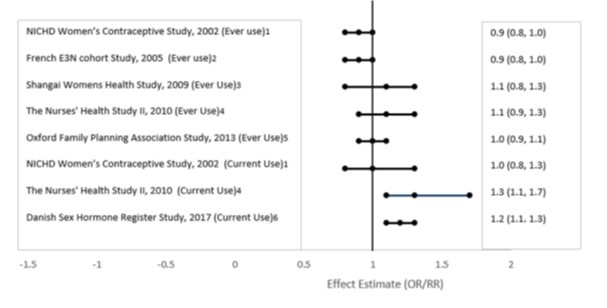
RR = relative risk; OR = odds ratio; HR = hazard ratio. “ever COC” are females with current or past COC use; “never COC use” are females that never used COCs.
The following serious adverse reactions with the use of COCs are discussed elsewhere in the labeling:
- Serious cardiovascular adverse events [see BOXED WARNING and WARNINGS (1) ]
- Vascular events [see WARNINGS (1) ]
- Liver disease [see WARNINGS (2) ]
- Hypertension [see WARNINGS (4) ]
- Gallbladder disease [see WARNINGS (7) ]
- Carbohydrate and lipid effects [see WARNINGS (8) ]
- Headache [see WARNINGS (9) ]
- Carcinoma of the cervix [see WARNINGS (3) ]
Adverse reactions reported by COC users and described elsewhere in the labeling are:
- Bleeding irregularities and amenorrhea [see WARNINGS (10) ]
- Mood changes, including depression [see WARNINGS (11) ]
- Melasma/chloasma which may persist [see WARNINGS (14) ]
- Edema/fluid retention [see PRECAUTIONS (2) ]
- Diminution in lactation when given immediately postpartum [see PRECAUTIONS (7) ]
The following adverse reactions have been reported in patients receiving oral contraceptives and are believed to be drug-related: Breast tenderness, pain, enlargement, secretion; Nausea, vomiting and gastrointestinal symptoms (such as abdominal pain, cramps and bloating); Change in menstrual flow; Temporary infertility after discontinuation of treatment; Change in weight or appetite (increase or decrease); Change in cervical erosion and secretion; Cholestatic jaundice; Rash (allergic); Vaginitis, including candidiasis; Change in corneal curvature (steepening); Intolerance to contact lenses; Mesenteric thrombosis; Decrease in serum folate levels; Exacerbation of systemic lupus erythematosus; Exacerbation of porphyria; Exacerbation of chorea; Aggravation of varicose veins; Anaphylactic/anaphylactoid reactions, including urticaria, angioedema, and severe reactions with respiratory and circulatory symptoms.
The following adverse reactions have been reported in users of oral contraceptives, and the association has been neither confirmed nor refuted: Congenital anomalies; Premenstrual syndrome; Cataracts; Optic neuritis, which may lead to partial or complete loss of vision; Cystitis-like syndrome; Nervousness; Dizziness; Hirsutism; Loss of scalp hair; Erythema multiforme; Erythema nodosum; Hemorrhagic eruption; Impaired renal function; Hemolytic uremic syndrome; Budd-Chiari syndrome; Acne; Changes in libido; Colitis; Sickle-cell disease; Cerebral-vascular disease with mitral valve prolapse; Lupus-like syndromes; Pancreatitis; Dysmenorrhea.
DESCRIPTION
Levonorgestrel and Ethinyl Estradiol Tablets USP are a combination oral contraceptive (COC) consisting of 21 light-orange active tablets, each containing 0.15 mg of levonorgestrel, a synthetic progestin and 30 mcg of ethinyl estradiol, an estrogen, and 7 pink inert tablets (without hormones).
The structural formulas for the active components are:
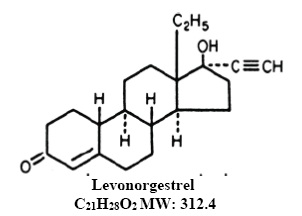
Levonorgestrel is chemically 18, 19-Dinorpregn-4-en-20-yn-3-one, 13-ethyl-17-hydroxy-,(17α)-(-)-.
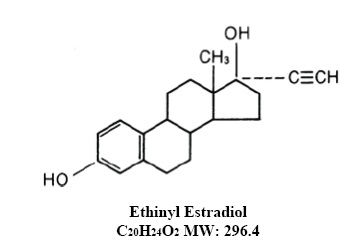
Ethinyl Estradiol is 19-nor-17α-pregna-1, 3, 5(10)-trien-20-yne-3, 17-diol.
Each light-orange active tablet contains the following inactive ingredients: lactose monohydrate, FD&C Yellow No. 6, microcrystalline cellulose, povidone K-30, polacrilin potassium and magnesium stearate.
Each pink inert tablet contains the following inactive ingredients: lactose monohydrate, FD&C Red no. 40 aluminum lake, microcrystalline cellulose, povidone K-30, croscarmellose sodium and magnesium stearate.
CLINICAL PHARMACOLOGY
Combination oral contraceptives prevent pregnancy primarily by suppressing ovulation.
HOW SUPPLIED/STORAGE AND HANDLING
Levonorgestrel and Ethinyl Estradiol Tablets USP 0.15 mg/0.03 mg are available in blister pack, containing 28 Tablets:
| 21 Active Tablets: | Light orange color, round, uncoated tablets debossed with 'EF1' on one side and plain on other side, tablets may have mottled appearance on either of the surface. |
| 7 Inert Tablets: | Pink color, round, uncoated tablets debossed with 'EF2' on one side and plain on other side, tablets may have mottled appearance on either of the surface. |
| NDC 79929-003-05 |
The blister packs of 3 are available in box.
Store at 20º to 25°C (68° to 77º F) [See USP Controlled Room Temperature].
Manufactured For:
Naari Pte Limited
36 Robinson Road, #13-06
City House, Singapore 068877
Issued December 2021
