Get your patient on Kit For The Preparation Of Technetium Tc99m Pyrophosphate - Technetium Tc99m Pyrophosphate injection (Technetium Tc99m Pyrophosphate)
Kit For The Preparation Of Technetium Tc99m Pyrophosphate - Technetium Tc99m Pyrophosphate injection prescribing information

INDICATIONS AND USAGE
Technetium Tc 99m Pyrophosphate Injection is a bone imaging agent used to demonstrate areas of altered osteogenesis, and a cardiac imaging agent used as an adjunct in the diagnosis of acute myocardial infarction.
Kit for the Preparation of Technetium Tc 99m Pyrophosphate Injection is a blood pool imaging agent which may be used for gated blood pool imaging and for the detection of sites of gastrointestinal bleeding. When reconstituted with sterile non-pyrogenic isotonic saline and administered intravenously 30 minutes prior to the intravenous administration of Sodium Pertechnetate Tc 99m Injection, approximately 76% of the injected radioactivity remains in the blood pool.
DOSAGE AND ADMINISTRATION
After preparation with oxidant-free Sodium Pertechnetate Tc 99m Injection, the suggested dose range of Technetium Tc 99m Pyrophosphate Injection in the average ADULT patient (70 kg) is:
Bone Imaging - 185-555 megabecquerels (5-15 mCi)
Cardiac Imaging - 370-555 megabecquerels (10-15 mCi)
The suggested dose range of the non-radioactive reconstituted Kit for the Preparation of Technetium Tc 99m Pyrophosphate Injection in the average ADULT patient (70 kg) is:
Blood Imaging - Administer not less than one-third nor more than the total contents of one vial
[555 - 740 megabecquerels (15-20mCi) of Pertechnetate Tc 99m Injection].
Bone and Cardiac Imaging
Technetium Tc 99m Pyrophosphate Injection is injected intravenously over a 10 to 20 second period. For optimal results, bone imaging should be done 1 to 6 hours following administration. Cardiac imaging should be done 30 to 90 minutes following administration. The acute myocardial infarct can be visualized from 24 hours to 6 days following onset of symptoms, with maximum localization at 48 to 72 hours. Cardiac imaging should be done with a gamma scintillation camera. It is recommended that images be made of the anterior, left anterior oblique and left lateral projections.
Blood Pool Imaging
Kit for the Preparation of Technetium Tc 99m Pyrophosphate Injection may be reconstituted with sterile, non-pyrogenic isotonic saline containing no preservatives. Administer not less than one-third nor more than the total contents of one vial 30 minutes prior to the intravenous administration of 555 to 740 megabecquerels (15-20 mCi) Sodium Pertechnetate Tc 99m Injection. The non-radioactive reconstituted Kit for the Preparation of Technetium Tc 99m Pyrophosphate Injection should be injected by direct venipuncture. Heparinized catheter systems should be avoided. Cardiac imaging should be done 10 to 30 minutes following the administration of Sodium Pertechnetate Tc 99m Injection utilizing a scintillation camera interfaced to an electrocardiographic gating device.
Parenteral drug products should be inspected visually for particulate matter and discoloration prior to administration whenever solution and container permit.
The patient dose should be measured by a suitable radioactivity calibration system immediately prior to administration.
Radiation Dosimetry
Bone and Cardiac Imaging
The effective half-life was assumed to be the physical half-life for all calculated values. The estimated radiation absorbed doses to an average ADULT patient (70 kg) from an intravenous injection of a maximum of 555 megabecquerels (15 mCi) of Technetium Tc 99m Pyrophosphate Injection are shown in Table 4.
Technetium Tc 99m Pyrophosphate Injection | ||
Target Organ | mGy/555 MBq | rads/15 mCi |
Total Body | 1.8 | 0.18 |
Kidneys | 3.6 | 0.36 |
Red Marrow | 3.5 | 0.35 |
Bone Surfaces | 21.1 | 2.11 |
Bladder Wall | 13.3 | 1.33 |
Testes | 1.4 | 0.14 |
Ovaries | 2.1 | 0.21 |
Effective Dose Equivalent | 3.3 mSv | 0.33 rem |
•Based on the model in MIRD Dose Estimate Report No. 13 (J Nucl Med 30:1117-1122, 1989).
Estimate calculated using phantoms of Cristy & Eckerman (Report ORNL/TM-8381/V1 & V7). Bone and marrow model of Eckerman (Aspects of dosimetry of radionuclides within the skeleton with particular emphasis on the active marrow. In Fourth International Radiopharmaceutical Dosimetry Symposium; A.T. Schlafke-Stelson and E.E. Watson eds. CONF-851113, Oak Ridge Associated Universities, Oak Ridge, TN 37831, 1986. pp 514-534.) used.
The effective dose equivalent is a quantity which may be suitable for comparing risks of different procedures in nuclear medicine, radiology, and other applications involving ionizing radiation, but should not be construed to give information about risks to individual patients and should not be applied to situations involving radiation therapy.
Blood Pool Imaging
The estimated absorbed radiation doses to an average adult patient (70 kg) from an intravenous injection of 740 megabecquerels (20 mCi) of Sodium Pertechnetate Tc 99m Injection, 30 minutes after the intravenous administration of the non-radioactive reconstituted Kit for the Preparation of Technetium Tc 99m Pyrophosphate Injection are shown in Table 5.
Sodium Pertechnetate Tc 99m 30 min. | ||
Post Injection with Pyrophosphate | ||
Target Organ | mGy/740 MBq | rads/20 mCi |
Total Body | 3.2 | 0.32 |
Spleen | 3.6 | 0.36 |
Bladder Wall b | 24.0 | 2.40 |
Testes | 2.4 | 0.24 |
Ovaries | 4.6 | 0.46 |
Blood | 10.4 | 1.04 |
Red Marrow | 4.4 | 0.44 |
a Assume 75% of the Sodium Pertechnetate Tc 99m labels red blood cells and the other 25% remains as pertechnetate. Method of calculation: MIRD Dose Estimate Report No. 8, J Nucl Med . 17: 74-77, 1976.
b If 25% excreted with 1 hour T b
CONTRAINDICATIONS
None known.
ADVERSE REACTIONS
Some hypersensitivity reactions have been associated with pyrophosphate use.
DESCRIPTION
Kit for the Preparation of Technetium Tc 99m Pyrophosphate Injection is a multidose reaction vial which contains the sterile, non-pyrogenic, non-radioactive ingredients necessary to produce Technetium Tc 99m Pyrophosphate Injection for diagnostic use by intravenous injection.
Each 10 mL vial contains 12.0 mg of sodium pyrophosphate, 2.8 mg minimum stannous tin as stannous chloride dihydrate and 4.9 mg maximum total tin as stannous chloride dihydrate; pH is adjusted to 5.3-5.7 with hydrochloric acid prior to lyophilization. No bacteriostatic preservative is present. Sealed under nitrogen.
The chemical names are: (1) Diphosphoric acid, Ditin (2 + ) salt; (2) Ditin (2 + ) pyrophosphate (4 - ). The structural formula is:
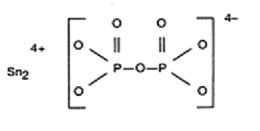
When a solution of sterile, non-pyrogenic, oxidant-free isotonic Sodium Pertechnetate Tc 99m Injection U.S.P. is added to the vial, Technetium Tc 99m Pyrophosphate Injection is formed for intravenous injection.
When a solution of sterile, non-pyrogenic, isotonic saline is added to the vial, it forms a blood pool imaging agent when Sodium Pertechnetate Tc 99m Injection is injected intravenously 30 minutes after the intravenous administration of the non-radioactive reconstituted Kit for the Preparation of Technetium Tc 99m Pyrophosphate Injection. The precise structure of Technetium Tc 99m Pyrophosphate Injection is not known at this time.
Physical Characteristics
Technetium Tc 99m decays by isomeric transition with a physical half-life of 6.02 hours.¹ The principal photon that is useful for detection and imaging studies is listed in Table 1.
Radiation | Mean Percent Per Disintegration | Mean Energy (keV) |
Gamma-2 | 89.07 | 140.5 |
¹Kocher DC: Radioactive decay data tables. DOE/TIC-11026: 108, 1981
External Radiation
The specific gamma ray constant for Tc 99m is 0.78 R/hr-millicurie at 1 cm. The first half-value layer is 0.017 cm of lead (Pb). A range of values for the relative attenuation of the radiation emitted by this radionuclide that results from interposition of various thicknesses of Pb is shown in Table 2. For example, the use of a 0.25 cm thickness of Pb will attenuate the radiation emitted by a factor of about 1,000.
Shield Thickness (Pb) cm | Coefficient of Attenuation |
0.017 | 0.5 |
0.08 | 10 -1 |
0.16 | 10 -2 |
0.25 | 10 -3 |
0.33 | 10 -4 |
To correct for physical decay of this radionuclide, the fractions that remain at selected intervals after the time of calibration are shown in Table 3.
Hours | Fraction Remaining | Hours | Fraction Remaining |
0• | 1.000 | 7 | 0.447 |
1 | 0.891 | 8 | 0.398 |
2 | 0.794 | 9 | 0.355 |
3 | 0.708 | 10 | 0.316 |
4 | 0.631 | 11 | 0.282 |
5 | 0.562 | 12 | 0.251 |
6 | 0.501 |
• Calibration time
CLINICAL PHARMACOLOGY
When injected intravenously, Technetium Tc 99m Pyrophosphate Injection has a specific affinity for areas of osteogenesis. It is also concentrated in the injured myocardium, primarily in areas of irreversibly damaged myocardial cells.
One to two hours after intravenous injection of Technetium Tc 99m Pyrophosphate Injection, an estimated 40 to 50 percent of the injected dose has been taken up by the skeleton, and approximately 0.01 to 0.02 percent per gram of acutely infarcted myocardium. Within a period of one hour, 10 to 11 percent remains in the vascular system, declining to approximately 2 to 3 percent twenty-four hours post injection.
The average urinary excretion was observed to be about 40 percent of the administered dose after 24 hours.
The non-radioactive reconstituted Kit for the Preparation of Technetium Tc 99m Pyrophosphate Injection also has an affinity for red blood cells. When administered 30 minutes prior to the intravenous administration of Sodium Pertechnetate Tc 99m Injection, approximately 76 percent of the injected activity remains in the blood pool providing excellent images of the cardiac chambers.
HOW SUPPLIED
The Kit for the Preparation of Technetium Tc 99m Pyrophosphate Injection is supplied in packages of 5 or 30 sterile, non-pyrogenic, white capped 10mL vials. Each multidose vial contains 12.0 mg sodium pyrophosphate, 2.8 mg minimum stannous tin as stannous chloride dihydrate and 4.9 mg maximum total tin as stannous chloride dihydrate; pH is adjusted with hydrochloric acid to 5.3-5.7 prior to lyophilization. No bacteriostatic preservative is present. Sealed under nitrogen.
Included in each 5-vial package are one package insert and 10 radiation labels.
Included in each 30-vial package are one package insert and 60 radiation labels.
Store the kit as packaged at 20-25°C (68-77°F) [See USP]. Store the reconstituted vials at 20-25°C (68-77°) [See USP].
Directions for use
Bone and Cardiac Imaging
Technetium Tc 99m Pyrophosphate Injection is prepared from Kit for the Preparation of Technetium Tc 99m Pyrophosphate Injection by the following aseptic procedure:
- Waterproof gloves should be worn during the preparation procedure. Remove the white flip-off cap from the vial and swab the top of the vial closure with alcohol to sterilize the surface.
- Complete the radiation label and affix to the vial. Place the vial in an appropriate radiation shield suitably labeled and identified.
- With a sterile shielded syringe, aseptically obtain 1-10 milliliters of a suitable, oxidant free, sterile and non-pyrogenic Sodium Pertechnetate Tc 99m Injection containing no more than 3.7 gigabecquerels (100 mCi). Aseptically add the Sodium Pertechnetate Tc 99m Injection to the vial.
- Swirl the contents of the vial for one minute and let stand for at least 10 minutes.
- Record date and time of preparation.
- It is recommended that the radiochemical purity of the prepared radiopharmaceutical be checked prior to patient administration.
- Examine vial contents for particulates and discoloration prior to injection.
- Withdrawals for administration must be made aseptically using a sterile shielded syringe and needle. Since the vials contain nitrogen to prevent oxidation of the complex, the vials should not be vented. If repeated withdrawals are made from a vial, the replacement of contents with air should be minimized.
- Aseptically withdraw material with a sterile lead shielded syringe for use within six (6) hours of preparation. For optimal results, this time should be minimized. The vial contains no bacteriostatic preservative. Store the reconstituted vial at 20-25°C (68-77°F) [See USP]. Discard the vial six (6) hours after reconstitution.
- The patient dose should be measured by suitable radioactivity calibration system immediately prior to administration.
Blood Pool Imaging
The non-radioactive Kit for the Preparation of Technetium Tc 99m Pyrophosphate Injection is prepared by adhering to the following aseptic procedure:
- Remove the white flip-off cap from the vial and swab the top of the vial closure with alcohol to sterilize the surface.
- Reconstitute the reaction vial with 3 milliliters of sterile, non-pyrogenic, isotonic saline containing no preservatives.
- Swirl the contents of the vial for one minute and let stand for at least 10 minutes.
- Record date and time of preparation.
- Examine vial contents for particulates and discoloration prior to injection.
- Withdrawals for administration must be made aseptically using a sterile syringe and needle. Since the vials contain nitrogen to prevent oxidation of the complex, the vials should not be vented. If repeated withdrawals are made from a vial, the replacement of contents with air should be minimized.
- Aseptically withdraw the reconstituted non-radioactive Kit for the Preparation of Technetium Tc 99m Pyrophosphate Injection with a sterile syringe for use within six (6) hours of preparation. For optimal results, this time should be minimized. The vial contains no bacteriostatic preservative. Store the reconstituted vial at 20-25°C (68-77°F) [See USP]. Discard the vial six (6) hours after reconstitution.
- Between one-third and a total vial of stannous pyrophosphate may be administered by direct venipuncture 30 minutes prior to intravenous administration of 555 to 740 megabecquerels (15-20 mCi) of Sodium Pertechnetate Tc 99m Injection. Heparinized catheter systems should not be used.
- The patient dose of Sodium Pertechnetate Tc 99m Injection should be measured by a suitable radioactivity calibration system immediately prior to administration.
NDC # 45567-0060-1 for 5 vial kits
NDC # 45567-0060-2 for 30 vial kits
This reagent kit for preparation of a radiopharmaceutical is approved for use by persons licensed pursuant to Section 120.547, Code of Massachusetts Regulation 105, or under equivalent license of the U.S. Nuclear Regulatory Commission or an Agreement State.
Manufactured By:
Sun Pharmaceutical Industries, Inc.
Billerica, MA 01821
PL-000017
Rev 2
Feb 2025
