Haloperidol - Haloperidol tablet prescribing information

WARNING
Increased Mortality in Elderly Patients with Dementia-Related Psychosis
Elderly patients with dementia-related psychosis treated with antipsychotic drugs are at an increased risk of death. Analyses of seventeen placebo-controlled trials (modal duration of 10 weeks), largely in patients taking atypical antipsychotic drugs, revealed a risk of death in drug-treated patients of between 1.6 to 1.7 times the risk of death in placebo-treated patients. Over the course of a typical 10-week controlled trial, the rate of death in drug-treated patients was about 4.5%, compared to a rate of about 2.6% in the placebo group. Although the causes of death were varied, most of the deaths appeared to be either cardiovascular (e.g., heart failure, sudden death) or infectious (e.g., pneumonia) in nature. Observational studies suggest that, similar to atypical antipsychotic drugs treatment with conventional antipsychotic drugs may increase mortality. The extent to which the findings of increased mortality in observational studies may be attributed to the antipsychotic drug as opposed to some characteristic(s) of the patients is not clear. Haloperidol is not approved for the treatment of patients with dementia-related psychosis (see WARNINGS ).
INDICATIONS AND USAGE
Haloperidol is indicated for use in the management of manifestations of psychotic disorders.
Haloperidol is indicated for the control of tics and vocal utterances of Tourette’s Disorder in children and adults. Haloperidol is effective for the treatment of severe behavior problems in children of combative, explosive hyperexcitability (which cannot be accounted for by immediate provocation). Haloperidol is also effective in the short-term treatment of hyperactive children who show excessive motor activity with accompanying conduct disorders consisting of some or all of the following symptoms: impulsivity, difficulty sustaining attention, aggressivity, mood lability, and poor frustration tolerance. Haloperidol should be reserved for these two groups of children only after failure to respond to psychotherapy or medications other than antipsychotics.
DOSAGE AND ADMINISTRATION
There is considerable variation from patient to patient in the amount of medication required for treatment. As with all antipsychotic drugs, dosage should be individualized according to the needs and response of each patient. Dosage adjustments, either upward or downward, should be carried out as rapidly as practicable to achieve optimum therapeutic control.
To determine the initial dosage, consideration should be given to the patient’s age, severity of illness, previous response to other antipsychotic drugs, and any concomitant medication or disease state. Children, debilitated or geriatric patients, as well as those with a history of adverse reactions to antipsychotic drugs, may require less haloperidol. The optimal response in such patients is usually obtained with more gradual dosage adjustments and at lower dosage levels, as recommended below.
Clinical experience suggests the following recommendations:
Oral Administration
Initial Dosage Range
Adults
| Moderate Symptomatology | 0.5 mg to 2 mg b.i.d. or t.i.d. |
| Severe Symptomatology | 3 mg to 5 mg b.i.d. or t.i.d. |
To achieve prompt control, higher doses may be required in some cases.
| Geriatric or Debilitated Patients | 0.5 mg to 2 mg b.i.d. or t.i.d. |
| Chronic or Resistant Patients | 3 mg to 5 mg b.i.d. or t.i.d. |
| Patients who remain severely disturbed or inadequately controlled may require dosage adjustment. Daily dosages up to 100 mg may be necessary in some cases to achieve an optimal response. Infrequently, haloperidol has been used in doses above 100 mg for severely resistant patients; however, the limited clinical usage has not demonstrated the safety of prolonged administration of such doses. | |
Children
The following recommendations apply to children between the ages of 3 and 12 years (weight range 15 to 40 kg). Haloperidol is not intended for children under 3 years old. Therapy should begin at the lowest dose possible (0.5 mg per day). If required, the dose should be increased by an increment of 0.5 mg at 5 to 7 day intervals until the desired therapeutic effect is obtained. (see chart below).
The total dose may be divided, to be given b.i.d. or t.i.d.
| Psychotic Disorders | 0.05 mg/kg/day to 0.15 mg/kg/day |
| Non-Psychotic Behavior Disorders and Tourette's Disorder | 0.05 mg/kg/day to 0.075 mg/kg/day |
| Severely disturbed psychotic children may require higher doses. In severely disturbed, non-psychotic children or in hyperactive children with accompanying conduct disorders, who have failed to respond to psychotherapy or medications other than antipsychotics, it should be noted that since these behaviors may be short-lived, short-term administration of haloperidol may suffice. There is no evidence establishing a maximum effective dosage. There is little evidence that behavior improvement is further enhanced in dosages beyond 6 mg per day. | |
Maintenance Dosage
Upon achieving a satisfactory therapeutic response, dosage should then be gradually reduced to the lowest effective maintenance level.
Switchover Procedure
The oral form should supplant the injectable as soon as practicable. In the absence of bioavailability studies establishing bioequivalence between these two dosage forms, the following guidelines for dosage are suggested. For an initial approximation of the total daily dose required, the parenteral dose administered in the preceding 24 hours may be used. Since this dose is only an initial estimate, it is recommended that careful monitoring of clinical signs and symptoms, including clinical efficacy, sedation, and adverse effects, be carried out periodically for the first several days following the initiation of switchover. In this way, dosage adjustments, either upward or downward, can be quickly accomplished. Depending on the patient’s clinical status, the first oral dose should be given within 12-24 hours following the last parenteral dose.
CONTRAINDICATIONS
Haloperidol is contraindicated in severe toxic central nervous system depression or comatose states from any cause and in individuals who are hypersensitive to this drug or have Parkinson’s disease.
ADVERSE REACTIONS
Cardiovascular Effects
Tachycardia, hypotension, and hypertension have been reported. QT prolongation and/or ventricular arrhythmias have also been reported, in addition to ECG pattern changes compatible with the polymorphous configuration of torsade de pointes, and may occur more frequently with high doses and in predisposed patients (see WARNINGS and PRECAUTIONS ).
Cases of sudden and unexpected death have been reported in association with the administration of haloperidol. The nature of the evidence makes it impossible to determine definitively what role, if any, haloperidol played in the outcome of the reported cases. The possibility that haloperidol caused death cannot, of course, be excluded, but it is to be kept in mind that sudden and unexpected death may occur in psychotic patients when they go untreated or when they are treated with other antipsychotic drugs.
CNS Effects
Extrapyramidal Symptoms (EPS)
EPS during the administration of haloperidol have been reported frequently, often during the first few days of treatment. EPS can be categorized generally as Parkinson-like symptoms, akathisia, or dystonia (including opisthotonos and oculogyric crisis). While all can occur at relatively low doses, they occur more frequently and with greater severity at higher doses. The symptoms may be controlled with dose reductions or administration of antiparkinson drugs such as benztropine mesylate USP or trihexyphenidyl hydrochloride USP. It should be noted that persistent EPS have been reported; the drug may have to be discontinued in such cases.
Class effect: Symptoms of dystonia, prolonged abnormal contractions of muscle groups, may occur in susceptible individuals during the first few days of treatment. Dystonic symptoms include: spasm of the neck muscles, sometimes progressing to tightness of the throat, swallowing difficulty, difficulty breathing, and/or protrusion of the tongue. While these symptoms can occur at low doses, they occur more frequently and with greater severity with high potency and at higher doses of first generation antipsychotic drugs. An elevated risk of acute dystonia is observed in males and younger age groups.
Generally, patients receiving short-term therapy experience no problems with abrupt discontinuation of antipsychotic drugs. However, some patients on maintenance treatment experience transient dyskinetic signs after abrupt withdrawal. In certain of these cases, the dyskinetic movements are indistinguishable from the syndrome described below under "TARDIVE DYSKINESIA" except for duration. It is not known whether gradual withdrawal of antipsychotic drugs will reduce the rate of occurrence of withdrawal emergent neurological signs but until further evidence becomes available, it seems reasonable to gradually withdraw use of haloperidol.
As with all antipsychotic agents, haloperidol has been associated with persistent dyskinesias. Tardive dyskinesia, a syndrome consisting of potentially irreversible, involuntary, dyskinetic movements, may appear in some patients on long-term therapy or may occur after drug therapy has been discontinued. The risk appears to be greater in elderly patients on high-dose therapy, especially females. The symptoms are persistent and in some patients appear irreversible. The syndrome is characterized by rhythmical involuntary movements of tongue, face, mouth or jaw (e.g., protrusion of tongue, puffing of cheeks, puckering of mouth, chewing movements). Sometimes these may be accompanied by involuntary movements of extremities and the trunk.
There is no known effective treatment for tardive dyskinesia; antiparkinson agents usually do not alleviate the symptoms of this syndrome. It is suggested that all antipsychotic agents be discontinued if these symptoms appear. Should it be necessary to reinstitute treatment, or increase the dosage of the agent, or switch to a different antipsychotic agent, this syndrome may be masked.
It has been reported that fine vermicular movement of the tongue may be an early sign of tardive dyskinesia and if the medication is stopped at that time, the full syndrome may not develop.
Tardive dystonia, not associated with the above syndrome, has also been reported. Tardive dystonia is characterized by delayed onset of choreic or dystonic movements, is often persistent, and has the potential of becoming irreversible.
Insomnia, restlessness, anxiety, euphoria, agitation, drowsiness, depression, lethargy, headache, confusion, vertigo, grand mal seizures, exacerbation of psychotic symptoms including hallucinations and catatonic-like behavioral states which may be responsive to drug withdrawal and/or treatment with anticholinergic drugs.
Body as a Whole
Neuroleptic malignant syndrome (NMS), hyperpyrexia and heat stroke have been reported with haloperidol (see WARNINGS for further information concerning NMS).
Hematologic Effects
Reports have appeared citing the occurrence of mild and usually transient leukopenia and leukocytosis, minimal decreases in red blood cell counts, anemia, or a tendency toward lymphomonocytosis. Agranulocytosis has rarely been reported to have occurred with the use of haloperidol, and then only in association with other medication.
Liver Effects
Impaired liver function and/or jaundice have been reported.
Dermatologic Reactions
Maculopapular and acneiform skin reactions and isolated cases of photosensitivity and loss of hair.
Endocrine Disorders
Lactation, breast engorgement, mastalgia, menstrual irregularities, gynecomastia, impotence, increased libido, hyperglycemia, hypoglycemia and hyponatremia.
Gastrointestinal Effects
Anorexia, constipation, diarrhea, hypersalivation, dyspepsia, nausea and vomiting.
Autonomic Reactions
Dry mouth, blurred vision, urinary retention, diaphoresis and priapism.
Respiratory Effects
Laryngospasm, bronchospasm and increased depth of respiration.
Special Senses
Cataracts, retinopathy and visual disturbances.
Postmarketing Events
Hyperammonemia has been reported in a 5½ year old child with citrullinemia, an inherited disorder of ammonia excretion, following treatment with haloperidol.
DESCRIPTION
Haloperidol is the first of the butyrophenone series of major tranquilizers. The chemical designation is 4-[4-( p -chlorophenyl)-4-hydroxypiperidino]-4'-fluorobutyrophenone. It has the following structural formula.
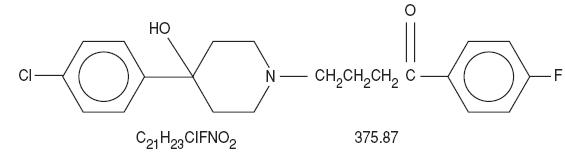
Each haloperidol tablet, USP intended for oral administration contains haloperidol, USP 0.5 mg or 1 mg or 2 mg or 5 mg or 10 mg or 20 mg. In addition each 0.5 mg, 1 mg, 2 mg tablet contains the following inactive ingredients: colloidal silicon dioxide, magnesium stearate, microcrystalline cellulose, pregelatinized starch (maize) and each 5 mg, 10 mg, 20 mg tablet contains the following inactive ingredients: calcium stearate, dibasic calcium phosphate dihydrate, povidone (PVP K 30), sodium starch glycolate and starch. 1 mg: D&C Yellow #10 Aluminium Lake, FD&C Yellow #6 Aluminium Lake; 2 mg: D & C Red #27 Aluminum Lake; 5 mg: D & C Yellow #10 Aluminum Lake and FD & C Blue #1 Aluminum Lake; 10 mg: D & C Yellow #10 Aluminum Lake and FD & C Blue #1 Aluminum Lake; 20 mg: FD & C Yellow #6 Aluminum Lake and D & C Red #27 Aluminum Lake.
CLINICAL PHARMACOLOGY
The precise mechanism of action has not been clearly established.
HOW SUPPLIED
Haloperidol Tablets USP, 0.5 mg are white to off white coloured, round, flat faced, bevel edged, uncoated tablets debossed with "15" and "11" on either side of partial score line and plain on other side and are supplied as follows:
NDC 68382-407-01 in bottles of 100 tablets
NDC 68382-407-10 in bottles of 1,000 tablets
NDC 68382-407-77 in carton of 100 tablets (10 x 10 unit-dose)
Haloperidol Tablets USP, 1 mg are pale yellow to yellow coloured, round, flat faced, bevel edged, uncoated tablets debossed with "15" and "12" on either side of partial score line and plain on other side and are supplied as follows:
NDC 68382-408-01 in bottles of 100 tablets
NDC 68382-408-10 in bottles of 1,000 tablets
NDC 68382-408-77 in carton of 100 tablets (10 x 10 unit-dose)
Haloperidol Tablets USP, 2 mg are light pink coloured, round, flat faced, bevel edged, uncoated tablets debossed with "15" and "13" on either side of partial score line and plain on other side and are supplied as follows:
NDC 68382-409-01 in bottles of 100 tablets
NDC 68382-409-10 in bottles of 1,000 tablets
NDC 68382-409-77 in carton of 100 tablets (10 x 10 unit-dose)
Haloperidol Tablets USP, 5 mg are green, capsule-shaped, flat-faced, beveled-edge tablets debossed with the logo of 'ZC', '07' and partial bisect, on one side and plain on the other side and are supplied as follows:
NDC 68382-079-01 in bottles of 100 tablets
NDC 68382-079-10 in bottles of 1,000 tablets
Haloperidol Tablets USP, 10 mg are light green, capsule-shaped, flat-faced, beveled-edge tablets debossed with the logo of 'ZC', '08' and partial bisect, on one side and plain on the other side and are supplied as follows:
NDC 68382-080-06 in bottles of 30 tablets
NDC 68382-080-01 in bottles of 100 tablets
NDC 68382-080-10 in bottles of 1,000 tablets
Haloperidol Tablets USP, 20 mg are coral, capsule-shaped, flat-faced, beveled-edge tablets debossed with the logo of 'ZC', '09' and bisect on one side and plain on the other side and are supplied as follows:
NDC 68382-081-06 in bottles of 30 tablets
NDC 68382-081-01 in bottles of 100 tablets
Store at 20° to 25°C (68° to 77°F) [See USP Controlled Room Temperature].
Dispense in a tight, light-resistant container.
Call your doctor for medical advice about side effects. You may report side effects to FDA at 1-800-FDA-1088.
