Etopophos - Etoposide Phosphate injection, Powder, Lyophilized, For Solution prescribing information

1 INDICATIONS AND USAGE
Refractory Testicular Tumors
ETOPOPHOS is indicated, in combination with other chemotherapeutic drugs, for treatment of patients with refractory testicular tumors.
Small Cell Lung Cancer
ETOPOPHOS is indicated, in combination with cisplatin, for first-line treatment of patients with small cell lung cancer.
DOSAGE AND ADMINISTRATION
Refractory Testicular Tumors
The recommended dose of ETOPOPHOS is:
- 50 to 100 mg/m 2 per day administered intravenously over 5 minutes to 3.5 hours on days 1 through 5 of each 21-day (or 28-day cycle), or
- 100 mg/m 2 administered intravenously over 5 minutes to 3.5 hours on days 1, 3, and 5 of each 21-day (or 28-day cycle).
Small Cell Lung Cancer
The recommended dose of ETOPOPHOS is:
• 35 mg/m 2 per day administered intravenously over 5 minutes to 3.5 hours for 4 days, or • 50 mg/m 2 per day administered intravenously over 5 minutes to 3.5 hours for 5 days.
Dosage Modification
In patients with a creatinine clearance (CLcr) 15-50 mL/min, administer 75% of the recommended dose. Data are not available in patients with CLcr less than 15 mL/min. Consider further dose reduction in these patients.
Preparation and Administration
Preparation
- Reconstitute with Sterile Water for Injection, USP; 5% Dextrose Injection, USP; 0.9% Sodium Chloride Injection, USP; Bacteriostatic Water for Injection with Benzyl Alcohol; or Bacteriostatic Sodium Chloride for Injection with Benzyl Alcohol, using the quantity of diluent shown below:
| Vial Strength | Volume of Diluent | Final Concentration |
| 100 mg | 5 mL | 20 mg/mL |
| 10 mL | 10 mg/mL |
- Following reconstitution, ETOPOPHOS can be further diluted to concentrations as low as 0.1 mg/mL with either 5% Dextrose Injection, USP, or 0.9% Sodium Chloride Injection, USP.
- Inspect parenteral drug products visually for particulate matter and discoloration prior to administration whenever solution and container permit.
Storage After reconstitution, store under the following conditions:
- Refrigerated 2° to 8°C (36° to 46°F) for 7 days;
- Room temperature at 20° to 25°C (68° to 77°F) for 24 hours following reconstitution with Sterile Water for Injection, USP, 5% Dextrose Injection, USP, or 0.9% Sodium Chloride Injection, USP;
- Room temperature 20° to 25°C (68° to 77°F) for 48 hours following reconstitution with Bacteriostatic Water for Injection with benzyl alcohol or Bacteriostatic Sodium Chloride for Injection with benzyl alcohol.
Reconstituted ETOPOPHOS solutions further diluted as directed can be stored under refrigeration 2° to 8°C (36° to 46°F) or at room temperature 20° to 25°C (68° to 77°F) for 24 hours.
Administration DO NOT GIVE ETOPOPHOS BY BOLUS INTRAVENOUS INJECTION. ETOPOPHOS solutions may be administered at infusion rates up to 3.5 hours. Extravasation of ETOPOPHOS may result in swelling, pain, cellulitis, and necrosis including skin necrosis.
ETOPOPHOS is a cytotoxic drug. Follow applicable special handling and disposal procedures. 1 To minimize the risk of dermal exposure, use of gloves is recommended. If dermal contact occurs, immediately and thoroughly wash areas of skin contact with soap and water and flush mucosa with water.
DOSAGE FORMS AND STRENGTHS
For injection: 114 mg etoposide phosphate (equivalent to 100 mg etoposide), white to off-white, lyophilized powder in single-dose vial for reconstitution [see Description (11) ] .
USE IN SPECIFIC POPULATIONS
Pregnancy
Risk Summary Based on animal data and its mechanism of action, ETOPOPHOS can cause fetal harm when administered to a pregnant woman. Etoposide, the active moiety of etoposide phosphate is teratogenic in mice and rats (see Data) . Advise pregnant women of the potential hazard to a fetus. Advise women of childbearing potential to avoid becoming pregnant. In the U.S. general population, the estimated background risk of major birth defects and miscarriage in clinically recognized pregnancies is 2% to 4% and 15% to 20%, respectively.
Data Animal Data In rats, an intravenous etoposide dose of 0.4 mg/kg/day (about 0.05 times of the 50 mg/m 2 human dose based on body surface area [BSA]) during organogenesis caused maternal toxicity, embryotoxicity, and teratogenicity (skeletal abnormalities, exencephaly, encephalocele, and anophthalmia); higher doses of 1.2 and 3.6 mg/kg/day (about 0.14 and 0.5 times the 50 mg/m 2 human dose based on BSA) resulted in 90% and 100% embryonic resorptions. In mice, a single etoposide dose of 1.0 mg/kg (approximately 0.06 times the 50 mg/m 2 human dose based on BSA) administered intraperitoneally on days 6, 7, or 8 of gestation caused embryotoxicity, cranial abnormalities, and major skeletal malformations. An intraperitoneal dose of 1.5 mg/kg (about 0.1 times the 50 mg/m 2 human based on BSA) on day 7 of gestation caused an increase in the incidence of intrauterine death and fetal malformations and a significant decrease in the average fetal body weight [see Nonclinical Toxicology (13.1) ] .
Lactation
There is no information regarding the presence of etoposide in human milk or its effects on breastfed infant milk production. Because of the potential for serious adverse reactions in nursing infants from ETOPOPHOS, advise women not to breastfeed during treatment with ETOPOPHOS.
Females and Males of Reproductive Potential
Contraception Females Advise females of reproductive potential to use effective contraception during treatment with ETOPOPHOS and for 6 months after the final dose. Males ETOPOPHOS may damage spermatozoa and testicular tissue, resulting in possible genetic fetal abnormalities. Males with female sexual partners of reproductive potential should use effective contraception during treatment with ETOPOPHOS and for 4 months after the final dose.
Infertility Females In females of reproductive potential, ETOPOPHOS may cause infertility and result in amenorrhea. Premature menopause can occur with ETOPOPHOS. Recovery of menses and ovulation is related to age at treatment. Males In male patients, ETOPOPHOS may result in oligospermia, azoospermia, and permanent loss of fertility. Sperm counts have been reported to return to normal levels in some men, and in some cases, have occurred several years after the end of therapy [See Nonclinical Toxicology (13.1) ] .
Pediatric Use
Safety and effectiveness in pediatric patients have not been established.
Geriatric Use
Clinical studies of etoposide did not include sufficient numbers (n=71) of patients aged 65 years and over to determine whether they respond differently from younger patients. Other reported clinical experience has not identified differences in responses between elderly and younger patients.
CONTRAINDICATIONS
ETOPOPHOS is contraindicated in patients with a history of a severe hypersensitivity reaction to etoposide products [see Warnings and Precautions (5.3) ] .
WARNINGS AND PRECAUTIONS
Myelosuppression
ETOPOPHOS causes myelosuppression that results in thrombocytopenia and neutropenia. Fatal infections and bleeding have occurred. Obtain complete blood counts prior to each cycle of ETOPOPHOS and more frequently as clinically indicated [see Adverse Reactions (6.1)] .
Secondary Leukemias
Secondary leukemias have occurred with long term use of ETOPOPHOS.
Hypersensitivity Reactions
ETOPOPHOS can cause hypersensitivity reactions, including rash, urticaria, pruritus, and anaphylaxis [see Adverse Reactions (6.1)] . If hypersensitivity reactions occur, immediately interrupt ETOPOPHOS and institute supportive management. Permanently discontinue ETOPOPHOS in patients who experience a severe hypersensitivity reaction.
Embryo-Fetal Toxicity
Based on animal studies and its mechanism of action, ETOPOPHOS can cause fetal harm when administered to a pregnant woman. Advise pregnant women of the potential hazard to the fetus [see Use in Specific Populations (8.1 )] .
Advise females of reproductive potential to use effective contraception during treatment with ETOPOPHOS and for at least 6 months after the final dose. Advise males with female partners of reproductive potential to use effective contraception for 4 months after the final dose [see Use in Specific Populations (8.3 )] .
ADVERSE REACTIONS
The following serious adverse reactions are described elsewhere in the labeling:
- Myelosuppression [see Warnings and Precautions (5.1) ]
- Secondary leukemias [see Warnings and Precautions (5.2) ]
- Hypersensitivity reactions [see Warnings and Precautions (5.3) ]
Clinical Trials Experience
Because clinical trials are conducted under widely varying conditions, adverse reaction rates, observed in the clinical trials of a drug, cannot be directly compared to rates in the clinical trials of another drug and may not reflect the rates observed in practice.
ETOPOPHOS has been used as a single agent in clinical studies involving 206 patients with a variety of malignancies (including one non-Hodgkin’s lymphoma) and in combination with cisplatin in 60 patients with small cell lung cancer. The most common adverse reaction was neutropenia.
Other Important Adverse Reactions Gastrointestinal Toxicity Nausea and vomiting are the major gastrointestinal toxicities. The severity of nausea and vomiting is generally mild to moderate, with treatment discontinuation required in 1% of patients. Nausea and vomiting are managed with standard antiemetic therapy.
Other Toxicities Other clinically important adverse reactions in clinical trials were: Gastrointestinal: abdominal pain, constipation, dysphagia General: fever Ocular: transient cortical blindness, optic neuritis Respiratory: interstitial pneumonitis/pulmonary fibrosis Skin: pigmentation, radiation recall dermatitis, Stevens-Johnson syndrome, and toxic epidermal necrolysis Neurologic: seizure, aftertaste Hepatobiliary disorder: hepatotoxicity
6.2 Postmarketing Experience
The following adverse reactions have been identified during postapproval use of ETOPOPHOS. Because these reactions are reported voluntarily from a population of uncertain size, it is not always possible to reliably estimate their frequency or establish a causal relationship to drug exposure.
Extravasation Extravasation, resulting in local soft tissue toxicity. Extravasation of ETOPOPHOS can result in swelling, pain, cellulitis, and necrosis, including skin necrosis.
Acute Renal Failure Reversible cases of acute renal failure have been reported with administration of high dose (2220 mg/m 2 ) ETOPOPHOS with total body irradiation used for hematopoietic stem cell transplantation. The ETOPOPHOS formulation contains dextran 40, which has been associated with acute renal failure when administered in high doses.
DRUG INTERACTIONS
Warfarin: Co-administration of ETOPOPHOS with warfarin can result in elevated international normalized ratio (INR). Measure INR frequently.
DESCRIPTION
ETOPOPHOS (etoposide phosphate) is a topoisomerase inhibitor. The chemical name for etoposide phosphate is: 4'-Demethylepipodophyllotoxin 9-[4,6-O-(R)-ethylidene-β-D-glucopyranoside], 4' (dihydrogen phosphate).
Etoposide phosphate has the following structure:
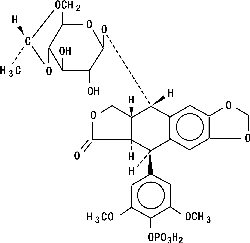
Etoposide phosphate is a phosphate ester of etoposide, a semi-synthetic derivative of podophyllotoxin. ETOPOPHOS is available for intravenous infusion as a sterile lyophilized powder in single-dose vials for reconstitution containing 114 mg etoposide phosphate, equivalent to 100 mg etoposide, 32.7 mg sodium citrate USP, and 300 mg dextran 40.
CLINICAL PHARMACOLOGY
Mechanism of Action
Etoposide phosphate is a prodrug that is converted to its active moiety, etoposide, by dephosphorylation. Etoposide causes the induction of DNA strand breaks by an interaction with DNA-topoisomerase II or the formation of free radicals, leading to cell cycle arrest, primarily at the G2 stage of the cell cycle, and cell death.
Pharmacodynamics
Following intravenous administration of 90, 100, and 110 mg/m 2 dose of ETOPOPHOS over 60 minutes, mean nadir values (expressed as percent decrease from baseline) for granulocytes, hemoglobin, and thrombocytes were 81.0 ± 16.5%, 21.4 ± 9.9%, and 44.1 ± 20.7%, respectively.
Pharmacokinetics
Following intravenous administration of an etoposide formulation, the area under the concentration time curve (AUC) and maximum plasma concentration (C max ) values increased linearly and etoposide did not accumulate in the plasma following daily administration for 4 to 5 days.
Distribution Following administration of an injectable etoposide formulation, the mean volume of distribution of etoposide at steady state was 18 to 29 liters. Etoposide enters the CSF poorly. In vitro, etoposide is 97% bound to human plasma proteins, primarily albumin.
Elimination The terminal elimination half-life of etoposide ranges from 4 to 11 hours. Total body clearance values range from 33 to 48 mL/min.
Metabolism Following intravenous administration of ETOPOPHOS, etoposide phosphate is completely converted to etoposide in plasma. Etoposide is metabolized by opening of the lactone ring, O-demethylation, and conjugation (i.e., glucuronidation and sulfation). O-demethylation occurs through the CYP450 3A4 isoenzyme pathway to produce the active catechol metabolite.
Excretion At 120 hours after intravenous administration of radiolabeled etoposide formulation, the mean recovery of radioactivity in the urine was 56% of the dose, 45% of which was excreted as etoposide and 8% or less as metabolites. Fecal recovery of radioactivity was 44% of the dose.
Specific Populations Following intravenous administration of etoposide in adults, the total body clearance of etoposide was correlated with creatinine clearance, serum albumin concentration, and non-renal clearance. No clinically significant differences in the pharmacokinetics of etoposide were observed based on age and sex.
Drug Interaction Studies Cisplatin: Co-administration of cisplatin may increase exposure to etoposide. Highly protein-bound drugs: Phenylbutazone, sodium salicylate, and aspirin displaced protein-bound etoposide in vitro. Select antiepileptic medications: Co-administration with antiepileptic medications including phenytoin, phenobarbital, carbamazepine, and valproic acid may increase etoposide clearance. Etoposide may be a substrate of the P-glycoprotein (P-gp) transporter system based upon in vitro studies.
NONCLINICAL TOXICOLOGY
Carcinogenesis, Mutagenesis, Impairment of Fertility
ETOPOPHOS was non-mutagenic in an in vitro Ames microbial mutagenicity assay; however, ETOPOPHOS is rapidly and completely converted to etoposide in vivo. Therefore, as etoposide is mutagenic in the Ames assay, ETOPOPHOS is considered mutagenic in vivo.
In rats, oral dosing of ETOPOPHOS for 5 consecutive days at doses greater than or equal to 86 mg/kg/day (about 10 times the 50 mg/m 2 human dose based on BSA) resulted in irreversible testicular atrophy. Irreversible testicular atrophy was also present in rats treated with ETOPOPHOS intravenously for 30 days at 5.11 mg/kg/day (about 0.5 times the 50 mg/m 2 human dose based on BSA).
CLINICAL STUDIES
Study 1 was a multicenter trial in patients, with previously untreated, small cell lung cancer, randomized (1:1) to receive either etoposide phosphate (80 mg/m 2 /day) plus cisplatin (20 mg/m 2 /day) for 5 days, or etoposide (80 mg/m 2 /day) plus cisplatin (20 mg/m 2 /day). The major efficacy outcome measure was objective response rate (ORR). Among the 121 patients enrolled, the median age was 64 years, 65% of patients were male, 89% were White, and ECOG performance score was 0 to 2. Study 1 demonstrated an overall response rate of 61% (95% confidence interval [CI] 47, 73) for patients treated with etoposide phosphate plus cisplatin, and 58% (95% CI: 45, 71) for those receiving etoposide plus cisplatin.
HOW SUPPLIED/STORAGE AND HANDLING
How Supplied/Storage ETOPOPHOS is supplied as a single-dose vial containing etoposide phosphate equivalent to 100 mg etoposide as a lyophilized powder for reconstitution, individually packaged in a carton: NDC 61269-410-20 Store unopened vials at 2° to 8°C (36°-46°F). Keep vial in outer carton to protect from light.
Handling ETOPOPHOS is a cytotoxic drug. Follow applicable special handling and disposal procedures. 1
