Ethacrynate Sodium - Ethacrynate Sodium injection, Powder, For Solution prescribing information

INDICATIONS AND USAGE
Ethacrynate sodium is indicated for treatment of edema when an agent with greater diuretic potential than those commonly employed is required.
1. Treatment of the edema associated with congestive heart failure, cirrhosis of the liver, and renal disease, including the nephrotic syndrome.
2. Short-term management of ascites due to malignancy, idiopathic edema, and lymphedema.
3. Short-term management of hospitalized pediatric patients, other than infants, with congenital heart disease or the nephrotic syndrome.
4. Intravenous ethacrynate sodium is indicated when a rapid onset of diuresis is desired, e.g., in acute pulmonary edema, or when gastrointestinal absorption is impaired or oral medication is not practicable.
DOSAGE AND ADMINISTRATION
Dosage must be regulated carefully to prevent a more rapid or substantial loss of fluid or electrolyte than is indicated or necessary. The magnitude of diuresis and natriuresis is largely dependent on the degree of fluid accumulation present in the patient. Similarly, the extent of potassium excretion is determined in large measure by the presence and magnitude of aldosteronism.
Oral Use
Ethacrynic Acid Tablets USP are available as 25 mg tablets.
Dosage: To Initiate Diuresis
In Adults: The smallest dose required to produce gradual weight loss (about 1 to 2 pounds per day) is recommended. Onset of diuresis usually occurs at 50 to 100 mg for adults. After diuresis has been achieved, the minimally effective dose (usually from 50 to 200 mg daily) may be given on a continuous or intermittent dosage schedule. Dosage adjustments are usually in 25 to 50 mg increments to avoid derangement of water and electrolyte excretion.
The patient should be weighed under standard conditions before and during the institution of diuretic therapy with this compound. Small alterations in dose should effectively prevent a massive diuretic response. The following schedule may be helpful in determining the smallest effective dose.
Day 1 - 50 mg once daily after a meal
Day 2 - 50 mg twice daily after meals, if necessary
Day 3 - 100 mg in the morning and 50 to 100 mg following the afternoon or evening meal, depending upon response to the morning dose.
A few patients may require initial and maintenance doses as high as 200 mg twice daily. These higher doses, which should be achieved gradually, are most often required in patients with severe, refractory edema.
In Pediatric Patients (excluding infants, see CONTRAINDICATIONS ): The initial dose should be 25 mg. Careful stepwise increments in dosage of 25 mg should be made to achieve effective maintenance.
Maintenance Therapy
It is usually possible to reduce the dosage and frequency of administration once dry weight has been achieved.
Ethacrynic Acid Tablets USP may be given intermittently after an effective diuresis is obtained with the regimen outlined above. Dosage may be on an alternate daily schedule or more prolonged periods of diuretic therapy may be interspersed with rest periods. Such an intermittent dosage schedule allows time for correction of any electrolyte imbalance and may provide a more efficient diuretic response.
The chloruretic effect of this agent may give rise to retention of bicarbonate and a metabolic alkalosis. This may be corrected by giving chloride (ammonium chloride or arginine chloride). Ammonium chloride should not be given to cirrhotic patients.
Ethacrynic Acid Tablets USP has additive effects when used with other diuretics. For example, a patient who is on maintenance dosage of an oral diuretic may require additional intermittent diuretic therapy, such as an organomercurial, for the maintenance of basal weight. The intermittent use of Ethacrynic Acid Tablets USP orally may eliminate the need for injections of organomercurials. Small doses of Ethacrynic Acid Tablets USP may be added to existing diuretic regimens to maintain basal weight. This drug may potentiate the action of carbonic anhydrase inhibitors, with augmentation of natriuresis and kaliuresis. Therefore, when adding Ethacrynic Acid Tablets USP the initial dose and changes of dose should be in 25 mg increments, to avoid electrolyte depletion. Rarely, patients who failed to respond to ethacrynic acid have responded to older established agents.
While many patients do not require supplemental potassium, the use of potassium chloride or potassium-sparing agents, or both, during treatment with Ethacrynic Acid Tablets USP is advisable, especially in cirrhotic or nephrotic patients and in patients receiving digitalis.
Salt liberalization usually prevents the development of hyponatremia and hypochloremia. During treatment with Ethacrynic Acid Tablets USP, salt may be liberalized to a greater extent than with other diuretics. Cirrhotic patients, however, usually require at least moderate salt restriction concomitant with diuretic therapy.
Intravenous Use
Intravenous ethacrynate sodium is for intravenous use when oral intake is impractical or in urgent conditions, such as acute pulmonary edema.
The usual intravenous dose for the average sized adult is 50 mg, or 0.5 to 1 mg per kg of body weight. Usually only one dose has been necessary; occasionally a second dose at a new injection site, to avoid possible thrombophlebitis, may be required. A single intravenous dose not exceeding 100 mg has been used in critical situations.
Insufficient pediatric experience precludes recommendation for this age group.
To reconstitute the dry material, add 50 mL of 5 percent Dextrose Injection, or Sodium Chloride Injection to the vial. Occasionally, some 5 percent Dextrose Injection solutions may have a low pH (below 5). The resulting solution with such a diluent may be hazy or opalescent. Intravenous use of such a solution is not recommended. Inspect the vial containing Intravenous Ethacrynate Sodium for particulate matter and discoloration before use.
The solution may be given slowly through the tubing of a running infusion or by direct intravenous injection over a period of several minutes. Do not mix this solution with whole blood or its derivatives. Discard unused reconstituted solution after 24 hours.
Ethacrynate sodium for injection should not be given subcutaneously or intramuscularly because of local pain and irritation.
CONTRAINDICATIONS
All diuretics, including ethacrynic acid, are contraindicated in anuria. If increasing electrolyte imbalance, azotemia, and/or oliguria occur during treatment of severe, progressive renal disease, the diuretic should be discontinued.
In a few patients this diuretic has produced severe, watery diarrhea. If this occurs, it should be discontinued and not used again.
Until further experience in infants is accumulated, therapy with parenteral ethacrynate sodium is contraindicated.
Hypersensitivity to any component of this product.
ADVERSE REACTIONS
Gastrointestinal
Anorexia, malaise, abdominal discomfort or pain, dysphagia, nausea, vomiting, and diarrhea have occurred. These are more frequent with large doses or after one to three months of continuous therapy. A few patients have had sudden onset of profuse, watery diarrhea. Discontinue ethacrynate sodium if diarrhea is severe and do not give it again. Gastrointestinal bleeding has occurred in some patients. Rarely, acute pancreatitis has been reported.
Metabolic
Reversible hyperuricemia and acute gout have been reported. Acute symptomatic hypoglycemia with convulsions occurred in two uremic patients who received doses above those recommended. Hyperglycemia has been reported. Rarely, jaundice and abnormal liver function tests have been reported in seriously ill patients receiving multiple drug therapy, including ethacrynate sodium.
Hematologic
Agranulocytosis or severe neutropenia has been reported in a few critically ill patients also receiving agents known to produce this effect. Thrombocytopenia has been reported rarely. Henoch-Schönlein purpura has been reported rarely in patients with rheumatic heart disease receiving multiple drug therapy, including ethacrynate sodium.
Special Senses
(see WARNINGS )
Deafness, tinnitus and vertigo with a sense of fullness in the ears, and blurred vision have occurred.
Central Nervous System
Headache, fatigue, apprehension, confusion.
Miscellaneous
Skin rash, fever, chills, hematuria.
Ethacrynate sodium occasionally has caused local irritation and pain after intravenous use.
For medical advice about adverse reactions contact your medical professional.
To report SUSPECTED ADVERSE REACTIONS, contact Endo at 1-800-828-9393 or FDA at 1-800-FDA-1088 or www.fda.gov/medwatch.
Drug Interactions
Lithium generally should not be given with diuretics because they reduce its renal clearance and add a high risk of lithium toxicity. Read circulars for lithium preparations before use of such concomitant therapy.
Ethacrynate sodium may increase the ototoxic potential of other drugs such as aminoglycoside and some cephalosporin antibiotics. Their concurrent use should be avoided.
A number of drugs, including ethacrynic acid, have been shown to displace warfarin from plasma protein; a reduction in the usual anticoagulant dosage may be required in patients receiving both drugs.
In some patients, the administration of a non-steroidal anti-inflammatory agent can reduce the diuretic, natriuretic, and antihypertensive effects of loop, potassium-sparing and thiazide diuretics. Therefore, when ethacrynate sodium and non-steroidal anti-inflammatory agents are used concomitantly, the patient should be observed closely to determine if the desired effect of the diuretic is obtained.
DESCRIPTION
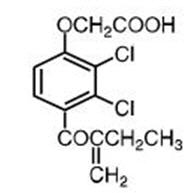
Ethacrynic acid is an unsaturated ketone derivative of an aryloxyacetic acid. It is designated chemically as [2,3-dichloro-4-(2- methylene-1-oxobutyl)phenoxy] acetic acid, and has a molecular weight of 303.14. Ethacrynic acid is a white, or practically white, crystalline powder, very slightly soluble in water, but soluble in most organic solvents such as alcohols, chloroform, and benzene. Its empirical formula is C 13 H 12 Cl 2 O 4 and its structural formula is:
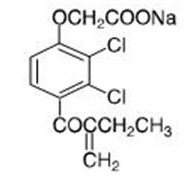
Ethacrynate sodium, the sodium salt of ethacrynic acid, is soluble in water at 25°C to the extent of about 7 percent. Solutions of the sodium salt are relatively stable at about pH 7 at room temperature for short periods, but as the pH or temperature increases the solutions are less stable. The molecular weight of ethacrynate sodium is 325.12. Its empirical formula is C 13 H 11 Cl 2 NaO 4 and its structural formula is:
Intravenous Ethacrynate Sodium is a sterile freeze-dried powder and is supplied in a vial containing: Ethacrynate sodium equivalent to ethacrynic acid...... 50 mg Inactive ingredient: Mannitol......................62.5 mg
CLINICAL PHARMACOLOGY
Pharmacokinetics and Metabolism
Ethacrynate sodium acts on the ascending limb of the loop of Henle and on the proximal and distal tubules. Urinary output is usually dose dependent and related to the magnitude of fluid accumulation. Water and electrolyte excretion may be increased several times over that observed with thiazide diuretics, since ethacrynate sodium inhibits reabsorption of a much greater proportion of filtered sodium than most other diuretic agents. Therefore, ethacrynate sodium is effective in many patients who have significant degrees of renal insufficiency (see WARNINGS concerning deafness ). Ethacrynate sodium has little or no effect on glomerular filtration or on renal blood flow, except following pronounced reductions in plasma volume when associated with rapid diuresis.
The electrolyte excretion pattern of ethacrynic acid varies from that of the thiazides and mercurial diuretics. Initial sodium and chloride excretion is usually substantial and chloride loss exceeds that of sodium. With prolonged administration, chloride excretion declines, and potassium and hydrogen ion excretion may increase. Ethacrynate sodium is effective whether or not there is clinical acidosis or alkalosis.
Although ethacrynate sodium, in carefully controlled studies in animals and experimental subjects, produces a more favorable sodium/potassium excretion ratio than the thiazides, in patients with increased diuresis excessive amounts of potassium may be excreted.
Onset of action is rapid, usually within 30 minutes after an oral dose of Ethacrynic Acid Tablets USP or within 5 minutes after an intravenous injection of ethacrynate sodium. After oral use, diuresis peaks in about 2 hours and lasts about 6 to 8 hours.
The sulfhydryl binding propensity of ethacrynic acid differs somewhat from that of the organomercurials. Its mode of action is not by carbonic anhydrase inhibition.
Ethacrynic acid does not cross the blood-brain barrier.
HOW SUPPLIED
Ethacrynate sodium for injection is a dry white material either in a plug form or as a powder.
NDC 42023-157-01: Ethacrynate sodium equivalent to 50 mg of ethacrynic acid, in a single dose vial.
The vial stopper is not made with natural rubber latex.
Storage
Store in a tightly closed container between 20° to 25°C (68° to 77°F). (See USP Controlled Room Temperature.)
