Get your patient on Ergocalciferol
Ergocalciferol prescribing information

INDICATIONS AND USAGE
Ergocalciferol is indicated for use in the treatment of hypoparathyroidism, refractory rickets, also known as vitamin D resistant rickets, and familial hypophosphatemia.
DOSAGE AND ADMINISTRATION
THE RANGE BETWEEN THERAPEUTIC AND TOXIC DOSES IS NARROW.
Vitamin D Resistant Rickets: 12,000 to 500,000 IU units daily.
Hypoparathyroidism: 50,000 to 200,000 IU units daily concomitantly with calcium lactate 4 g, six times per day.
DOSAGE MUST BE INDIVIDUALIZED UNDER CLOSE MEDICAL SUPERVISION.
Calcium intake should be adequate. Blood calcium and phosphorus determinations must be made every 2 weeks or more frequently if necessary.
X-rays of the bones should be taken every month until condition is corrected and stabilized.
CONTRAINDICATIONS
Ergocalciferol is contraindicated in patients with hypercalcemia, malabsorption syndrome, abnormal sensitivity to the toxic effects of vitamin D, and hypervitaminosis D.
ADVERSE REACTIONS
Hypervitaminosis D is characterized by effects on the following organ system:
Renal: Impairment of renal function with polyuria, nocturia, polydipsia, hypercalciuria, reversible azotemia, hypertension, nephrocalcinosis, generalized vascular calcification, or irreversible renal insufficiency which may result in death.
CNS: Mental retardation.
Soft Tissues: Widespread calcification of the soft tissues, including the heart, blood vessels, renal tubules, and lungs.
Skeletal: Bone demineralization (osteoporosis) in adults occurs concomitantly.
Decline in the average rate of linear growth and increased mineralization of bones in infants and children (dwarfism) vague aches, stiffness, and weakness.
Gastrointestinal: Nausea, anorexia, constipation.
Metabolic: Mild acidosis, anemia, weight loss.
To report SUSPECTED ADVERSE REACTIONS, contact Torrent Pharma Inc. at 1-800-912-9561 or FDA at 1-800-FDA-1088 or www.fda.gov/medwatch.
Drug Interactions
Mineral oil interferes with the absorption of fat-soluble vitamins, including vitamin D preparations.
Administration of thiazide diuretics to hypoparathyroid patients who are concurrently being treated with ergocalciferol may cause hypercalcemia.
DESCRIPTION
Ergocalciferol capsules, USP, is a synthetic calcium regulator for oral administration.
Ergocalciferol is a white, colorless crystal, insoluble in water, soluble in organic solvents, and slightly soluble in vegetable oils. It is affected by air and by light. Ergosterol or provitamin D 2 is found in plants and yeast and has no antirachitic activity.
There are more than 10 substances belonging to a group of steroid compounds, classified as having vitamin D or antirachitic activity.
One USP unit of vitamin D 2 is equivalent to one International Unit (IU), and 1 mcg of vitamin D 2 is equal to 40 IU.
Each capsule contains 1.25 mg (50,000 International Units vitamin D) of ergocalciferol, USP, in an edible vegetable oil.
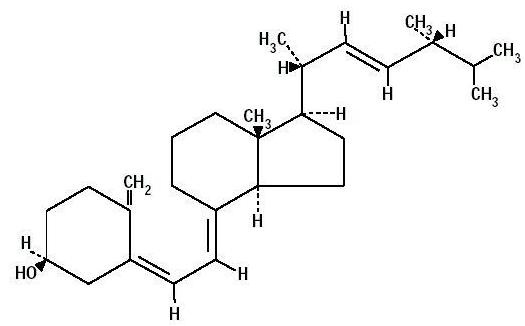
Ergocalciferol, also called vitamin D 2 , is 9, 10-secoergosta-5,7,10 (19), 22-tetraen-3-ol, (3ß,5Z,7E,22 E )-; (C 28 H 44 O) with a molecular weight of 396.65, and has the following structural formula:
Inactive Ingredients: Butylated Hydroxylanisole, FD&C Blue #1, FD&C Yellow #5, Gelatin, Glycerin, Purified Water, Soybean Oil.
CLINICAL PHARMACOLOGY
The in vivo synthesis of the major biologically active metabolites of vitamin D occurs in two steps. The first hydroxylation of ergocalciferol takes place in the liver (to 25-hydroxyvitamin D) and the second in the kidneys (to 1, 25-dihydroxyvitamin D). Vitamin D metabolites promote the active absorption of calcium and phosphorus by the small intestine, thus elevating serum calcium and phosphate levels sufficiently to permit bone mineralization. Vitamin D metabolites also mobilize calcium and phosphate from bone and probably increase the reabsorption of calcium and perhaps also of phosphate by the renal tubules.
There is a time lag of 10 to 24 hours between the administration of vitamin D and the initiation of its action in the body due to the necessity of synthesis of the active metabolites in the liver and kidneys. Parathyroid hormone is responsible for the regulation of this metabolism in the kidneys.
HOW SUPPLIED
Capsules of 1.25 mg (50,000 IU vitamin D) of ergocalciferol, USP are clear, forest green, oval, soft gelatin capsules laser printed with “E09” supplied in HDPE bottles:
Bottles of 100 - NDC 13668-757-01
Store at 77°F (25°C); excursions permitted between 59° to 86°F (15° to 30°C) [See USP Controlled Room Temperature].
Dispense in a tight, light-resistant container as defined in the USP/NF.
Rx Only
Manufactured by: Esjay Pharma Private Limited, Tamilnadu, India - 602117
Distributed by: Torrent Pharma INC. Basking Ridge, NJ 07920.

8104206
P3495/00/25
Rev. 11/2025
