Get your patient on Doxepin Hydrochloride - Doxepin Hydrochloride capsule (Doxepin Hydrochloride)
Doxepin Hydrochloride - Doxepin Hydrochloride capsule prescribing information

Suicidality and Antidepressant Drugs
Antidepressants increased the risk compared to placebo of suicidal thinking and behavior (suicidality) in children, adolescents and young adults in short-term studies of major depressive disorder (MDD) and other psychiatric disorders. Anyone considering the use of doxepin or any other antidepressant in a child, adolescent, or young adult must balance this risk with the clinical need. Short-term studies did not show an increase in the risk of suicidality with antidepressants compared to placebo in adults beyond age 24; there was a reduction in risk with antidepressants compared to placebo in adults aged 65 and older. Depression and certain other psychiatric disorders are themselves associated with increases in the risk of suicide. Patients of all ages who are started on antidepressant therapy should be monitored appropriately and observed closely for clinical worsening, suicidality, or unusual changes in behavior. Families and caregivers should be advised of the need for close observation and communication with the prescriber. Doxepin is not approved for use in pediatric patients. (See WARNINGS: Clinical Worsening and Suicide Risk , PRECAUTIONS: Information for Patients and PRECAUTIONS: Pediatric Use .)
INDICATIONS AND USAGE
Doxepin Hydrochloride Capsules, USP are recommended for the treatment of:
- Psychoneurotic patients with depression and/or anxiety.
- Depression and/or anxiety associated with alcoholism (not to be taken concomitantly with alcohol).
- Depression and/or anxiety associated with organic disease (the possibility of drug interaction should be considered if the patient is receiving other drugs concomitantly).
- Psychotic depressive disorders with associated anxiety including involutional depression and manic-depressive disorders.
The target symptoms of psychoneurosis that respond particularly well to doxepin hydrochloride capsules include anxiety, tension, depression, somatic symptoms and concerns, sleep disturbances, guilt, lack of energy, fear, apprehension and worry.
Clinical experience has shown that doxepin hydrochloride capsules are safe and well tolerated even in the elderly patient. Owing to lack of clinical experience in the pediatric population, doxepin hydrochloride capsules are not recommended for use in children under 12 years of age.
DOSAGE AND ADMINISTRATION
For most patients with illness of mild to moderate severity, a starting daily dose of 75 mg is recommended. Dosage may subsequently be increased or decreased at appropriate intervals and according to individual response. The usual optimum dose range is 75 mg/day to 150 mg/day.
In more severely ill patients higher doses may be required with subsequent gradual increase to 300 mg/day if necessary. Additional therapeutic effect is rarely to be obtained by exceeding a dose of 300 mg/day.
In patients with very mild symptomatology or emotional symptoms accompanying organic disease, lower doses may suffice. Some of these patients have been controlled on doses as low as 25 to 50 mg/day.
The total daily dosage of doxepin (as the hydrochloride) may be given on a divided or once a day dosage schedule. If the once a day schedule is employed, the maximum recommended dose is 150 mg/day. This dose may be given at bedtime. The 150 mg capsule strength is intended for maintenance therapy only and is not recommended for initiation of treatment.
Antianxiety effect is apparent before the antidepressant effect. Optimal antidepressant effect may not be evident for 2 to 3 weeks.
CONTRAINDICATIONS
Doxepin hydrochloride capsules are contraindicated in individuals who have shown hypersensitivity to the drug. Possibility of cross sensitivity with other dibenzoxepines should be kept in mind.
Doxepin hydrochloride capsules are contraindicated in patients with glaucoma or a tendency to urinary retention. These disorders should be ruled out, particularly in older patients.
ADVERSE REACTIONS
NOTE: Some of the adverse reactions noted below have not been specifically reported with doxepin use. However, due to the close pharmacological similarities among the tricyclics, the reactions should be considered when prescribing doxepin.
Anticholinergic Effects: Dry mouth, blurred vision, constipation and urinary retention have been reported. If they do not subside with continued therapy or become severe, it may be necessary to reduce the dosage.
Central Nervous System Effects: Drowsiness is the most commonly noticed side effect. This tends to disappear as therapy is continued. Other infrequently reported CNS side effects are confusion, disorientation, hallucinations, numbness, paresthesias, ataxia, extrapyramidal symptoms, seizures, tardive dyskinesia and tremor.
Cardiovascular: Cardiovascular effects including hypotension, hypertension and tachycardia have been reported occasionally.
Allergic: Skin rash, edema, photosensitization and pruritus have occasionally occurred.
Hematologic: Eosinophilia has been reported in a few patients. There have been occasional reports of bone marrow depression manifesting as agranulocytosis, leukopenia, thrombocytopenia and purpura.
Gastrointestinal: Nausea, vomiting, indigestion, taste disturbances, diarrhea, anorexia and aphthous stomatitis have been reported. (See Anticholinergic Effects .)
Endocrine: Raised or lowered libido, testicular swelling, gynecomastia in males, enlargement of breasts and galactorrhea in the female, raising or lowering of blood sugar levels and syndrome of inappropriate antidiuretic hormone secretion have been reported with tricyclic administration.
Other: Dizziness, tinnitus, weight gain, sweating, chills, fatigue, weakness, flushing, jaundice, alopecia, headache, exacerbation of asthma, angle closure glaucoma, mydriasis and hyperpyrexia (in association with chlorpromazine) have been occasionally observed as adverse effects.
Withdrawal Symptoms
The possibility of development of withdrawal symptoms upon abrupt cessation of treatment after prolonged doxepin administration should be borne in mind. These are not indicative of addiction and gradual withdrawal of medication should not cause these symptoms.
DESCRIPTION
Doxepin hydrochloride is one of a class of psychotherapeutic agents known as dibenzoxepin tricyclic compounds. The molecular formula of the compound is C19H21NO•HCl having a molecular weight of 315.84. It is a white or almost white crystalline powder freely soluble in water, in ethanol and in dichloromethane. Soluble in chloroform and in methanol. It may be represented by the following structural formula:
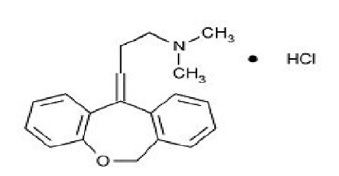
Chemically, doxepin hydrochloride is a dibenzoxepin derivative and is the first of a family of tricyclic psychotherapeutic agents. Specifically, it is an isomeric mixture of 1- Propanamine, 3-dibenz[b,e]oxepin-11 (6H)ylidene-N,N-dimethyl-hydrochloride.
Each 10 mg, 25 mg, 50 mg, 75 mg and 100 mg doxepin hydrochloride capsules, USP for oral administration contains doxepin hydrochloride, USP equivalent to 10 mg, 25 mg, 50 mg, 75 mg and 100 mg of doxepin, respectively and the following inactive ingredients: colloidal silicon dioxide, corn starch, magnesium stearate, microcrystalline cellulose, pregelatinized starch and sodium lauryl sulfate. The empty gelatin capsule shells contain D&C Yellow No. 10 (25 mg, 50 mg, 75 mg and 100 mg), FD&C Red No. 40 (25 mg and 50 mg), FD&C Green No. 3 (75 mg and 100 mg), gelatin, iron oxide yellow (10 mg only) and titanium dioxide. The imprinting ink contains black iron oxide, potassium hydroxide and shellac.
Meets USP Dissolution Test 3.
CLINICAL PHARMACOLOGY
The mechanism of action of doxepin is not definitely known. It is not a central nervous system stimulant nor a monoamine oxidase inhibitor. The current hypothesis is that the clinical effects are due, at least in part, to influences on the adrenergic activity at the synapses so that deactivation of norepinephrine by reuptake into the nerve terminals is prevented. Animal studies suggest that doxepin does not appreciably antagonize the antihypertensive action of guanethidine. In animal studies anticholinergic, antiserotonin and antihistamine effects on smooth muscle have been demonstrated. At higher than usual clinical doses norepinephrine response was potentiated in animals. This effect was not demonstrated in humans.
At clinical dosages up to 150 mg per day, doxepin can be given to man concomitantly with guanethidine and related compounds without blocking the antihypertensive effect. At dosages above 150 mg per day blocking of the antihypertensive effect of these compounds has been reported.
Doxepin is virtually devoid of euphoria as a side effect. Characteristic of this type of compound, doxepin has not been demonstrated to produce the physical tolerance or psychological dependence associated with addictive compounds.
HOW SUPPLIED
Doxepin Hydrochloride Capsules, USP are available containing doxepin hydrochloride, USP equivalent to 10 mg, 25 mg, 50 mg, 75 mg or 100 mg of doxepin.
The 10 mg capsules are hard gelatin capsules with buff opaque cap imprinted in black with ‘DOC’ and buff opaque body imprinted in black with ‘10 mg’ with 360 degree thin line, containing white to off white powder. They are available as follows: NDC 64980-594-01 bottles of 100 capsules
The 25 mg capsules are hard gelatin capsules with ivory opaque cap imprinted in black with ‘DOC’ and white opaque body imprinted in black with ‘25 mg’ with 360 degree thin line, containing white to off white powder. They are available as follows: NDC 64980-595-01 bottles of 100 capsules
The 50 mg capsules are hard gelatin capsules with ivory opaque cap imprinted in black with ‘DOC’ and ivory opaque body imprinted in black with ‘50 mg’ with 360 degree thin line, containing white to off white powder. They are available as follows: NDC 64980-596-01 bottles of 100 capsules
The 75 mg capsules hard gelatin capsules with britelite green opaque cap imprinted in black with ‘DOC’ and britelite green opaque body imprinted in black with ‘75 mg’ with 360 degree thin line, containing white to off white powder. They are available as follows: NDC 64980-597-01 bottles of 100 capsules
The 100 mg capsules are hard gelatin capsules with britelite green opaque cap imprinted in black with ‘DOC’ and white opaque body imprinted in black with ‘100 mg’ with 360 degree thin line, containing white to off white powder. They are available as follows: NDC 64980-598-01 bottles of 100 capsules
Store at 20°C to 25°C (68°F to 77°F). [See USP Controlled Room Temperature.]
Protect from light.
Dispense in a tight, light-resistant container as defined in the USP using a child-resistant closure.
PHARMACIST: Dispense a Medication Guide with each prescription.
Manufactured by: Unique Pharmaceutical Laboratories (A Div. of J. B. Chemicals & Pharmaceuticals Ltd.), Mumbai 400 030, India
Distributed by:
Rising Pharma Holdings, Inc.
East Brunswick, NJ 08816
Revised: 03/2025

140542
