Get your patient on Diclofenac - Diclofenac Sodium solution/ Drops (Diclofenac Sodium)
Diclofenac - Diclofenac Sodium solution/ Drops prescribing information

INDICATIONS AND USAGE
Diclofenac sodium ophthalmic solution, 0.1% is indicated for the treatment of postoperative inflammation in patients who have undergone cataract extraction and for the temporary relief of pain and photophobia in patients undergoing corneal refractive surgery.
DOSAGE AND ADMINISTRATION
Cataract Surgery
One drop of Diclofenac sodium ophthalmic solution, 0.1% should be applied to the affected eye, 4 times daily beginning 24 hours after cataract surgery and continuing through the first 2 weeks of the postoperative period.
Corneal Refractive Surgery
One or two drops of Diclofenac sodium ophthalmic solution, 0.1% should be applied to the operative eye within the hour prior to corneal refractive surgery. Within 15 minutes after surgery, one or two drops should be applied to the operative eye and continued 4 times daily for up to 3 days.
CONTRAINDICATIONS
Diclofenac sodium ophthalmic solution, 0.1% is contraindicated in patients who are hypersensitive to any component of the medication.
ADVERSE REACTIONS
Ocular
Transient burning and stinging were reported in approximately 15% of patients across studies with the use of Diclofenac sodium ophthalmic solution, 0.1%. In cataract surgery studies, keratitis was reported in up to 28% of patients using Diclofenac sodium ophthalmic solution, 0.1%, although in many of these cases keratitis was initially noted prior to the initiation of treatment. Elevated intraocular pressure following cataract surgery was reported in approximately 15% of patients undergoing cataract surgery. Lacrimation complaints were reported in approximately 30% of case studies undergoing incisional refractive surgery. The following adverse reactions were reported in approximately 10% or less of the patients: abnormal vision, acute elevated IOP, blurred vision, conjunctivitis, corneal deposits, corneal edema, corneal opacity, corneal lesions, discharge, eyelid swelling, eye pain, injection (redness), iritis, irritation, itching, lacrimation disorder, and ocular allergy.
Systemic
The following adverse reactions were reported in 3% or less of the patients: abdominal pain, asthenia, chills, dizziness, facial edema, fever, headache, insomnia, nausea, pain, rhinitis, viral infection and vomiting.
Clinical Practice
The following reactions have been identified during postmarketing use of topical diclofenac sodium ophthalmic solution, 0.1% in clinical practice. Because they are reported voluntarily from a population of unknown size, estimates of frequency cannot be made. The reactions, which have been chosen for inclusion due to either their seriousness, frequency of reporting, possible causal connection to topical diclofenac sodium ophthalmic solution, 0.1%, or a combination of these factors, include corneal erosion, corneal infiltrates, corneal perforation, corneal thinning, corneal ulceration and epithelilal breakdown (see PRECAUTIONS , General ).
TO REPORT SUSPECTED ADVERSE REACTIONS , contact Altaire Pharmaceuticals, Inc., at 1-800-258-2471 or FDA at 1-800-FDA-1088 or www.fda.gov/medwatch .
DESCRIPTION
Diclofenac sodium ophthalmic solution, 0.1% is a sterile, topical, nonsteroidal, anti-inflammatory product for ophthalmic use. Diclofenac sodium is designated chemically as 2-[(2,6-dichlorophenyl)amino] benzeneacetic acid, monosodium salt, with an empirical formula of C 14 H 10 Cl l2 NO 2 Na. The structural formula of diclofenac sodium is:
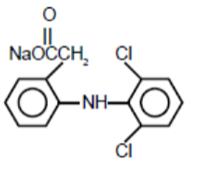
Diclofenac sodium ophthalmic solution, 0.1% is available as a sterile solution which contains diclofenac sodium 0.1% (1mg/mL).
Inactive Ingredients: polyoxyl 35 castor oil, Boric acid, tromethamine, sorbic acid (2 mg/mL), edetate disodium (1 mg/mL), and purified water.
Diclofenac sodium ophthalmic solution, 0.1% is a faintly yellow-white to light beige, slightly hygroscopic crystalline powder. It is freely soluble in methanol, sparingly soluble in water, very slightly soluble in acetonitrile, and insoluble in chloroform and in 0.1N hydrochloric acid. Its molecular weight is 318.14. Diclofenac sodium ophthalmic solution, 0.1% is an iso osmotic solution with an osmolality of about 300 mOsmol/1000 g, buffered at approximately pH 7.2. Diclofenac sodium ophthalmic solution, 0.1% has a faint characteristic odor of castor oil.
CLINICAL PHARMACOLOGY
Pharmacodynamics
Diclofenac sodium is one of a series of phenylacetic acids that has demonstrated anti-inflammatory and analgesic properties in pharmacological studies. It is thought to inhibit the enzyme cyclooxygenase, which is essential in the biosynthesis of prostaglandins.
Animal Studies
Prostaglandins have been shown in many animal models to be mediators of certain kinds of intraocular inflammation. In studies performed in animal eyes, prostaglandins have been shown to produce disruption of the blood-aqueous humor barrier, vasodilation, increased vascular permeability, leukocytosis, and increased intraocular pressure.
Pharmacokinetics
Results from a bioavailability study established that plasma levels of diclofenac following ocular instillation of two drops of Diclofenac sodium ophthalmic solution, 0.1% to each eye were below the limit of quantification (10 ng/mL) over a 4-hour period. This study suggests that limited, if any, systemic absorption occurs with Diclofenac sodium ophthalmic solution, 0.1%.
Clinical Trials
Postoperative Anti-Inflammatory Effects In two double-masked, controlled, efficacy studies of postoperative inflammation, a total of 206 cataract patients were treated with Diclofenac sodium ophthalmic solution, 0.1% and 103 patients were treated with vehicle placebo. Diclofenac sodium ophthalmic solution, 0.1% was favored over vehicle placebo over a 2-week period for the clinical assessments of inflammation as measured by anterior chamber cells and flare.
In double-masked, controlled studies of corneal refractive surgery (radial keratotomy (RK) and laser photorefractive keratectomy (PRK)) patients were treated with Diclofenac sodium ophthalmic solution, 0.1% and/or vehicle placebo. The efficacy of Diclofenac sodium ophthalmic solution, 0.1% given before and shortly after surgery was favored over vehicle placebo during the 6-hour period following surgery for the clinical assessments of pain and photophobia. Patients were permitted to use a hydrogel soft contact lens with Diclofenac sodium ophthalmic solution, 0.1% for up to three days after PRK.
Clinical Trials
Postoperative Anti-Inflammatory Effects In two double-masked, controlled, efficacy studies of postoperative inflammation, a total of 206 cataract patients were treated with Diclofenac sodium ophthalmic solution, 0.1% and 103 patients were treated with vehicle placebo. Diclofenac sodium ophthalmic solution, 0.1% was favored over vehicle placebo over a 2-week period for the clinical assessments of inflammation as measured by anterior chamber cells and flare.
In double-masked, controlled studies of corneal refractive surgery (radial keratotomy (RK) and laser photorefractive keratectomy (PRK)) patients were treated with Diclofenac sodium ophthalmic solution, 0.1% and/or vehicle placebo. The efficacy of Diclofenac sodium ophthalmic solution, 0.1% given before and shortly after surgery was favored over vehicle placebo during the 6-hour period following surgery for the clinical assessments of pain and photophobia. Patients were permitted to use a hydrogel soft contact lens with Diclofenac sodium ophthalmic solution, 0.1% for up to three days after PRK.
HOW SUPPLIED
Diclofenac sodium ophthalmic solution, 0.1% (1 mg/mL) Sterile Solution is supplied in a low density polyethylene (LDPE) white bottle with a LDPE Dropper Tip and Polypropylene grey closure. The 2.5 mL is supplied in a 7.5 mL size bottle and the 5 mL is supplied in a 10 mL size bottle.
Bottles of 2.5 mL Bottles of 5 mL Store at 20° to 25°C (68° to 77°F). Dispense in original, unopened container only .
[LOGO] ALTAIRE PHARMACEUTICALS, INC. 311 West Lane, PO Box 849 Aquebogue, NY 11931
Altaire 2014
