Get your patient on Detrol - Tolterodine Tartrate tablet, Film Coated (Tolterodine Tartrate)
Detrol - Tolterodine Tartrate tablet, Film Coated prescribing information

INDICATIONS AND USAGE
DETROL Tablets are indicated for the treatment of overactive bladder with symptoms of urge urinary incontinence, urgency, and frequency.
DOSAGE AND ADMINISTRATION
The initial recommended dose of DETROL Tablets is 2 mg twice daily. The dose may be lowered to 1 mg twice daily based on individual response and tolerability. For patients with significantly reduced hepatic or renal function or who are currently taking drugs that are potent inhibitors of CYP3A4, the recommended dose of DETROL is 1 mg twice daily (see PRECAUTIONS, General , PRECAUTIONS, Reduced Hepatic and Renal Function , and PRECAUTIONS, Drug Interactions ).
CONTRAINDICATIONS
DETROL Tablets are contraindicated in patients with urinary retention, gastric retention, or uncontrolled narrow-angle glaucoma. DETROL is also contraindicated in patients who have demonstrated hypersensitivity to the drug or its ingredients, or to fesoterodine fumarate extended-release tablets which, like DETROL, are metabolized to 5-hydroxymethyl tolterodine.
ADVERSE REACTIONS
The Phase 2 and 3 clinical trial program for DETROL Tablets included 3071 patients who were treated with DETROL (N=2133) or placebo (N=938). The patients were treated with 1, 2, 4, or 8 mg/day for up to 12 months. No differences in the safety profile of tolterodine were identified based on age, gender, race, or metabolism.
The data described below reflect exposure to DETROL 2 mg bid in 986 patients and to placebo in 683 patients exposed for 12 weeks in five Phase 3, controlled clinical studies. Because clinical trials are conducted under widely varying conditions, adverse reaction rates observed in the clinical trials of a drug cannot be directly compared to rates in the clinical trials of another drug and may not reflect the rates observed in practice. The adverse reaction information from clinical trials does, however, provide a basis for identifying the adverse events that appear to be related to drug use and approximating rates.
Sixty-six percent of patients receiving DETROL 2 mg bid reported adverse events versus 56% of placebo patients. The most common adverse events reported by patients receiving DETROL were dry mouth, headache, constipation, vertigo/dizziness, and abdominal pain. Dry mouth, constipation, abnormal vision (accommodation abnormalities), urinary retention, and xerophthalmia are expected side effects of antimuscarinic agents.
Dry mouth was the most frequently reported adverse event for patients treated with DETROL 2 mg bid in the Phase 3 clinical studies, occurring in 34.8% of patients treated with DETROL and 9.8% of placebo-treated patients. One percent of patients treated with DETROL discontinued treatment due to dry mouth.
The frequency of discontinuation due to adverse events was highest during the first 4 weeks of treatment. Seven percent of patients treated with DETROL 2 mg bid discontinued treatment due to adverse events versus 6% of placebo patients. The most common adverse events leading to discontinuation of DETROL were dizziness and headache.
Three percent of patients treated with DETROL 2 mg bid reported a serious adverse event versus 4% of placebo patients. Significant ECG changes in QT and QTc have not been demonstrated in clinical-study patients treated with DETROL 2 mg bid. Table 5 lists the adverse events reported in 1% or more of the patients treated with DETROL 2 mg bid in the 12-week studies. The adverse events are reported regardless of causality.
Body System | Adverse Event | % DETROL N=986 | % Placebo N=683 |
Autonomic Nervous | accommodation abnormal dry mouth | 2 35 | 1 10 |
General | chest pain fatigue headache influenza-like symptoms | 2 4 7 3 | 1 3 5 2 |
Central/Peripheral Nervous | vertigo/dizziness | 5 | 3 |
Gastrointestinal | abdominal pain constipation diarrhea dyspepsia | 5 7 4 4 | 3 4 3 1 |
Urinary | dysuria | 2 | 1 |
Skin/Appendages | dry skin | 1 | 0 |
Musculoskeletal | arthralgia | 2 | 1 |
Vision | xerophthalmia | 3 | 2 |
Psychiatric | somnolence | 3 | 2 |
Metabolic/Nutritional | weight gain | 1 | 0 |
Resistance Mechanism | infection | 1 | 0 |
Post-marketing Surveillance
The following events have been reported in association with tolterodine use in worldwide post-marketing experience: General: anaphylaxis and angioedema; Cardiovascular: tachycardia, palpitations, peripheral edema; Central/Peripheral Nervous: confusion, disorientation, memory impairment, hallucinations.
Reports of aggravation of symptoms of dementia (e.g., confusion, disorientation, delusion) have been reported after tolterodine therapy was initiated in patients taking cholinesterase inhibitors for the treatment of dementia.
Because these spontaneously reported events are from the worldwide post-marketing experience, the frequency of events and the role of tolterodine in their causation cannot be reliably determined.
Drug Interactions
CYP3A4 Inhibitors
Ketoconazole, an inhibitor of the drug metabolizing enzyme CYP3A4, significantly increased plasma concentrations of tolterodine when coadministered to subjects who were poor metabolizers (see CLINICAL PHARMACOLOGY, Variability in Metabolism and Drug-Drug Interactions ). For patients receiving ketoconazole or other potent CYP3A4 inhibitors such as other azole antifungals (e.g., itraconazole, miconazole) or macrolide antibiotics (e.g., erythromycin, clarithromycin) or cyclosporine or vinblastine, the recommended dose of DETROL is 1 mg twice daily (see DOSAGE AND ADMINISTRATION ).
DESCRIPTION
DETROL Tablets contain tolterodine tartrate. The active moiety, tolterodine, is a muscarinic receptor antagonist. The chemical name of tolterodine tartrate is (R)-2-[3-[bis(1-methylethyl)-amino]1-phenylpropyl]-4-methylphenol [R-(R•,R•)]-2,3dihydroxybutanedioate (1:1) (salt). The empirical formula of tolterodine tartrate is C 26 H 37 NO 7 , and its molecular weight is 475.6. The structural formula of tolterodine tartrate is represented below:
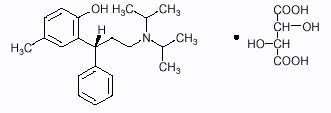
Tolterodine tartrate is a white, crystalline powder. The pKa value is 9.87 and the solubility in water is 12 mg/mL. It is soluble in methanol, slightly soluble in ethanol, and practically insoluble in toluene. The partition coefficient (Log D) between n-octanol and water is 1.83 at pH 7.3.
DETROL Tablets for oral administration contain 1 or 2 mg of tolterodine tartrate. The inactive ingredients are colloidal anhydrous silica, calcium hydrogen phosphate dihydrate, cellulose microcrystalline, hypromellose, magnesium stearate, sodium starch glycolate (pH 3.0 to 5.0), stearic acid, and titanium dioxide.
CLINICAL PHARMACOLOGY
Tolterodine is a competitive muscarinic receptor antagonist. Both urinary bladder contraction and salivation are mediated via cholinergic muscarinic receptors.
After oral administration, tolterodine is metabolized in the liver, resulting in the formation of the 5-hydroxymethyl derivative, a major pharmacologically active metabolite. The 5-hydroxymethyl metabolite, which exhibits an antimuscarinic activity similar to that of tolterodine, contributes significantly to the therapeutic effect. Both tolterodine and the 5-hydroxymethyl metabolite exhibit a high specificity for muscarinic receptors, since both show negligible activity or affinity for other neurotransmitter receptors and other potential cellular targets, such as calcium channels.
Tolterodine has a pronounced effect on bladder function. Effects on urodynamic parameters before and 1 and 5 hours after a single 6.4 mg dose of tolterodine immediate release were determined in healthy volunteers. The main effects of tolterodine at 1 and 5 hours were an increase in residual urine, reflecting an incomplete emptying of the bladder, and a decrease in detrusor pressure. These findings are consistent with an antimuscarinic action on the lower urinary tract.
Pharmacokinetics
Absorption
In a study with 14 C-tolterodine solution in healthy volunteers who received a 5 mg oral dose, at least 77% of the radiolabeled dose was absorbed. Tolterodine immediate release is rapidly absorbed, and maximum serum concentrations (C max ) typically occur within 1 to 2 hours after dose administration. C max and area under the concentration-time curve (AUC) determined after dosage of tolterodine immediate release are dose-proportional over the range of 1 to 4 mg.
Effect of Food
Food intake increases the bioavailability of tolterodine (average increase 53%), but does not affect the levels of the 5-hydroxymethyl metabolite in extensive metabolizers. This change is not expected to be a safety concern and adjustment of dose is not needed.
Distribution
Tolterodine is highly bound to plasma proteins, primarily α 1 -acid glycoprotein. Unbound concentrations of tolterodine average 3.7% ± 0.13% over the concentration range achieved in clinical studies. The 5-hydroxymethyl metabolite is not extensively protein bound, with unbound fraction concentrations averaging 36% ± 4.0%. The blood to serum ratio of tolterodine and the 5-hydroxymethyl metabolite averages 0.6 and 0.8, respectively, indicating that these compounds do not distribute extensively into erythrocytes. The volume of distribution of tolterodine following administration of a 1.28 mg intravenous dose is 113 ± 26.7 L.
Metabolism
Tolterodine is extensively metabolized by the liver following oral dosing. The primary metabolic route involves the oxidation of the 5-methyl group and is mediated by the cytochrome P450 2D6 (CYP2D6) and leads to the formation of a pharmacologically active 5-hydroxymethyl metabolite. Further metabolism leads to formation of the 5-carboxylic acid and N -dealkylated 5-carboxylic acid metabolites, which account for 51% ± 14% and 29% ± 6.3% of the metabolites recovered in the urine, respectively.
Variability in Metabolism
A subset (about 7%) of the population is devoid of CYP2D6, the enzyme responsible for the formation of the 5-hydroxymethyl metabolite of tolterodine. The identified pathway of metabolism for these individuals (“poor metabolizers”) is dealkylation via cytochrome P450 3A4 (CYP3A4) to N -dealkylated tolterodine. The remainder of the population is referred to as “extensive metabolizers.” Pharmacokinetic studies revealed that tolterodine is metabolized at a slower rate in poor metabolizers than in extensive metabolizers; this results in significantly higher serum concentrations of tolterodine and in negligible concentrations of the 5-hydroxymethyl metabolite.
Excretion
Following administration of a 5 mg oral dose of 14 C-tolterodine solution to healthy volunteers, 77% of radioactivity was recovered in urine and 17% was recovered in feces in 7 days. Less than 1% (<2.5% in poor metabolizers) of the dose was recovered as intact tolterodine, and 5% to 14% (<1% in poor metabolizers) was recovered as the active 5-hydroxymethyl metabolite.
A summary of mean (± standard deviation) pharmacokinetic parameters of tolterodine immediate release and the 5-hydroxymethyl metabolite in extensive (EM) and poor (PM) metabolizers is provided in Table 1. These data were obtained following single and multiple doses of tolterodine 4 mg administered twice daily to 16 healthy male volunteers (8 EM, 8 PM).
| Cmax = Maximum plasma concentration; tmax = Time of occurrence of Cmax; | |||||||||
| Cavg = Average plasma concentration; t1/2 = Terminal elimination half-life; CL/F = Apparent oral clearance. | |||||||||
| EM = Extensive metabolizers; PM = Poor metabolizers. | |||||||||
Tolterodine | 5-Hydroxymethyl Metabolite | ||||||||
Phenotype (CYP2D6) | t max (h) | C max Parameter was dose-normalized from 4 mg to 2 mg. (µg/L) | C avg (µg/L) | t 1/2 (h) | CL/F (L/h) | t max (h) | C max (µg/L) | C avg (µg/L) | t 1/2 (h) |
Single-dose EM PM | 1.6±1.5 1.4±0.5 | 1.6±1.2 10±4.9 | 0.50±0.35 8.3±4.3 | 2.0±0.7 6.5±1.6 | 534±697 17±7.3 | 1.8±1.4 = not applicable. | 1.8±0.7 | 0.62±0.26 | 3.1±0.7 |
Multiple-dose EM PM | 1.2±0.5 1.9±1.0 | 2.6±2.8 19±7.5 | 0.58±0.54 12±5.1 | 2.2±0.4 9.6±1.5 | 415±377 11±4.2 | 1.2±0.5 | 2.4±1.3 | 0.92±0.46 | 2.9±0.4 |
Pharmacokinetics in Special Populations
Age
In Phase 1, multiple-dose studies in which tolterodine immediate release 4 mg (2 mg bid) was administered, serum concentrations of tolterodine and of the 5-hydroxymethyl metabolite were similar in healthy elderly volunteers (aged 64 through 80 years) and healthy young volunteers (aged less than 40 years). In another Phase 1 study, elderly volunteers (aged 71 through 81 years) were given tolterodine immediate release 2 or 4 mg (1 or 2 mg bid). Mean serum concentrations of tolterodine and the 5-hydroxymethyl metabolite in these elderly volunteers were approximately 20% and 50% higher, respectively, than reported in young healthy volunteers. However, no overall differences were observed in safety between older and younger patients on tolterodine in Phase 3, 12-week, controlled clinical studies; therefore, no tolterodine dosage adjustment for elderly patients is recommended (see PRECAUTIONS, Geriatric Use ).
Pediatric
The pharmacokinetics of tolterodine have not been established in pediatric patients.
Gender
The pharmacokinetics of tolterodine immediate release and the 5-hydroxymethyl metabolite are not influenced by gender. Mean C max of tolterodine (1.6 µg/L in males versus 2.2 µg/L in females) and the active 5-hydroxymethyl metabolite (2.2 µg/L in males versus 2.5 µg/L in females) are similar in males and females who were administered tolterodine immediate release 2 mg. Mean AUC values of tolterodine (6.7 µg·h/L in males versus 7.8 µg·h/L in females) and the 5-hydroxymethyl metabolite (10 µg·h/L in males versus 11 µg·h/L in females) are also similar. The elimination half-life of tolterodine for both males and females is 2.4 hours, and the half-life of the 5-hydroxymethyl metabolite is 3.0 hours in females and 3.3 hours in males.
Race
Pharmacokinetic differences due to race have not been established.
Renal Insufficiency
Renal impairment can significantly alter the disposition of tolterodine immediate release and its metabolites. In a study conducted in patients with creatinine clearance between 10 and 30 mL/min, tolterodine immediate release and the 5-hydroxymethyl metabolite levels were approximately 2–3 fold higher in patients with renal impairment than in healthy volunteers. Exposure levels of other metabolites of tolterodine (e.g., tolterodine acid, N -dealkylated tolterodine acid, N -dealkylated tolterodine, and N -dealkylated hydroxylated tolterodine) were significantly higher (10–30 fold) in renally impaired patients as compared to the healthy volunteers. The recommended dosage for patients with significantly reduced renal function is DETROL 1 mg twice daily (see PRECAUTIONS, General and DOSAGE AND ADMINISTRATION ).
Hepatic Insufficiency
Liver impairment can significantly alter the disposition of tolterodine immediate release. In a study conducted in cirrhotic patients, the elimination half-life of tolterodine immediate release was longer in cirrhotic patients (mean, 7.8 hours) than in healthy, young, and elderly volunteers (mean, 2 to 4 hours). The clearance of orally administered tolterodine was substantially lower in cirrhotic patients (1.0 ± 1.7 L/h/kg) than in the healthy volunteers (5.7 ± 3.8 L/h/kg). The recommended dose for patients with significantly reduced hepatic function is DETROL 1 mg twice daily (see PRECAUTIONS, General and DOSAGE AND ADMINISTRATION ).
Drug-Drug Interactions
Fluoxetine
Fluoxetine is a selective serotonin reuptake inhibitor and a potent inhibitor of CYP2D6 activity. In a study to assess the effect of fluoxetine on the pharmacokinetics of tolterodine immediate release and its metabolites, it was observed that fluoxetine significantly inhibited the metabolism of tolterodine immediate release in extensive metabolizers, resulting in a 4.8-fold increase in tolterodine AUC. There was a 52% decrease in C max and a 20% decrease in AUC of the 5-hydroxymethyl metabolite. Fluoxetine thus alters the pharmacokinetics in patients who would otherwise be extensive metabolizers of tolterodine immediate release to resemble the pharmacokinetic profile in poor metabolizers. The sums of unbound serum concentrations of tolterodine immediate release and the 5-hydroxymethyl metabolite are only 25% higher during the interaction. No dose adjustment is required when DETROL and fluoxetine are coadministered.
Other Drugs Metabolized by Cytochrome P450 Isoenzymes
Tolterodine immediate release does not cause clinically significant interactions with other drugs metabolized by the major drug metabolizing CYP enzymes. In vivo drug-interaction data show that tolterodine immediate release does not result in clinically relevant inhibition of CYP1A2, 2D6, 2C9, 2C19, or 3A4 as evidenced by lack of influence on the marker drugs caffeine, debrisoquine, S-warfarin, and omeprazole. In vitro data show that tolterodine immediate release is a competitive inhibitor of CYP2D6 at high concentrations (Ki 1.05 µM), while tolterodine immediate release as well as the 5-hydroxymethyl metabolite are devoid of any significant inhibitory potential regarding the other isoenzymes.
CYP3A4 Inhibitors
The effect of 200 mg daily dose of ketoconazole on the pharmacokinetics of tolterodine immediate release was studied in 8 healthy volunteers, all of whom were poor metabolizers (see Pharmacokinetics, Variability in Metabolism for discussion of poor metabolizers). In the presence of ketoconazole, the mean C max and AUC of tolterodine increased by 2 and 2.5 fold, respectively. Based on these findings, other potent CYP3A inhibitors such as other azole antifungals (e.g., itraconazole, miconazole) or macrolide antibiotics (e.g., erythromycin, clarithromycin) or cyclosporine or vinblastine may also lead to increases of tolterodine plasma concentrations (see PRECAUTIONS and DOSAGE AND ADMINISTRATION ).
Warfarin
In healthy volunteers, coadministration of tolterodine immediate release 4 mg (2 mg bid) for 7 days and a single dose of warfarin 25 mg on day 4 had no effect on prothrombin time, Factor VII suppression, or on the pharmacokinetics of warfarin.
Oral Contraceptives
Tolterodine immediate release 4 mg (2 mg bid) had no effect on the pharmacokinetics of an oral contraceptive (ethinyl estradiol 30 µg/levonorgestrel 150 µg) as evidenced by the monitoring of ethinyl estradiol and levonorgestrel over a 2-month cycle in healthy female volunteers.
Diuretics
Coadministration of tolterodine immediate release up to 8 mg (4 mg bid) for up to 12 weeks with diuretic agents, such as indapamide, hydrochlorothiazide, triamterene, bendroflumethiazide, chlorothiazide, methylchlorothiazide, or furosemide, did not cause any adverse electrocardiographic (ECG) effects.
Cardiac Electrophysiology
The effect of 2 mg BID and 4 mg BID of tolterodine immediate release (IR) on the QT interval was evaluated in a 4-way crossover, double-blind, placebo- and active-controlled (moxifloxacin 400 mg QD) study in healthy male (N=25) and female (N=23) volunteers aged 18–55 years. Study subjects [approximately equal representation of CYP2D6 extensive metabolizers (EMs) and poor metabolizers (PMs)] completed sequential 4-day periods of dosing with moxifloxacin 400 mg QD, tolterodine 2 mg BID, tolterodine 4 mg BID, and placebo. The 4 mg BID dose of tolterodine IR (two times the highest recommended dose) was chosen because this dose results in tolterodine exposure similar to that observed upon coadministration of tolterodine 2 mg BID with potent CYP3A4 inhibitors in patients who are CYP2D6 poor metabolizers (see PRECAUTIONS, Drug Interactions ). QT interval was measured over a 12-hour period following dosing, including the time of peak plasma concentration (T max ) of tolterodine and at steady state (Day 4 of dosing).
Table 2 summarizes the mean change from baseline to steady state in corrected QT interval (QTc) relative to placebo at the time of peak tolterodine (1 hour) and moxifloxacin (2 hour) concentrations. Both Fridericia’s (QTcF) and a population-specific (QTcP) method were used to correct QT interval for heart rate. No single QT correction method is known to be more valid than others. QT interval was measured manually and by machine, and data from both are presented. The mean increase of heart rate associated with a 4 mg/day dose of tolterodine in this study was 2.0 beats/minute and 6.3 beats/minute with 8 mg/day tolterodine. The change in heart rate with moxifloxacin was 0.5 beats/minute.
Drug/Dose | N | QTcF (msec) (manual) | QTcF (msec) (machine) | QTcP (msec) (manual) | QTcP (msec) (machine) |
Tolterodine 2 mg BID At T max of 1 hr; 95% Confidence Interval | 48 | 5.01 (0.28, 9.74) | 1.16 (-2.99, 5.30) | 4.45 (-0.37, 9.26) | 2.00 (-1.81, 5.81) |
Tolterodine 4 mg BID | 48 | 11.84 (7.11, 16.58) | 5.63 (1.48, 9.77) | 10.31 (5.49, 15.12) | 8.34 (4.53, 12.15) |
Moxifloxacin 400 mg QD At T max of 2 hr; 90% Confidence Interval | 45 | 19.26 The effect on QT interval with 4 days of moxifloxacin dosing in this QT trial may be greater than typically observed in QT trials of other drugs. (15.49, 23.03) | 8.90 (4.77, 13.03) | 19.10 (15.32, 22.89) | 9.29 (5.34, 13.24) |
The reason for the difference between machine and manual read of QT interval is unclear.
The QT effect of tolterodine immediate release tablets appeared greater for 8 mg/day (two times the therapeutic dose) compared to 4 mg/day. The effect of tolterodine 8 mg/day was not as large as that observed after four days of therapeutic dosing with the active control moxifloxacin. However, the confidence intervals overlapped.
Tolterodine’s effect on QT interval was found to correlate with plasma concentration of tolterodine. There appeared to be a greater QTc interval increase in CYP2D6 poor metabolizers than in CYP2D6 extensive metabolizers after tolterodine treatment in this study.
This study was not designed to make direct statistical comparisons between drugs or dose levels. There has been no association of Torsade de Pointes in the international post-marketing experience with DETROL or DETROL LA (see PRECAUTIONS, Patients with Congenital or Acquired QT Prolongation ).
CLINICAL STUDIES
DETROL Tablets were evaluated for the treatment of overactive bladder with symptoms of urge urinary incontinence, urgency, and frequency in four randomized, double-blind, placebo-controlled, 12-week studies. A total of 853 patients received DETROL 2 mg twice daily and 685 patients received placebo. The majority of patients were Caucasian (95%) and female (78%), with a mean age of 60 years (range, 19 to 93 years). At study entry, nearly all patients perceived they had urgency and most patients had increased frequency of micturitions and urge incontinence. These characteristics were well balanced across treatment groups for the studies.
The efficacy endpoints for study 007 (see Table 3) included the change from baseline for:
- Number of incontinence episodes per week
- Number of micturitions per 24 hours (averaged over 7 days)
- Volume of urine voided per micturition (averaged over 2 days)
The efficacy endpoints for studies 008, 009, and 010 (see Table 4) were identical to the above endpoints with the exception that the number of incontinence episodes was per 24 hours (averaged over 7 days).
| SD = Standard Deviation. | |||
DETROL (SD) N=514 | Placebo (SD) N=508 | Difference (95% CI) | |
Number of Incontinence Episodes per Week Mean baseline Mean change from baseline | 23.2 -10.6 (17) | 23.3 -6.9 (15) | -3.7 (-5.7, -1.6) |
Number of Micturitions per 24 Hours Mean baseline Mean change from baseline | 11.1 -1.7 (3.3) | 11.3 -1.2 (2.9) | -0.5 The difference between DETROL and placebo was statistically significant. (-0.9, -0.1) |
Volume Voided per Micturition (mL) Mean baseline Mean change from baseline | 137 29 (47) | 136 14 (41) | 15(9, 21) |
| SD = Standard Deviation. | ||||
Study | DETROL (SD) | Placebo (SD) | Difference (95% CI) | |
Number of Incontinence Episodes per 24 Hours | ||||
008 | Number of patients Mean baseline Mean change from baseline | 93 2.9 -1.3 (3.2) | 40 3.3 -0.9 (1.5) | 0.5 (-1.3,0.3) |
009 | Number of patients Mean baseline Mean change from baseline | 116 3.6 -1.7 (2.5) | 55 3.5 -1.3 (2.5) | -0.4 (-1.0,0.2) |
010 | Number of patients Mean baseline Mean change from baseline | 90 3.7 -1.6 (2.4) | 50 3.5 -1.1 (2.1) | -0.5 (-1.1,0.1) |
Number of Micturitions per 24 Hours | ||||
008 | Number of patients Mean baseline Mean change from baseline | 118 11.5 -2.7 (3.8) | 56 11.7 -1.6 (3.6) | -1.2 The difference between DETROL and placebo was statistically significant. (-2.0,-0.4) |
009 | Number of patients Mean baseline Mean change from baseline | 128 11.2 -2.3 (2.1) | 64 11.3 -1.4 (2.8) | -0.9(-1.5,-0.3) |
010 | Number of patients Mean baseline Mean change from baseline | 108 11.6 -1.7 (2.3) | 56 11.6 -1.4 (2.8) | -0.38 (-1.1,0.3) |
Volume Voided per Micturition (mL) | ||||
008 | Number of patients Mean baseline Mean change from baseline | 118 166 38 (54) | 56 157 6 (42) | 32(18,46) |
009 | Number of patients Mean baseline Mean change from baseline | 129 155 36 (50) | 64 158 10 (47) | 26(14,38) |
010 | Number of patients Mean baseline Mean change from baseline | 108 155 31 (45) | 56 160 13 (52) | 18(4,32) |
HOW SUPPLIED
DETROL Tablets 1 mg (white, round, biconvex, film-coated tablets engraved with arcs above and below the letters “TO”) and DETROL Tablets 2 mg (white, round, biconvex, film-coated tablets engraved with arcs above and below the letters “DT”) are supplied as follows:
Bottles of 60 1 mg NDC 58151-098-91 2 mg NDC 58151-099-91
Store at 25ºC (77ºF); excursions permitted to 15–30ºC (59–86ºF) [see USP Controlled Room Temperature] (DTL).
Distributed by: Viatris Specialty LLC Morgantown, WV 26505 U.S.A.
Made in Italy
© 2023 Viatris Inc.
DETROL is a registered trademark of Viatris Specialty LLC, a Viatris Company.
The brands listed are trademarks of their respective owners.
UPJ:DTRLT:R1
Revised: 2/2023
