Get your patient on Dermacinrx Phn Pak (Lidocaine)
Dermacinrx Phn Pak prescribing information

INDICATION AND USAGE
HIGHLIGHTS OF PRESCRIBING INFORMATION These highlights do not include all the information needed to use Lidocaine patch 5% safely and effectively. See full prescribing information for Lidocaine patch 5%.
Lidocaine patch 5% is indicated for relief of pain associated with post-herpetic neuralgia. It should be applied only to intact skin.
Lidocaine patch 5% is indicated for relief of pain associated with post-herpetic neuralgia. It should be applied only to intact skin.
DOSAGE AND ADMINISTRATION
Apply lidocaine patch 5% to intact skin to cover the most painful area. Apply the prescribed number of patches (maximum of 3), only once for up to 12 hours within a 24-hour period. Patches may be cut into smaller sizes with scissors prior to removal of the release liner. (See HANDLING AND DISPOSAL) Clothing may be worn over the area of application. Smaller areas of treatment are recommended in a debilitated patient, or a patient with impaired elimination.
If irritation or a burning sensation occurs during application, remove the patch(es) and do not reapply until the irritation subsides.
When lidocaine patch 5% is used concomitantly with other products containing local anesthetic agents, the amount absorbed from all formulations must be considered.
Lidocaine patch 5% may not stick if it gets wet. Avoid contact with water, such as bathing, swimming or showering.
CONTRAINDICATIONS
Lidocaine patch 5% is contraindicated in patients with a known history of sensitivity to local anesthetics of the amide type, or to any other component of the product.
ADVERSE REACTIONS
Drug Interactions
Antiarrhythmic Drugs: Lidocaine patch 5% should be used with caution in patients receiving Class I antiarrhythmic drugs (such as tocainide and mexiletine) since the toxic effects are additive and potentially synergistic.
Local Anesthetics : When lidocaine patch 5% is used concomitantly with other products containing local anesthetic agents, the amount absorbed from all formulations must be considered.
DESCRIPTION
Lidocaine patch 5% is comprised of an adhesive material containing 5% lidocaine, which is applied to a white non-woven polyethylene terephthalate (PET) material backing and covered with a transparent PET release liner. The release liner is removed prior to application to the skin. The size of the patch is 10 cm x 14 cm. Lidocaine is chemically designated as acetamide, 2-(diethylamino)-N-(2,6-dimethylphenyl), has an octanol:water partition ratio of 43 at pH 7.4, and has the following structure:
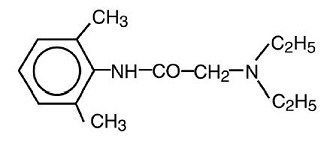
Each adhesive patch contains 700 mg of lidocaine (50 mg per gram adhesive) in an aqueous base. It also contains the following inactive ingredients: glycerin, D-sorbitol, propylene glycol, polyvinyl alcohol, urea, sodium polyacrylate, carboxymethylcellulose sodium, gelatin, polyacrylic acid, kaolin, tartaric acid, dihydroxyaluminum aminoacetate, methylparaben, propylparaben, and edetate disodium.
CLINICAL PHARMACOLOGY
CLINICAL STUDIES
Single-dose treatment with lidocaine patch was compared to treatment with vehicle patch (without lidocaine), and to no treatment (observation only) in a double-blind, crossover clinical trial with 35 post-herpetic neuralgia patients. Pain intensity and pain relief scores were evaluated periodically for 12 hours. Lidocaine patch performed statistically better than vehicle patch in terms of pain intensity from 4 to 12 hours.
Multiple-dose, two-week treatment with lidocaine patch was compared to vehicle patch (without lidocaine) in a double-blind, crossover clinical trial of withdrawal-type design conducted in 32 patients, who were considered as responders to the open-label use of lidocaine patch prior to the study. The constant type of pain was evaluated but not the pain induced by sensory stimuli (dysesthesia). Statistically significant differences favoring lidocaine patch were observed in terms of time to exit from the trial (14 versus 3.8 days at p-value <0.001), daily average pain relief, and patient’s preference of treatment. About half of the patients also took oral medication commonly used in the treatment of post-herpetic neuralgia. The extent of use of concomitant medication was similar in the two treatment groups.
HOW SUPPLIED
Lidocaine patch 5% is available as the following:
Carton of 15 patches, NDC 59088-396-82 Carton of 30 patches, NDC 59088-396-54
Each patch is packaged into an individual child-resistant envelope (NDC 59088-396-84).
Store at 20o to 25oC (68o to 77oF) [See USP Controlled Room Temperature].
For more information, call Actavis at 1-800-272-5525.
Manufactured by: Actavis Laboratories UT, Inc. Salt Lake City, UT 84108 USA
Distributed by: PureTek Corporation San Fernando, CA 91340 USA
Rev. 37780 02/16
