Get your patient on Clobetasol Propionate - Clobetasol Propionate solution (Clobetasol Propionate)
Clobetasol Propionate - Clobetasol Propionate solution prescribing information

INDICATIONS AND USAGE
Clobetasol Propionate Topical Solution USP, 0.05% is indicated for short-term topical treatment of inflammatory and pruritic manifestations of moderate to severe corticosteroid-responsive dermatoses of the scalp. Treatment beyond 2 consecutive weeks is not recommended, and the total dosage should not exceed 50 mL/week because of the potential for the drug to suppress the HPA axis.
This product is not recommended for use in pediatric patients under 12 years of age.
DOSAGE AND ADMINISTRATION
Clobetasol propionate topical solution should be applied to the affected scalp areas twice daily, once in the morning and once at night.
Clobetasol propionate topical solution is potent; therefore, treatment must be limited to 2 consecutive weeks and amounts greater than 50 mL/week should not be used.
Clobetasol propionate topical solution is not to be used with occlusive dressings.
Geriatric Use: In studies where geriatric patients (65 years of age or older, see PRECAUTIONS ) have been treated with clobetasol propionate topical solution, safety did not differ from that in younger patients; therefore, no dosage adjustment is recommended.
CONTRAINDICATIONS
Clobetasol propionate topical solution is contraindicated in patients with primary infections of the scalp, or in patients who are hypersensitive to clobetasol propionate, other corticosteroids, or any ingredient in this preparation.
ADVERSE REACTIONS
Clobetasol propionate topical solution is generally well tolerated when used for 2-week treatment periods.
The most frequent adverse events reported for clobetasol propionate topical solution have been local and have included burning and/or stinging sensation, which occurred in 29 of 294 patients; scalp pustules, which occurred in 3 of 294 patients; and tingling and folliculitis, each of which occurred in 2 of 294 patients. Less frequent adverse events were itching and tightness of the scalp, dermatitis, tenderness, headache, hair loss, and eye irritation, each of which occurred in 1 of 294 patients.
The following local adverse reactions are reported infrequently when topical corticosteroids are used as recommended. These reactions are listed in an approximately decreasing order of occurrence: burning, itching, irritation, dryness, folliculitis, hypertrichosis, acneiform eruptions, hypopigmentation, perioral dermatitis, allergic contact dermatitis, maceration of the skin, secondary infection, skin atrophy, striae, and miliaria. Systemic absorption of topical corticosteroids has produced reversible HPA axis suppression, manifestations of Cushing syndrome, hyperglycemia, and glucosuria in some patients. In rare instances, treatment (or withdrawal of treatment) of psoriasis with corticosteroids is thought to have exacerbated the disease or provoked the pustular form of the disease, so careful patient supervision is recommended.
To report SUSPECTED ADVERSE REACTIONS, contact Alembic Pharmaceuticals, Inc. at 1-866-210-9797 or FDA at 1-800-FDA-1088 or www.fda.gov/medwatch .
DESCRIPTION
Clobetasol Propionate Topical Solution USP, 0.05% contains the active compound clobetasol propionate, a synthetic corticosteroid, for topical dermatologic use. Clobetasol, an analog of prednisolone, has a high degree of glucocorticoid activity and a slight degree of mineralocorticoid activity.
Chemically, clobetasol propionate is (11β,16β)-21-chloro-9-fluoro-11-hydroxy-16-methyl-17-(1-oxopropoxy) pregna-1,4-diene-3,20-dione, and it has the following structural formula:
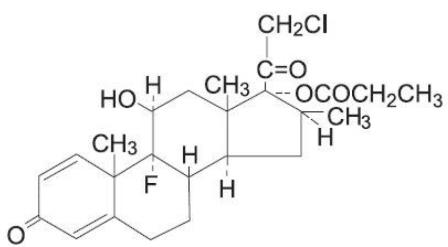
Clobetasol propionate has the molecular formula C 25 H 32 CIFO 5 and a molecular weight of 467. It is a white to cream-colored crystalline powder insoluble in water.
Clobetasol Propionate Topical Solution USP, 0.05% contains clobetasol propionate 0.5 mg/g in a base of carbopol 974P, isopropyl alcohol (39.3% w/w), purified water, and sodium hydroxide.
CLINICAL PHARMACOLOGY
The corticosteroids are a class of compounds comprising steroid hormones secreted by the adrenal cortex and their synthetic analogs. In pharmacologic doses, corticosteroids are used primarily for their anti-inflammatory and/or immunosuppressive effects. Topical corticosteroids such as clobetasol propionate are effective in the treatment of corticosteroid-responsive dermatoses primarily because of their anti-inflammatory, antipruritic, and vasoconstrictive actions. However, while the physiologic, pharmacologic, and clinical effects of the corticosteroids are well known, the exact mechanisms of their actions in each disease are uncertain.
Clobetasol propionate, a corticosteroid, has been shown to have topical (dermatologic) and systemic pharmacologic and metabolic effects characteristic of this class of drugs.
Pharmacokinetics
The extent of percutaneous absorption of topical corticosteroids, including clobetasol propionate, is determined by many factors, including the vehicle, the integrity of the epidermal barrier, and the use of occlusive dressings (see DOSAGE AND ADMINISTRATION ).
As with all topical corticosteroids, clobetasol propionate can be absorbed from normal intact skin. Inflammation and/or other disease processes in the skin may increase percutaneous absorption. Occlusive dressings substantially increase the percutaneous absorption of topical corticosteroids (see DOSAGE AND ADMINISTRATION ).
Once absorbed through the skin, topical corticosteroids enter pharmacokinetic pathways similarly to systemically administered corticosteroids. Corticosteroids are bound to plasma proteins in varying degrees. Corticosteroids are metabolized primarily in the liver and are then excreted by the kidneys. Some of the topical corticosteroids, including clobetasol propionate and its metabolites, are also excreted into the bile.
Following repeated nonocclusive application in the treatment of scalp psoriasis, there is some evidence that clobetasol propionate topical solution has the potential to depress plasma cortisol levels in some patients. However, hypothalamic-pituitary-adrenal (HPA) axis effects produced by systemically absorbed clobetasol propionate have been shown to be transient and reversible upon completion of a 2-week course of treatment.
HOW SUPPLIED
Clobetasol Propionate Topical Solution USP, 0.05% is supplied in white opaque oval shape bottles,
25 mL (NDC 62332-486-25), and
50 mL (NDC 62332-486-50)
