Claravis - Isotretinoin capsule, Liquid Filled prescribing information

CONTRAINDICATIONS AND WARNINGS
Claravis ™ must not be used by patients who are or may become pregnant. There is an extremely high risk that life-threatening birth defects will result if pregnancy occurs while taking Claravis in any amount, even for short periods of time. Potentially any fetus exposed during pregnancy can be affected. There are no accurate means of determining whether an exposed fetus has been affected.
Birth defects which have been documented following isotretinoin exposure include abnormalities of the face, eyes, ears, skull, central nervous system, cardiovascular system, and thymus and parathyroid glands. Cases of IQ scores less than 85 with or without other abnormalities have been reported. There is an increased risk of spontaneous abortion, and premature births have been reported.
Documented external abnormalities include: skull abnormality; ear abnormalities (including anotia, micropinna, small or absent external auditory canals); eye abnormalities (including microphthalmia); facial dysmorphia; cleft palate. Documented internal abnormalities include: CNS abnormalities (including cerebral abnormalities, cerebellar malformation, hydrocephalus, microcephaly, cranial nerve deficit); cardiovascular abnormalities; thymus gland abnormality; parathyroid hormone deficiency. In some cases death has occurred with certain of the abnormalities previously noted.
If pregnancy does occur during treatment of a patient who is taking Claravis, Claravis must be discontinued immediately and the patient should be referred to an Obstetrician-Gynecologist experienced in reproductive toxicity for further evaluation and counseling.
Special Prescribing Requirements
Because of isotretinoin's teratogenicity and to minimize fetal exposure, Claravis is approved for marketing only under a special restricted distribution program approved by the Food and Drug Administration. This REMS is called iPLEDGE ® . Claravis must only be prescribed by prescribers who are enrolled and activated with the iPLEDGE REMS. Claravis must only be dispensed by a pharmacy enrolled and activated with iPLEDGE, and must only be dispensed to patients who are enrolled and meet all the requirements of iPLEDGE (see PRECAUTIONS ).
INDICATIONS AND USAGE
Severe Recalcitrant Nodular Acne
Claravis (isotretinoin capsules) is indicated for the treatment of severe recalcitrant nodular acne. Nodules are inflammatory lesions with a diameter of 5 mm or greater. The nodules may become suppurative or hemorrhagic. “Severe,” by definition, 2 means “many” as opposed to “few or several” nodules. Because of significant adverse effects associated with its use, Claravis should be reserved for patients with severe nodular acne who are unresponsive to conventional therapy, including systemic antibiotics. In addition, Claravis is indicated only for those patients who are not pregnant, because Claravis can cause life threatening birth defects (see Boxed CONTRAINDICATIONS AND WARNINGS ).
A single course of therapy for 15 to 20 weeks has been shown to result in complete and prolonged remission of disease in many patients. 1,3,4 If a second course of therapy is needed, it should not be initiated until at least 8 weeks after completion of the first course, because experience has shown that patients may continue to improve while off Claravis. The optimal interval before retreatment has not been defined for patients who have not completed skeletal growth (see WARNINGS, Skeletal, Bone Mineral Density , Hyperostosis, Premature Epiphyseal Closure ).
DOSAGE AND ADMINISTRATION
Claravis should be administered with a meal (see PRECAUTIONS, Information for Patients ).
The recommended dosage range for Claravis is 0.5 to 1 mg/kg/day given in two divided doses with food for 15 to 20 weeks. In studies comparing 0.1, 0.5, and 1 mg/kg/day 8 , it was found that all dosages provided initial clearing of disease, but there was a greater need for retreatment with the lower dosages. During treatment, the dose may be adjusted according to response of the disease and/or the appearance of clinical side effects – some of which may be dose related. Adult patients whose disease is very severe with scarring or is primarily manifested on the trunk may require dose adjustments up to 2 mg/kg/day, as tolerated. Failure to take Claravis with food will significantly decrease absorption. Before upward dose adjustments are made, the patients should be questioned about their compliance with food instructions.
The safety of once daily dosing with Claravis has not been established. Once daily dosing is not recommended.
If the total nodule count has been reduced by more than 70% prior to completing 15 to 20 weeks of treatment, the drug may be discontinued. After a period of 2 months or more off therapy, and if warranted by persistent or recurring severe nodular acne, a second course of therapy may be initiated. The optimal interval before retreatment has not been defined for patients who have not completed skeletal growth. Long-term use of Claravis, even in low doses, has not been studied, and is not recommended. It is important that Claravis be given at the recommended doses for no longer than the recommended duration. The effect of long-term use of Claravis on bone loss is unknown (see WARNINGS, Skeletal, Bone Mineral Density , Hyperostosis , and Premature Epiphyseal Closure ).
Contraceptive measures must be followed for any subsequent course of therapy (see PRECAUTIONS ).
Body Weight | Total mg/day | |||
kilograms | pounds | 0.5 mg/kg | 1 mg/kg | 2 mg/kg• |
40 | 88 | 20 | 40 | 80 |
50 | 110 | 25 | 50 | 100 |
60 | 132 | 30 | 60 | 120 |
70 | 154 | 35 | 70 | 140 |
80 | 176 | 40 | 80 | 160 |
90 | 198 | 45 | 90 | 180 |
100 | 220 | 50 | 100 | 200 |
•See DOSAGE AND ADMINISTRATION : the recommended dosage range is 0.5 to 1 mg/kg/day.
INFORMATION FOR PHARMACISTS
Access the iPLEDGE REMS system via the internet (www.ipledgeprogram.com) or telephone (1-866-495-0654) to obtain an authorization and the “ do not dispense to patient after” date. Claravis must only be dispensed in no more than a 30-day supply.
REFILLS REQUIRE A NEW PRESCRIPTION AND A NEW AUTHORIZATION FROM THE iPLEDGE SYSTEM.
A Claravis Medication Guide must be given to the patient each time Claravis is dispensed, as required by law. This Claravis Medication Guide is an important part of the risk management program for the patient.
CONTRAINDICATIONS
Pregnancy: Category X. See Boxed CONTRAINDICATIONS AND WARNINGS .
Allergic Reactions
Claravis is contraindicated in patients who are hypersensitive to this medication or to any of its components (see PRECAUTIONS, Hypersensitivity ).
ADVERSE REACTIONS
Clinical Trials and Postmarketing Surveillance
The adverse reactions listed below reflect the experience from investigational studies of Claravis, and the postmarketing experience. The relationship of some of these events to Claravis therapy is unknown. Many of the side effects and adverse reactions seen in patients receiving Claravis are similar to those described in patients taking very high doses of vitamin A (dryness of the skin and mucous membranes, e.g., of the lips, nasal passage, and eyes).
Dose Relationship
Cheilitis and hypertriglyceridemia are usually dose related. Most adverse reactions reported in clinical trials were reversible when therapy was discontinued; however, some persisted after cessation of therapy (see WARNINGS and ADVERSE REACTIONS ).
Body as a Whole allergic reactions, including vasculitis, systemic hypersensitivity (see PRECAUTIONS, Hypersensitivity ), edema, fatigue, lymphadenopathy, weight loss.
Cardiovascular palpitation, tachycardia, vascular thrombotic disease, stroke.
Endocrine/Metabolic hypertriglyceridemia (see WARNINGS, Lipids ), alterations in blood sugar levels (see PRECAUTIONS, Laboratory Tests ).
Gastrointestinal inflammatory bowel disease (see WARNINGS, Inflammatory Bowel Disease ), hepatitis (see WARNINGS, Hepatotoxicity ), pancreatitis (see WARNINGS, Lipids ), bleeding and inflammation of the gums, colitis, esophagitis/esophageal ulceration, ileitis, nausea, other nonspecific gastrointestinal symptoms.
Hematologic allergic reactions (see PRECAUTIONS, Hypersensitivity ), anemia, thrombocytopenia, neutropenia, rare reports of agranulocytosis (see PRECAUTIONS, Information for Patients ). See PRECAUTIONS, Laboratory Tests for other hematological parameters.
Musculoskeletal skeletal hyperostosis, calcification of tendons and ligaments, premature epiphyseal closure, decreases in bone mineral density (see WARNINGS, Skeletal ), musculoskeletal symptoms (sometimes severe) including back pain, myalgia, and arthralgia (see PRECAUTIONS, Information for Patients ), transient pain in the chest (see PRECAUTIONS, Information for Patients ), arthritis, tendonitis, other types of bone abnormalities, elevations of CPK/rare reports of rhabdomyolysis (see PRECAUTIONS, Laboratory Tests ).
Neurological pseudotumor cerebri (see WARNINGS, Pseudotumor Cerebri ), dizziness, drowsiness, headache, insomnia, lethargy, malaise, nervousness, paresthesias, seizures, stroke, syncope, weakness.
Psychiatric suicidal ideation, suicide attempts, suicide, depression, psychosis, aggression, violent behaviors (see WARNINGS, Psychiatric Disorders ), emotional instability. Of the patients reporting depression, some reported that the depression subsided with discontinuation of therapy and recurred with reinstitution of therapy.
Reproductive System abnormal menses.
Respiratory bronchospasms (with or without a history of asthma), respiratory infection, voice alteration.
Skin and Appendages acne fulminans, alopecia (which in some cases persists), bruising, cheilitis (dry lips), dry mouth, dry nose, dry skin, epistaxis, eruptive xanthomas, 7 erythema multiforme, flushing, fragility of skin, hair abnormalities, hirsutism, hyperpigmentation and hypopigmentation, infections (including disseminated herpes simplex), nail dystrophy, paronychia, peeling of palms and soles, photoallergic/photosensitizing reactions, pruritus, pyogenic granuloma, rash (including facial erythema, seborrhea, and eczema), Stevens-Johnson syndrome, sunburn susceptibility increased, sweating, toxic epidermal necrolysis, urticaria, vasculitis (including Wegener's granulomatosis; see PRECAUTIONS, Hypersensitivity ), abnormal wound healing (delayed healing or exuberant granulation tissue with crusting; see PRECAUTIONS, Information for Patients ).
Special Senses
Hearing hearing impairment (see WARNINGS, Hearing Impairment ), tinnitus.
Vision corneal opacities (see WARNINGS, Corneal Opacities ), decreased night vision which may persist (see WARNINGS, Decreased Night Vision ), cataracts, color vision disorder, conjunctivitis, dry eyes, eyelid inflammation, keratitis, optic neuritis, photophobia, visual disturbances.
Urinary System glomerulonephritis (see PRECAUTIONS, Hypersensitivity ), nonspecific urogenital findings (see PRECAUTIONS, Laboratory Tests for other urological parameters).
Laboratory
Elevation of plasma triglycerides (see WARNINGS, Lipids ), decrease in serum high-density lipoprotein (HDL) levels, elevations of serum cholesterol during treatment.
Increased alkaline phosphatase, SGOT (AST), SGPT (ALT), GGTP or LDH (see WARNINGS, Hepatotoxicity ).
Elevation of fasting blood sugar, elevations of CPK (see PRECAUTIONS, Laboratory Tests ), hyperuricemia.
Decreases in red blood cell parameters, decreases in white blood cell counts (including severe neutropenia and rare reports of agranulocytosis; see PRECAUTIONS, Information for Patients ), elevated sedimentation rates, elevated platelet counts, thrombocytopenia.
White cells in the urine, proteinuria, microscopic or gross hematuria.
Drug Interactions
- Vitamin A : Because of the relationship of Claravis to vitamin A, patients should be advised against taking vitamin supplements containing vitamin A to avoid additive toxic effects.
- Tetracyclines : Concomitant treatment with Claravis and tetracyclines should be avoided because Claravis use has been associated with a number of cases of pseudotumor cerebri (benign intracranial hypertension), some of which involved concomitant use of tetracyclines.
- Micro-dosed Progesterone Preparations : Micro-dosed progesterone preparations (“minipills” that do not contain an estrogen) may be an inadequate method of contraception during Claravis therapy. Although other hormonal contraceptives are highly effective, there have been reports of pregnancy from patients who can become pregnant who have used combined oral contraceptives, as well as transdermal patch/injectable/implantable/vaginal ring hormonal birth control products. These reports are more frequent for patients who can become pregnant who use only a single form of contraception. It is not known if hormonal contraceptives differ in their effectiveness when used with Claravis. Therefore, it is critically important for patients who can become pregnant to select and commit to use two forms of effective contraception simultaneously, at least one of which must be a primary form (see PRECAUTIONS ).
- Norethindrone/ethinyl estradiol : In a study of 31 premenopausal female patients with severe recalcitrant nodular acne receiving Ortho-Novum ® 7/7/7 Tablets as an oral contraceptive agent, Claravis at the recommended dose of 1 mg/kg/day, did not induce clinically relevant changes in the pharmacokinetics of ethinyl estradiol and norethindrone and in the serum levels of progesterone, follicle-stimulating hormone (FSH) and luteinizing hormone (LH). Prescribers are advised to consult the package insert of medication administered concomitantly with hormonal contraceptives, since some medications may decrease the effectiveness of these birth control products.
- St. John’s Wort : Claravis use is associated with depression in some patients (see WARNINGS, Psychiatric Disorders and ADVERSE REACTIONS , Psychiatric ). Patients should be prospectively cautioned not to self-medicate with the herbal supplement St. John’s Wort because a possible interaction has been suggested with hormonal contraceptives based on reports of breakthrough bleeding on oral contraceptives shortly after starting St. John’s Wort. Pregnancies have been reported by users of combined hormonal contraceptives who also used some form of St. John’s Wort.
- Phenytoin : Claravis has not been shown to alter the pharmacokinetics of phenytoin in a study in seven healthy volunteers. These results are consistent with the in vitro finding that neither isotretinoin nor its metabolites induce or inhibit the activity of the CYP 2C9 human hepatic P450 enzyme. Phenytoin is known to cause osteomalacia. No formal clinical studies have been conducted to assess if there is an interactive effect on bone loss between phenytoin and Claravis. Therefore, caution should be exercised when using these drugs together.
- Systemic Corticosteroids : Systemic corticosteroids are known to cause osteoporosis. No formal clinical studies have been conducted to assess if there is an interactive effect on bone loss between systemic corticosteroids and Claravis. Therefore, caution should be exercised when using these drugs together.
DESCRIPTION
Isotretinoin, USP a retinoid, is available as Claravis ™ (isotretinoin capsules USP), in 10 mg, 20 mg, 30 mg and 40 mg hard gelatin capsules for oral administration. Chemically, isotretinoin is 13- cis -retinoic acid and is related to both retinoic acid and retinol (vitamin A). It is a yellow to orange crystalline powder. The structural formula is:
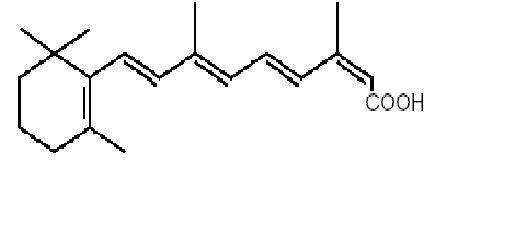
C 20 H 28 O 2 Molecular Weight: 300.44
Each capsule contains the following inactive ingredients: butylated hydroxyanisole, edetate disodium, gelatin, hydrogenated vegetable oil, polysorbate 80, soybean oil, titanium dioxide, white wax (beeswax), and vitamin E.
In addition, the 10 mg capsule contains black iron oxide and FD&C yellow no. 6. The 20 mg capsule contains black iron oxide, red iron oxide and yellow iron oxide. The 30 mg capsule contains red iron oxide and yellow iron oxide. The 40 mg capsule contains FD&C yellow no. 6.
The edible imprinting ink contains: 10 mg strength, D&C red no. 7 calcium lake, FD&C yellow no. 6 aluminum lake, propylene glycol, shellac glaze, and titanium dioxide; 20 mg strength, ammonium hydroxide, propylene glycol, shellac glaze, simethicone and titanium dioxide; 30 mg strength, D&C yellow no. 10 aluminum lake, FD&C blue no.1 aluminum lake, FD&C blue no. 2 aluminum lake, FD&C red no. 40 aluminum lake, iron oxide black, propylene glycol, and shellac glaze; 40 mg strength, ammonium hydroxide, iron oxide black, propylene glycol, and shellac glaze.
Meets dissolution test 2.
CLINICAL PHARMACOLOGY
Isotretinoin is a retinoid, which when administered in pharmacologic dosages of 0.5 to 1 mg/kg/day (see DOSAGE AND ADMINISTRATION ), inhibits sebaceous gland function and keratinization. The exact mechanism of action of isotretinoin is unknown.
Nodular Acne
Clinical improvement in nodular acne patients occurs in association with a reduction in sebum secretion. The decrease in sebum secretion is temporary and is related to the dose and duration of treatment with Claravis, and reflects a reduction in sebaceous gland size and an inhibition of sebaceous gland differentiation. 1
Pharmacokinetics
Absorption
Due to its high lipophilicity, oral absorption of isotretinoin is enhanced when given with a high-fat meal. In a crossover study, 74 healthy adult subjects received a single 80 mg oral dose (2 x 40 mg capsules) of Claravis under fasted and fed conditions. Both peak plasma concentration (C max ) and the total exposure (AUC) of isotretinoin were more than doubled following a standardized high-fat meal when compared with Claravis given under fasted conditions (see Table 2 ). The observed elimination half-life was unchanged. This lack of change in half-life suggests that food increases the bioavailability of isotretinoin without altering its disposition. The time to peak concentration (T max ) was also increased with food and may be related to a longer absorption phase. Therefore, Claravis capsules should always be taken with food (see DOSAGE AND ADMINISTRATION ). Clinical studies have shown that there is no difference in the pharmacokinetics of isotretinoin between patients with nodular acne and healthy subjects with normal skin.
Claravis 2 x 40 mg Capsules | AUC 0-∞ (ng • hr/mL) | C max (ng/mL) | T max (hr) | t ½ (hr) |
Fed Eating a standardized high-fat meal. | 10,004 (22%) | 862 (22%) | 5.3 (77%) | 21 (39%) |
Fasted | 3,703 (46%) | 301 (63%) | 3.2 (56%) | 21 (30%) |
Distribution
Isotretinoin is more than 99.9% bound to plasma proteins, primarily albumin.
Metabolism
Following oral administration of isotretinoin, at least three metabolites have been identified in human plasma: 4- oxo -isotretinoin, retinoic acid (tretinoin), and 4- oxo -retinoic acid (4- oxo -tretinoin). Retinoic acid and 13- cis -retinoic acid are geometric isomers and show reversible interconversion. The administration of one isomer will give rise to the other. Isotretinoin is also irreversibly oxidized to 4- oxo -isotretinoin, which forms its geometric isomer 4- oxo -tretinoin.
After a single 80 mg oral dose of isotretinoin to 74 healthy adult subjects, concurrent administration of food increased the extent of formation of all metabolites in plasma when compared to the extent of formation under fasted conditions.
All of these metabolites possess retinoid activity that is in some in vitro models more than that of the parent isotretinoin. However, the clinical significance of these models is unknown. After multiple oral dose administration of isotretinoin to adult cystic acne patients (≥18 years), the exposure of patients to 4- oxo -isotretinoin at steady-state under fasted and fed conditions was approximately 3.4 times higher than that of isotretinoin.
In vitro studies indicate that the primary P450 isoforms involved in isotretinoin metabolism are 2C8, 2C9, 3A4, and 2B6. Isotretinoin and its metabolites are further metabolized into conjugates, which are then excreted in urine and feces.
Elimination
Following oral administration of an 80 mg dose of 14 C-isotretinoin as a liquid suspension, 14 C-activity in blood declined with a half-life of 90 hours. The metabolites of isotretinoin and any conjugates are ultimately excreted in the feces and urine in relatively equal amounts (total of 65% to 83%). After a single 80 mg oral dose of isotretinoin to 74 healthy adult subjects under fed conditions, the mean ± SD elimination half-lives (t ½ ) of isotretinoin and 4- oxo -isotretinoin were 21 ± 8.2 hours and 24 ± 5.3 hours, respectively. After both single and multiple doses, the observed accumulation ratios of isotretinoin ranged from 0.9 to 5.43 in patients with cystic acne.
Special Patient Populations
Pediatric Patients
The pharmacokinetics of isotretinoin were evaluated after single and multiple doses in 38 pediatric patients (12 to 15 years) and 19 adult patients (≥18 years) who received isotretinoin for the treatment of severe recalcitrant nodular acne. In both age groups, 4- oxo -isotretinoin was the major metabolite; tretinoin and 4- oxo -tretinoin were also observed. The dose-normalized pharmacokinetic parameters for isotretinoin following single and multiple doses are summarized in Table 3 for pediatric patients. There were no statistically significant differences in the pharmacokinetics of isotretinoin between pediatric and adult patients.
Parameter | Isotretinoin (Single Dose) | Isotretinoin (Steady-State) |
C max (ng/mL) | 573.25 (278.79) | 731.98 (361.86) |
AUC (0 to 12) (ng·hr/mL) | 3033.37 (1394.17) | 5082 (2184.23) |
AUC (0 to 24) (ng·hr/mL) | 6003.81 (2885.67) | -- |
T max (hr) Median (range) | 6 (1 to 24.6) | 4 (0 to 12) |
C SSmin (ng/mL) | -- | 352.32 (184.44) |
T ½ (hr) | -- | 15.69 (5.12) |
CL/F (L/hr) | -- | 17.96 (6.27) |
In pediatric patients (12 to 15 years), the mean ± SD elimination half-lives (t ½ ) of isotretinoin and 4- oxo -isotretinoin were 15.7 ± 5.1 hours and 23.1 ± 5.7 hours, respectively. The accumulation ratios of isotretinoin ranged from 0.46 to 3.65 for pediatric patients.
HOW SUPPLIED
Claravis ™ (isotretinoin capsules USP) is available as:
10 mg: | Two-piece hard gelatin capsule with light gray opaque cap and light gray opaque body filled with yellow oily dispersion. Imprinted in red ink barr on one piece and 934 on the other piece. |
Available in cartons of 30 capsules containing 3 prescription blister packs of 10 capsules (NDC 0555-1054-86) and 100 capsules containing 10 prescription blister packs of 10 capsules (NDC 0555-1054-56). | |
20 mg: | Two-piece hard gelatin capsule with brown opaque cap and brown opaque body filled with yellow oily dispersion. Imprinted in white ink barr on one piece and 935 on the other piece. |
Available in cartons of 30 capsules containing 3 prescription blister packs of 10 capsules (NDC 0555-1055-86) and 100 capsules containing 10 prescription blister packs of 10 capsules (NDC 0555-1055-56). | |
30 mg: | Two-piece hard gelatin capsule with orange opaque cap and orange opaque body filled with yellow oily dispersion. Imprinted in black ink barr on one piece and 454 on the other piece. |
Available in cartons of 30 capsules containing 3 prescription blister packs of 10 capsules (NDC 0555-1056-86). | |
40 mg: | Two-piece hard gelatin capsule with light orange opaque cap and light orange opaque body filled with yellow oily dispersion. Imprinted in black ink barr on one piece and 936 on the other piece. |
Available in cartons of 30 capsules containing 3 prescription blister packs of 10 capsules (NDC 0555-1057-86) and 100 capsules containing 10 prescription blister packs of 10 capsules (NDC 0555-1057-56). |
Store at 20° to 25°C (68° to 77°F) [See USP Controlled Room Temperature].
Protect from light.
KEEP THIS AND ALL MEDICATIONS OUT OF THE REACH OF CHILDREN.
