Get your patient on Ciprofloxacin Hydrochloride - Ciprofloxacin Hydrochloride solution (Ciprofloxacin Hydrochloride)
Ciprofloxacin Hydrochloride - Ciprofloxacin Hydrochloride solution prescribing information

INDICATIONS AND USAGE:
Ciprofloxacin ophthalmic Solution is indicated for the treatment of infections caused by susceptible strains of the designated microorganisms in the conditions listed below:
Corneal Ulcers: Pseudomonas aeruginosa
Serratia marcescens •
Staphylococcus aureus
Staphylococcus epidermidis
Streptococcus pneumoniae
Streptococcus (Viridans Group) •
Conjunctivitis: Haemophilus influenzae
Staphylococcus aureus
Staphylococcus epidermidis
Streptococcus pneumoniae
•Efficacy for this organism was studied in fewer than 10 infections.
DOSAGE AND ADMINISTRATION:
Corneal Ulcers: The recommended dosage regimen for the treatment of corneal ulcers is two drops into the affected eye every 15 minutes for the first six hours and then two drops into the affected eye every 30 minutes for the remainder of the first day. On the second day, instill two drops in the affected eye hourly. On the third through the fourteenth day, place two drops in the affected eye every four hours. Treatment may be continued after 14 days if corneal re-epithelialization has not occurred.
Bacterial Conjunctivitis: The recommended dosage regimen for the treatment of bacterial conjunctivitis is one or two drops instilled into the conjunctival sac(s) every two hours while awake for two days and one or two drops every four hours while awake for the next five days.
CONTRAINDICATIONS:
A history of hypersensitivity to ciprofloxacin or any other component of the medication is a contraindication to its use. A history of hypersensitivity to other quinolones may also contraindicate the use of ciprofloxacin.
ADVERSE REACTIONS:
The most frequently reported drug related adverse reaction was local burning or discomfort. In corneal ulcer studies with frequent administration of the drug, white crystalline precipitates were seen in approximately 17% of patients (SEE PRECAUTIONS ). Other reactions occurring in less than 10% of patients included lid margin crusting, crystals/scales, foreign body sensation, itching, conjunctival hyperemia and a bad taste following instillation. Additional events occurring in less than 1% of patients included corneal staining, keratopathy/keratitis, allergic reactions, lid edema, tearing, photophobia, corneal infiltrates, nausea and decreased vision.
To report SUSPECTED ADVERSE REACTIONS, contact Advagen Pharma Ltd, at 866-488-0312 or FDA at 1-800-FDA-1088 or www.fda.gov/medwatch .
DESCRIPTION:
Ciprofloxacin ophthalmic solution is a synthetic, sterile, multiple dose, antimicrobial for topical ophthalmic use. Ciprofloxacin is a fluoroquinolone antibacterial active against a broad spectrum of gram-positive and gram-negative ocular pathogens. It is available as the monohydrochloride monohydrate salt of 1-cyclopropyl-6-fluoro-1,4-dihydro-4-oxo-7-(1-piperazinyl)-3-quinoline-carboxylic acid. It is a faint to light yellow crystalline powder with a molecular weight of 385.8. Its empirical formula is C 17 H 18 FN 3 O 3 •HCL•H 2 O and its chemical structure is as follows:
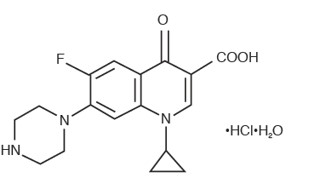
Ciprofloxacin differs from other quinolones in that it has a fluorine atom at the 6-position, a piperazine moiety at the 7-position, and a cyclopropyl ring at the 1-position.
Each mL of ciprofloxacin ophthalmic solution contains:
Active: Ciprofloxacin hydrochloride 3.5 mg equivalent to 3mg base.
Preservative: Benzalkonium chloride 0.006%.
Inactives: Acetic acid, edetate disodium 0.05%, mannitol 4.6%, Sodium acetate, hydrochloric acid and/or sodium hydroxide (to adjust pH) and water for injection. The pH is between 3.5 to 5.5 and the osmolality is between 290 to 300 mOsms/kg.
CLINICAL PHARMACOLOGY:
Systemic Absorption: A systemic absorption study was performed in which ciprofloxacin ophthalmic solution was administered in each eye every two hours while awake for two days followed by every four hours while awake for an additional 5 days. The maximum reported plasma concentration of ciprofloxacin was less than 5 ng/mL. The mean concentration was usually less than 2.5 ng/mL.
Microbiology : Ciprofloxacin has in vitro activity against a wide range of gram-negative and gram- positive organisms. The bactericidal action of ciprofloxacin results from interference with the enzyme DNA gyrase which is needed for the synthesis of bacterial DNA.
Ciprofloxacin has been shown to be active against most strains of the following organisms both in vitro and in clinical infections (SEE INDICATIONS AND USAGE section):
Gram-Positive:
Staphylococcus aureus
Staphylococcus epidermidis
Streptococcus pneumoniae
Streptococcus (Viridans Group)
Gram-Negative:
Haemophilus influenzae
Pseudomonas aeruginosa
Serratia marcescens
Ciprofloxacin has been shown to be active in vitro against most strains of the following organisms, however, the clinical significance of these data is unknown:
Gram-Positive: Enterococcus faecalis (Many strains are only moderately susceptible) Staphylococcus haemolyticus Staphylococcus hominis Staphylococcus saprophyticus Streptococcus pyogenes
Gram-Negative: Acinetobacter calcoaceticus Escherichia coli Proteus mirabilis subsp. anitratus Haemophilus ducreyi Proteus vulgaris Aeromonas caviae Haemophilus parainfluenzae Providencia rettgeri Aeromonas hydrophila Kiebsiella pneumoniae Providencia stuartii Brucella melitensis Klebsiella oxytoca Salmonella enteritidis Campylobacter coli Legionella pneumophila Salmonella typhi Campylobacter jejuni Moraxella (Branhamella) Shigella sonneii Citrobacter diversus catarrhalis Shigella flexneri Citrobacter freundii Morganella morganii Vibrio cholerae Edwardsiella tarda Neisseria gonorrhoeae Vibrio parahaemolyticus Enterobacter aerogenes Neisseria meningitidis Vibrio vulnificus Enterobacter cloacae Pasteurella multocida Yersinia enterocolitica
Other Organisms: Chlamydia trachomatis (only moderately susceptible) and Mycobacterium tuberculosis (only moderately susceptible).
Most strains of Pseudomonas cepacia and some strains of Pseudomonas maltophilia are resistant to ciprofloxacin as are most anaerobic bacteria, including Bacteroides fragilis and Clostridium difficile . The minimal bactericidal concentration (MBC) generally does not exceed the minimal inhibitory concentration (MIC) by more than a factor of 2. Resistance to ciprofloxacin in vitro usually develops slowly (multiple-step mutation).
Ciprofloxacin does not cross-react with other antimicrobial agents such as beta-lactams or aminoglycosides; therefore, organisms resistant to these drugs may be susceptible to ciprofloxacin.
Clinical Studies:
Following therapy with ciprofloxacin ophthalmic solution, 76% of the patients with corneal ulcers and positive bacterial cultures were clinically cured and complete re-epithelialization occurred in about 92% of the ulcers.
In 3 and 7 day multicenter clinical trials, 52% of the patients with conjunctivitis and positive conjunctival cultures were clinically cured and 70-80% had all causative pathogens eradicated by the end of treatment.
In a randomized, double-masked, multicenter, parallel-group clinical trial of pediatric patients with bacterial conjunctivitis, between birth and 31 days of age, patients were dosed with ciprofloxacin or another anti-infective agent. Clinical outcomes for the trial demonstrated a clinical cure rate of 80% at Day 9 anda microbiological eradication success rate of 85% at Day 9.
Please note that microbiologic eradication does not always correlate with clinical outcome in anti- infective trials.
Clinical Studies:
Following therapy with ciprofloxacin ophthalmic solution, 76% of the patients with corneal ulcers and positive bacterial cultures were clinically cured and complete re-epithelialization occurred in about 92% of the ulcers.
In 3 and 7 day multicenter clinical trials, 52% of the patients with conjunctivitis and positive conjunctival cultures were clinically cured and 70-80% had all causative pathogens eradicated by the end of treatment.
In a randomized, double-masked, multicenter, parallel-group clinical trial of pediatric patients with bacterial conjunctivitis, between birth and 31 days of age, patients were dosed with ciprofloxacin or another anti-infective agent. Clinical outcomes for the trial demonstrated a clinical cure rate of 80% at Day 9 anda microbiological eradication success rate of 85% at Day 9.
Please note that microbiologic eradication does not always correlate with clinical outcome in anti- infective trials.
How Supplied: As a sterile ophthalmic solution: 2.5 mL, 5 mL and 10 mL in translucent LDPE bottle, translucent LDPE nozzle and tan coloured polypropylene closure.
2.5 mL - NDC 72888-102-21
5 mL - NDC 72888-102-22
10 mL - NDC 72888-102-23
STORAGE: Store at 2°C to 25°C (36°F to 77°F). Protect from light.
ANIMAL PHARMACOLOGY:
Ciprofloxacin and related drugs have been shown to cause arthropathy in immature animals of most species tested following oral administration. However, a one-month topical ocular study using immature Beagle dogs did not demonstrate any articular lesions.
Distributed by:
Advagen Pharma Ltd.,
East Windsor, NJ 08520, USA.
Rev. 01, 09/2024
