Get your patient on Ciclopirox - Ciclopirox solution (Ciclopirox)
Ciclopirox - Ciclopirox solution prescribing information

INDICATIONS AND USAGE
(To understand fully the indication for this product, please read the entire INDICATIONS AND USAGE section of the labeling.)
Ciclopirox topical solution, 8% (nail lacquer), as a component of a comprehensive management program, is indicated as topical treatment in immunocompetent patients with mild to moderate onychomycosis of fingernails and toenails without lunula involvement, due to Trichophyton rubrum . The comprehensive management program includes removal of the unattached, infected nails as frequently as monthly, by a health care professional who has special competence in the diagnosis and treatment of nail disorders, including minor nail procedures.
- No studies have been conducted to determine whether ciclopirox might reduce the effectiveness of systemic antifungal agents for onychomycosis. Therefore, the concomitant use of ciclopirox topical solution, 8% (nail lacquer) and systemic antifungal agents for onychomycosis, is not recommended.
- Ciclopirox topical solution, 8% (nail lacquer), should be used only under medical supervision as described above.
- The effectiveness and safety of ciclopirox topical solution, 8% (nail lacquer), in the following populations has not been studied. The clinical trials with use of ciclopirox topical solution, 8% (nail lacquer), excluded patients who: were pregnant or nursing, planned to become pregnant, had a history of immunosuppression (e.g., extensive, persistent, or unusual distribution of dermatomycoses, extensive seborrheic dermatitis, recent or recurring herpes zoster, or persistent herpes simplex), were HIV seropositive, received organ transplant, required medication to control epilepsy, were insulin dependent diabetics or had diabetic neuropathy. Patients with severe plantar (moccasin) tinea pedis were also excluded.
- The safety and efficacy of using ciclopirox topical solution, 8% (nail lacquer), daily for greater than 48 weeks have not been established.
Clinical Trials Data The results of use of ciclopirox topical solution, 8% (nail lacquer), in treatment of onychomycosis of the toenail without lunula involvement were obtained from two double-blind, placebo-controlled studies conducted in the US. In these studies, patients with onychomycosis of the great toenails without lunula involvement were treated with ciclopirox topical solution, 8% (nail lacquer), in conjunction with monthly removal of the unattached, infected toenail by the investigator. Ciclopirox topical solution, 8% (nail lacquer), was applied for 48 weeks. At baseline, patients had 20-65% involvement of the target great toenail plate. Statistical significance was demonstrated in one of two studies for the endpoint “complete cure” (clear nail and negative mycology), and in two studies for the endpoint “almost clear” ( < 10% nail involvement and negative mycology) at the end of study. These results are presented below.
| At Week 48 (plus Last Observation Carried Forward) for the Intent-to-Treat (ITT) Population | ||||
| Study 312 | Study 313 | |||
| Active | Vehicle | Active | Vehicle | |
| Complete Cure• | 6/110 (5.5%) | 1/109 (0.9%) | 10/118 (8.5%) | 0/117 (0%) |
| Almost Clear•• | 7/107 (6.5%) | 1/108 (0.9%) | 14/116 (12%) | 1/115 (0.9%) |
| Negative Mycology Alone••• | 30/105 (29%) | 12/106 (11%) | 41/115 (36%) | 10/114 (9%) |
| • Clear nail and negative mycology •• ≤10% nail involvement and negative mycology ••• Negative KOH and negative culture | ||||
The summary of reported patient outcomes for the ITT population at 12 weeks following the end of treatment are presented below. Note that post - treatment efficacy assessments were scheduled only for patients who achieved a complete cure.
| Post-treatment Week 12 Data for Patients Who Achieved Complete Cure at Week 48 | ||||
| Study 312 | Study 313 | |||
| Active | Vehicle | Active | Vehicle | |
| Number of Treated Patients | 112 | 111 | 119 | 118 |
| Complete Cure at Week 48 | 6 | 1 | 10 | 0 |
| Post-treatment Week 12 Outcomes: Patients Missing All Week 12 Assessments Patients with Week 12 Assessments Complete Cure Almost Clear Negative Mycology | 2 4 3 2• 3 | 0 1 1 1 1 | 2 8 4 1• 5 | 0 0 0 0 0 |
•Four patients (from studies 312 and 313) who were completely cured did not have post-treatment Week 12 planimetry data.
DOSAGE AND ADMINISTRATION
Ciclopirox topical solution, 8% (nail lacquer), should be used as a component of a comprehensive management program for onychomycosis. Removal of the unattached, infected nail, as frequently as monthly, by a health care professional, weekly trimming by the patient, and daily application of the medication are all integral parts of this therapy. Careful consideration of the appropriate nail management program should be given to patients with diabetes (see PRECAUTIONS ).
Nail Care By Health Care Professionals
Removal of the unattached, infected nail, as frequently as monthly, trimming of onycholytic nail, and filing of excess horny material should be performed by professionals trained in treatment of nail disorders.
Nail Care By Patient Patients should file away (with emery board) loose nail material and trim nails, as required, or as directed by the health care professional, every seven days after ciclopirox topical solution, 8% (nail lacquer), is removed with alcohol.
Ciclopirox topical solution, 8% (nail lacquer), should be applied once daily (preferably at bedtime or eight hours before washing) to all affected nails with the applicator brush provided. The ciclopirox topical solution, 8% (nail lacquer), should be applied evenly over the entire nail plate.
If possible, ciclopirox topical solution, 8% (nail lacquer), should be applied to the nail bed, hyponychium, and the under surface of the nail plate when it is free of the nail bed (e.g., onycholysis).
The ciclopirox topical solution, 8% (nail lacquer), should not be removed on a daily basis. Daily applications should be made over the previous coat and removed with alcohol every seven days. This cycle should be repeated throughout the duration of therapy.
CONTRAINDICATIONS
Ciclopirox topical solution, 8% (nail lacquer), is contraindicated in individuals who have shown hypersensitivity to any of its components.
ADVERSE REACTIONS
In the vehicle-controlled clinical trials conducted in the US, 9% (30/327) of patients treated with ciclopirox topical solution, 8% (nail lacquer), and 7% (23/328) of patients treated with vehicle reported treatment-emergent adverse events (TEAE) considered by the investigator to be causally related to the test material. The incidence of these adverse events, within each body system, was similar between the treatment groups except for Skin and Appendages: 8% (27/327) and 4% (14/328) of subjects in the ciclopirox and vehicle groups reported at least one adverse event, respectively. The most common were rash-related adverse events: periungual erythema and erythema of the proximal nail fold were reported more frequently in patients treated with ciclopirox topical solution, 8% (nail lacquer), (5% [16/327]) than in patients treated with vehicle (1% [3/328]). Other TEAEs thought to be causally related included nail disorders such as shape change, irritation, ingrown toenail, and discoloration.
The incidence of nail disorders was similar between the treatment groups (2% [6/327] in the ciclopirox topical solution, 8% (nail lacquer), group and 2% [7/328] in the vehicle group). Moreover, application site reactions and/or burning of the skin occurred in 1 % of patients treated with ciclopirox topical solution, 8% (nail lacquer), (3/327) and vehicle (4/328).
A21-Day Cumulative Irritancy study was conducted under conditions of semi-occlusion. Mild reactions were seen in 46% of patients with the ciclopirox topical solution, 8% (nail lacquer), 32% with the vehicle and 2% with the negative control, but all were reactions of mild transient erythema. There was no evidence of allergic contact sensitization for either the ciclopirox topical solution, 8% (nail lacquer), or the vehicle base. In a separate study of the photosensitization potential of ciclopirox topical solution, 8% (nail lacquer), in a maximized test design that included the occluded application of sodium lauryl sulfate, no photoallergic reactions were noted. In four subjects localized allergic contact reactions were observed. In the vehicle-controlled studies, one patient treated with ciclopirox topical solution, 8% (nail lacquer), discontinued treatment due to a rash, localized to the palm (causal relation to test material undetermined).
Use of ciclopirox topical solution, 8% (nail lacquer), for 48 additional weeks was evaluated in an open-label extension study conducted in patients previously treated in the vehicle-controlled studies. Three percent (9/281) of subjects treated with ciclopirox topical solution, 8% (nail lacquer), experienced at least one TEAE that the investigator thought was causally related to the test material. Mild rash in the form of periungual erythema (1% [2/281]) and nail disorders (1 % [4/281]) were the most frequently reported. Four patients discontinued because of TEAEs. Two of the four had events considered to be related to test material: one patient’s great toenail “broke away” and another had an elevated creatine phosphokinase level on Day 1 (after 48 weeks of treatment with vehicle in the previous vehicle-controlled study).
DESCRIPTION
Ciclopirox topical solution, 8% (nail lacquer) contains a synthetic antifungal agent, ciclopirox. It is intended for topical use on fingernails and toenails and immediately adjacent skin. Each gram of ciclopirox topical solution, 8% (nail lacquer) contains 80 mg ciclopirox in a solution base consisting of ethyl acetate, NF; isopropyl alcohol, USP; and butyl monoester of poly[methylvinyl ether/maleic acid] in isopropyl alcohol. Ethyl acetate and isopropyl alcohol are solvents that vaporize after application. Ciclopirox topical solution, 8% (nail lacquer) is a clear, colorless to slightly yellowish solution.
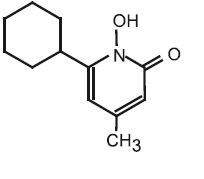
The chemical name for ciclopirox is 6-cyclohexyl-1-hydroxy-4- methyl-2(1 H)-pyridone, with the empirical formula C 12 H 17 NO 2 and a molecular weight of 207.27. The CAS Registry Number is [29342-05-0]. The chemical structure is:
CLINICAL PHARMACOLOGY
Microbiology Mechanism of Action The mechanism of action of ciclopirox has been investigated using various in vitro and in vivo infection models. One in vitro study suggested that ciclopirox acts by chelation of polyvalent cations (Fe +3 or Al +3 ) resulting in the inhibition of the metal-dependent enzymes that are responsible for the degradation of peroxides within the fungal cell. The clinical significance of this observation is not known.
Activity in vitro and ex vivo In vitro methodologies employing various broth or solid media with and without additional nutrients have been utilized to determine ciclopirox minimum inhibitory concentration (MIC) values for the dermatophytic molds. (1-2) As a consequence, a broad range of MIC values, 1-20 μg/mL, were obtained for Trichophyton rubrum and Trichophyton mentagrophytes species. Correlation between in vitro MIC results and clinical outcome has yet to be established for ciclopirox.
One ex vivo study was conducted evaluating 8% ciclopirox against new and established Trichophyton rubrum and Trichophyton mentagrophytes infections in ovine hoof material. (3) After 10 days of treatment the growth of T. rubrum and T. mentagrophytes in the established infection model was very minimally affected. Elimination of the molds from hoof material was not achieved in either the new or established infection models.
Susceptibility testing for Trichophyton rubrum species In vitro susceptibility testing methods for determining ciclopirox MIC values against the dermatophytic molds, including Trichophyton rubrum species, have not been standardized or validated. Ciclopirox MIC values will vary depending on the susceptibility testing method employed, composition and pH of media and the utilization of nutritional supplements. Breakpoints to determine whether clinical isolates of Trichophyton rubrum are susceptible or resistant to ciclopirox have not been established.
Resistance
Studies have not been conducted to evaluate drug resistance development in T. rubrum species exposed to 8% ciclopirox topical solution. Studies assessing cross-resistance to ciclopirox and other known antifungal agents have not been performed.
Antifungal Drug Interactions No studies have been conducted to determine whether ciclopirox might reduce the effectiveness of systemic antifungal agents for onychomycosis. Therefore, the concomitant use of 8% ciclopirox topical solution and systemic antifungal agents for onychomycosis is not recommended.
Pharmacokinetics As demonstrated in pharmacokinetic studies in animals and man, ciclopirox olamine is rapidly absorbed after oral administration and completely eliminated in all species via feces and urine. Most of the compound is excreted either unchanged or as glucuronide. After oral administration of 10 mg of radiolabeled drug (14C-ciclopirox) to healthy volunteers, approximately 96% of the radioactivity was excreted renally within 12 hours of administration. Ninety-four percent of the renally excreted radioactivity was in the form of glucuronides. Thus, glucuronidation is the main metabolic pathway of this compound.
Systemic absorption of ciclopirox was determined in 5 patients with dermatophytic onychomycoses, after application of ciclopirox topical solution, 8% (nail lacquer), to all 20 digits and adjacent 5 mm of skin once daily for six months. Random serum concentrations and 24 hour urinary excretion of ciclopirox were determined at two weeks and at 1, 2, 4 and 6 months after initiation of treatment and 4 weeks post-treatment. In this study, ciclopirox serum levels ranged from 12-80 ng/mL. Based on urinary data, mean absorption of ciclopirox from the dosage form was <5% of the applied dose. One month after cessation of treatment, serum and urine levels of ciclopirox were below the limit of detection.
In two vehicle-controlled trials, patients applied ciclopirox topical solution, 8% (nail lacquer) to all toenails and affected fingernails. Out of a total of 66 randomly selected patients on active treatment, 24 had detectable serum ciclopirox concentrations at some point during the dosing interval (range 10.0-24.6 ng/mL). It should be noted that eleven of these 24 patients took concomitant medication containing ciclopirox as ciclopirox olamine (Loprox ® Cream, 0. 77%).
The penetration of the ciclopirox topical solution, 8% (nail lacquer), was evaluated in an in vitro investigation. Radiolabeled ciclopirox applied once to onychomycotic toenails that were avulsed demonstrated penetration up to a depth of approximately 0.4 mm. As expected, nail plate concentrations decreased as a function of nail depth. The clinical significance of these findings in nail plates is unknown. Nail bed concentrations were not determined.
HOW SUPPLIED
Ciclopirox topical solution, 8% (nail lacquer), is supplied in 6.6 mL (NDC 21922-053-51) glass bottles with screw caps which are fitted with brushes.
Protect from light (e.g., store the bottle in the carton after every use).
Ciclopirox topical solution, 8% (nail lacquer), should be stored at 20° - 25°C (68° - 77°F) [see USP Controlled Room Temperature.]
CAUTION: Flammable. Keep away from heat and flame.
Rx ONLY
Call your doctor for medical advice about side effects. You may report side effects to FDA at 1-800-FDA-1088.
Manufactured by: Encube Ethicals Pvt. Ltd. Plot No. C-1, Madkaim Industrial Estate, Madkaim, Post: Mardol, Panda, Goa-403404, India.
References: 1. Dittmar W., Lohaus G. 1973. HOE296, A new antimycotic compound with a broad antimicrobial spectrum. Arzneim-Forsch./ Drug Res. 23:670-674. 2. Niewerth et. al., 1998. Antimicrobial susceptibility testing of dermatophytes: Comparison of the agar macrodilution and broth micro dilution tests. Chemotherapy. 44:31-35. 3. Yang et. al. 1997. A new simulation model for studying in vitro topical penetration of antifungal drugs into hard keratin. J. Mycol. Med. 7:195-98.
Gantrez is a registered trademark of GAF Corporation
Rev. 01/23
