Get your patient on Chlordiazepoxide Hydrochloride - Chlordiazepoxide Hydrochloride capsule (Chlordiazepoxide Hydrochloride)
Chlordiazepoxide Hydrochloride - Chlordiazepoxide Hydrochloride capsule prescribing information

WARNING: RISKS FROM CONCOMITANT USE WITH OPIOIDS; ABUSE, MISUSE, AND ADDICTION; AND DEPENDENCE AND WITHDRAWAL REACTIONS
- Concomitant use of benzodiazepines and opioids may result in profound sedation, respiratory depression, coma, and death. Reserve concomitant prescribing of these drugs for patients for whom alternative treatment options are inadequate. Limit dosages and durations to the minimum required. Follow patients for signs and symptoms of respiratory depression and sedation (see WARNINGS AND PRECAUTIONS ).
- The use of benzodiazepines, including chlordiazepoxide hydrochloride capsules, exposes users to risk of abuse, misuse, and addiction, which can lead to overdose or death. Abuse and misuse of benzodiazepines commonly involve concomitant use of other medications, alcohol, and/or illicit substances, which is associated with an increased frequency of serious adverse outcomes. Before prescribing chlordiazepoxide hydrochloride capsules and throughout treatment, assess each patient’s risk for abuse, misuse, and addiction (see WARNINGS ).
- The continued use of benzodiazepines, including chlordiazepoxide hydrochloride capsules, may lead to clinically significant physical dependence. The risk of dependence and withdrawal increase with longer treatment duration and higher daily dose. Abrupt discontinuation or rapid dosage reduction of chlordiazepoxide hydrochloride capsules after continued use may precipitate acute withdrawal reactions, which can be life-threatening. To reduce the risk of withdrawal reactions, use a gradual taper to discontinue chlordiazepoxide hydrochloride capsules or reduce the dosage (see DOSAGE AND ADMINISTRATION and WARNINGS ).
INDICATIONS AND USAGE
Chlordiazepoxide Hydrochloride Capsules are indicated for the management of anxiety disorders or for the short term relief of symptoms of anxiety, withdrawal symptoms of acute alcoholism, and preoperative apprehension and anxiety. Anxiety or tension associated with the stress of everyday life usually does not require treatment with an anxiolytic.
The effectiveness of chlordiazepoxide hydrochloride capsules in long-term use, that is, more than 4 months, has not been assessed by systematic clinical studies. The physician should periodically reassess the usefulness of the drug for the individual patient.
DOSAGE AND ADMINISTRATION
Because of the wide range of clinical indications for chlordiazepoxide, the optimum dosage varies with the diagnosis and response of the individual patient. The dosage, therefore, should be individualized for maximum beneficial effects.
| Adults | Usual Daily Dose |
| Relief of Mild and Moderate Anxiety Disorders and Symptoms of Anxiety | 5 mg or 10 mg, 3 or 4 times daily |
Relief of Severe Anxiety Disorders and Symptoms of Anxiety | 20 mg or 25 mg, 3 or 4 times daily |
Geriatric Patients, or in the presence of debilitating disease | 5 mg, 2 to 4 times daily |
| Preoperative Apprehension and Anxiety: On days preceding surgery, 5 to 10 mg orally, 3 or 4 times daily. If used as preoperative medication, 50 to 100 mg IM• 1 hour prior to surgery | |
| PEDIATRIC PATIENTS | USUAL DAILY DOSE |
| Because of the varied response of pediatric patients to CNS-acting drugs, therapy should be initiated with the lowest dose and increased as required. Since clinical experience in pediatric patients under 6 years of age is limited, the use of the drug in this age group is not recommended. | 5 mg, 2 to 4 times daily (may be increased in some pediatric patients to 10 mg, 2 to 3 times daily) |
For the relief of withdrawal symptoms of acute alcoholism, the parenteral form• is usually used initially. If the drug is administered orally, the suggested initial dose is 50 to 100 mg, to be followed by repeated doses as needed until agitation is controlled - up to 300 mg per day. Dosage should then be reduced to maintenance levels.
•See package insert for Injectable Chlordiazepoxide Hydrochloride
Discontinuation or Dosage Reduction of Chlordiazepoxide To reduce the risk of withdrawal reactions, use a gradual taper to discontinue chlordiazepoxide or reduce the dosage. If a patient develops withdrawal reactions, consider pausing the taper or increase the dosage to the previous tapered dosage level. Subsequently decrease the dosage more slowly (see WARNINGS: Dependence and Withdrawal Reactions and DRUG ABUSE AND DEPENDENCE: Dependence ).
CONTRAINDICATIONS
Chlordiazepoxide Hydrochloride Capsules are contraindicated in patients with known hypersensitivity to the drug.
ADVERSE REACTIONS
The necessity of discontinuing therapy because of undesirable effects has been rare. Drowsiness, ataxia and confusion have been reported in some patients particularly the elderly and debilitated. While these effects can be avoided in almost all instances by proper dosage adjustment, they have occasionally been observed at the lower dosage ranges.
In a few instances syncope has been reported.
Other adverse reactions reported during therapy include isolated instances of skin eruptions, edema, minor menstrual irregularities, nausea and constipation, extrapyramidal symptoms, as well as increased and decreased libido. Such side effects have been infrequent, and are generally controlled with reduction of dosage. Changes in EEG patterns (low-voltage fast activity) have been observed in patients during and after chlordiazepoxide treatment.
Blood dyscrasias (including agranulocytosis), jaundice and hepatic dysfunction have occasionally been reported during therapy. When chlordiazepoxide treatment is protracted, periodic blood counts and liver function tests are advisable.
To report SUSPECTED ADVERSE REACTIONS, contact Chartwell RX, LLC. at 1-845-232-1683 or FDA at 1- 800-FDA-1088 or www.fda.gov/medwatch.
DESCRIPTION
Chlordiazepoxide Hydrochloride, is the prototype for the benzodiazepine compounds. It is a versatile therapeutic agent of proven value for the relief of anxiety. Chlordiazepoxide Hydrochloride is among the safer of the effective psychopharmacologic compounds available, as demonstrated by extensive clinical evidence.
Chlordiazepoxide Hydrochloride is available as capsules containing 5 mg, 10 mg or 25 mg chlordiazepoxide hydrochloride. In addition, each capsule contains the following inactive ingredients:
5 mg: colloidal silicon dioxide, corn starch, D & C Yellow #10, FD & C Blue #1, FD & C Yellow #6, gelatin, lactose monohydrate, talc, titanium dioxide, shellac, black iron oxide, and propylene glycol.
10 mg: colloidal silicon dioxide, corn starch, D & C Yellow #10, FD & C Blue #1, FD & C Red #3, FD & C Yellow #6, gelatin, lactose monohydrate, talc, titanium dioxide, shellac, propylene glycol, and simethicone.
25 mg: colloidal silicon dioxide, corn starch, D & C Yellow #10, FD & C Blue #1, gelatin, lactose monohydrate, talc, titanium dioxide, shellac, black iron oxide, and propylene glycol.
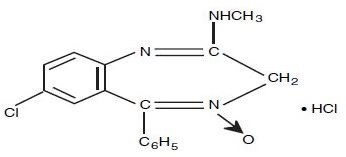
Chlordiazepoxide Hydrochloride is 7-chloro-2-(methylamino)-5-phenyl-3H-1,4-benzodiazepine 4-oxide hydrochloride. A white to practically white crystalline substance, it is soluble in water. It is unstable in solution and the powder must be protected from light. The molecular weight is 336.22. The structural formula of chlordiazepoxide hydrochloride is as follows:
CLINICAL PHARMACOLOGY
Chlordiazepoxide Hydrochloride has antianxiety, sedative, appetite-stimulating and weak analgesic actions. The precise mechanism of action is not known. The drug blocks EEG arousal from stimulation of the brain stem reticular formation. It takes several hours for peak blood levels to be reached and the half-life of the drug is between 24 and 48 hours. After the drug is discontinued plasma levels decline slowly over a period of several days. Chlordiazepoxide is excreted in the urine, with 1% to 2% unchanged and 3% to 6% as conjugate.
Animal Pharmacology
The drug has been studied extensively in many species of animals and these studies are suggestive of action on the limbic system of the brain, which recent evidence indicates is involved in emotional responses.
Hostile monkeys were made tame by oral drug doses which did not cause sedation. Chlordiazepoxide Hydrochloride revealed a “taming” action with the elimination of fear and aggression. The taming effect of chlordiazepoxide hydrochloride was further demonstrated in rats made vicious by lesions in the septal area of the brain. The drug dosage which effectively blocked the vicious reaction was well below the dose which caused sedation in these animals.
The LD 50 of parenterally administered chlordiazepoxide hydrochloride was determined in mice (72 hours) and rats (5 days), and calculated according to the method of Miller and Tainter, with the following results: mice, IV, 123±12mg/kg; mice, IM, 366±7mg/kg; rats, IV, 120±7 mg/kg; rats, IM, >160 mg/kg.
Effects on Reproduction
Reproduction studies in rats fed 10, 20 and 80 mg/kg daily and bred through one or two matings showed no congenital anomalies, nor were there adverse effects on lactation of the dams or growth of the newborn. However, in another study at 100 mg/kg daily there was noted a significant decrease in the fertilization rate and a marked decrease in the viability and body weight of offspring which may be attributable to sedative activity, thus resulting in lack of interest in mating and lessened maternal nursing and care of the young. One neonate in each of the first and second matings in the rat reproduction study at the 100 mg/kg dose exhibited major skeletal defects. Further studies are in progress to determine the significance of these findings.
HOW SUPPLIED
Chlordiazepoxide Hydrochloride Capsules, USP are available in the following presentations:
5 mg:
Light green and yellow, size #4 hard gelatin capsules, filled with white to off-white powder, imprinted “CE” on the cap and “81” on the body in black ink. Bottles of 60 (NDC 62135-220-60)
10 mg:
Black and green, size #4 hard gelatin capsules, filled with white to off-white powder, imprinted “CE” on the cap and “82” on the body in white ink. Bottles of 60 (NDC 62135-221-60)
25 mg:
Light green and white, size #4 hard gelatin capsules, filled with white to off-white powder, imprinted “CE” on the cap and “83” on the body in black ink. Bottles of 60 (NDC 62135-222-60)
Store at 20° to 25°C (68° to 77°F) [see USP Controlled Room Temperature].
Manufactured by: CorePharma, LLC Middlesex, NJ 08846
Manufactured for: Chartwell RX, LLC Congers, NY 10920
L70777 Rev 11/2022
Dispense with Medication Guide available at www.chartwellpharma.com /medguides
