Get your patient on Cardizem - Diltiazem Hydrochloride tablet, Coated (Diltiazem Hydrochloride)
Cardizem - Diltiazem Hydrochloride tablet, Coated prescribing information

INDICATIONS AND USAGE
CARDIZEM is indicated for the management of chronic stable angina and angina due to coronary artery spasm.
DOSAGE AND ADMINISTRATION
Exertional Angina Pectoris Due to Atherosclerotic Coronary Artery Disease or Angina Pectoris at Rest Due to Coronary Artery Spasm: Dosage must be adjusted to each patient’s needs. Starting with 30 mg four times daily, before meals and at bedtime, dosage should be increased gradually (given in divided doses three or four times daily) at 1- to 2-day intervals until optimum response is obtained. Although individual patients may respond to any dosage level, the average optimum dosage range appears to be 180 to 360 mg/day. There are no available data concerning dosage requirements in patients with impaired renal or hepatic function. If the drug must be used in such patients, titration should be carried out with particular caution.
Concomitant Use with Other Cardiovascular Agents
- Sublingual NTG may be taken as required to abort acute anginal attacks during CARDIZEM (diltiazem hydrochloride) therapy.
- Prophylactic Nitrate Therapy. CARDIZEM may be safely coadministered with short- and long-acting nitrates, but there have been no controlled studies to evaluate the antianginal effectiveness of this combination.
- Beta-blockers. (see WARNINGS and PRECAUTIONS . )
- 30 mg – CARDIZEM tablets may be swallowed whole, crushed, or chewed. Do not split CARDIZEM tablets.
- 60 mg, 90 mg, and 120 mg – CARDIZEM tablets may be swallowed whole, crushed, or chewed.
CONTRAINDICATIONS
CARDIZEM is contraindicated in:
- Patients with sick sinus syndrome except in the presence of a functioning ventricular pacemaker
- Patients with second- or third-degree AV block except in the presence of a functioning ventricular pacemaker
- Patients with hypotension (less than 90 mm Hg systolic)
- Patients who have demonstrated hypersensitivity to the drug
- Patients with acute myocardial infarction and pulmonary congestion documented by x-ray on admission
ADVERSE REACTIONS
Serious adverse reactions have been rare in studies carried out to date, but it should be recognized that patients with impaired ventricular function and cardiac conduction abnormalities usually have been excluded.
In domestic placebo-controlled angina trials, the incidence of adverse reactions reported during CARDIZEM therapy was not greater than that reported during placebo therapy.
The following represent occurrences observed in clinical studies of angina patients. In many cases, the relationship to CARDIZEM has not been established. The most common occurrences from these studies, as well as their frequency of presentation, are edema (2.4%), headache (2.1%), nausea (1.9%), dizziness (1.5%), rash (1.3%), and asthenia (1.2%). In addition, the following events were reported infrequently (less than 1%):
Cardiovascular: Angina, arrhythmia, AV block (first-degree), AV block (second- or third-degree – see WARNINGS, Cardiac Conduction ), bradycardia, bundle branch block, congestive heart failure, ECG abnormality, flushing, hypotension, palpitations, syncope, tachycardia, ventricular extrasystoles
Nervous System: Abnormal dreams, amnesia, depression, gait abnormality, hallucinations, insomnia, nervousness, paresthesia, personality change, somnolence, tremor
Gastrointestinal: Anorexia, constipation, diarrhea, dysgeusia, dyspepsia, mild elevations of alkaline phosphatase, SGOT, SGPT, and LDH (see WARNINGS, Acute Hepatic Injury ), thirst, vomiting, weight increase.
Dermatological: Petechiae, photosensitivity, pruritus, urticaria
Other: Amblyopia, CPK elevation, dry mouth, dyspnea, epistaxis, eye irritation, hyperglycemia, hyperuricemia, impotence, muscle cramps, nasal congestion, nocturia, osteoarticular pain, polyuria, sexual difficulties, tinnitus
The following postmarketing events have been reported infrequently in patients receiving CARDIZEM: acute generalized exanthematous pustulosis, allergic reactions, alopecia, angioedema (including facial or periorbital edema), asystole, erythema multiforme (including Stevens-Johnson syndrome, toxic epidermal necrolysis), extrapyramidal symptoms, gingival hyperplasia, hemolytic anemia, increased bleeding time, leukopenia, photosensitivity (including lichenoid keratosis and hyperpigmentation at sun-exposed skin areas), purpura, retinopathy, myopathy, and thrombocytopenia. There have been observed cases of a generalized rash, some characterized as leukocytoclastic vasculitis. In addition, events such as myocardial infarction have been observed, which are not readily distinguishable from the natural history of the disease in these patients. A definitive cause and effect relationship between these events and CARDIZEM therapy cannot yet be established. Exfoliative dermatitis (proven by rechallenge) has also been reported.
To report SUSPECTED ADVERSE REACTIONS, contact Bausch Health US, LLC at 1-800-321-4576 or FDA at 1-800-FDA-1088 or www.fda.gov/medwatch.
Drug Interactions
Due to the potential for additive effects, caution and careful titration are warranted in patients receiving CARDIZEM concomitantly with any agents known to affect cardiac contractility and/or conduction (see WARNINGS ).
Pharmacologic studies indicate that there may be additive effects in prolonging AV conduction when using beta-blockers or digitalis concomitantly with CARDIZEM (see WARNINGS ).
Diltiazem is both a substrate and an inhibitor of the Pg-p and cytochrome P450 3A4 enzyme system which may affect exposure to diltiazem and concomitant drugs metabolized by those pathways. Patients with renal and/or hepatic impairment may be particularly at risk of exposure changes.
Anesthetics: The depression of cardiac contractility, conductivity, and automaticity, as well as the vascular dilation associated with anesthetics, may be potentiated by calcium channel blockers. When used concomitantly, anesthetics and calcium blockers should be titrated carefully.
Benzodiazepines: Studies showed that diltiazem increased the AUC of midazolam and triazolam by 3- to 4-fold and the C max by 2-fold, compared to placebo. The elimination half-life of midazolam and triazolam also increased (1.5- to 2.5-fold) during coadministration with diltiazem. These pharmacokinetic effects seen during diltiazem coadministration can result in increased clinical effects (e.g., prolonged sedation) of both midazolam and triazolam.
Beta-blockers: Controlled and uncontrolled domestic studies suggest that concomitant use of CARDIZEM and beta-blockers is usually well tolerated. Available data are not sufficient, however, to predict the effects of concomitant treatment, particularly in patients with left ventricular dysfunction or cardiac conduction abnormalities.
Administration of CARDIZEM (diltiazem hydrochloride) concomitantly with propranolol in five normal volunteers resulted in increased propranolol levels in all subjects, and bioavailability of propranolol was increased approximately 50%. In vitro , propranolol appears to be displaced from its binding sites by diltiazem. If combination therapy is initiated or withdrawn in conjunction with propranolol, an adjustment in the propranolol dose may be warranted (see WARNINGS ).
Buspirone: In nine healthy subjects, diltiazem significantly increased the mean buspirone AUC 5.5-fold and C max 4.1-fold compared to placebo. The T 1/2 and T max of buspirone were not significantly affected by diltiazem. Enhanced effects and increased toxicity of buspirone may be possible during concomitant administration with diltiazem. Subsequent dose adjustments may be necessary during coadministration and should be based on clinical assessment.
Carbamazepine: Concomitant administration of diltiazem with carbamazepine has been reported to result in elevated serum levels of carbamazepine (40% to 72% increase) resulting in toxicity in some cases. Patients receiving these drugs concurrently should be monitored for a potential drug interaction.
Cimetidine: A study in six healthy volunteers has shown a significant increase in peak diltiazem plasma levels (58%) and area-under-the-curve (53%) after a 1-week course of cimetidine at 1200 mg per day and a single dose of diltiazem 60 mg. Ranitidine produced smaller, nonsignificant increases. The effect may be mediated by cimetidine’s known inhibition of hepatic cytochrome P450, the enzyme system responsible for the first-pass metabolism of diltiazem. Patients currently receiving diltiazem therapy should be carefully monitored for a change in pharmacological effect when initiating and discontinuing therapy with cimetidine. An adjustment in the diltiazem dose may be warranted.
Clonidine: Sinus bradycardia resulting in hospitalization and pacemaker insertion has been reported in association with the use of clonidine concurrently with diltiazem. Monitor heart rate in patients receiving concomitant diltiazem and clonidine.
Cyclosporine: A pharmacokinetic interaction between diltiazem and cyclosporine has been observed during studies involving renal and cardiac transplant patients. In renal and cardiac transplant recipients, a reduction of cyclosporine trough dose ranging from 15% to 48% was necessary to maintain concentrations similar to those seen prior to the addition of diltiazem. If these agents are to be administered concurrently, cyclosporine concentrations should be monitored, especially when diltiazem therapy is initiated, adjusted, or discontinued. The effect of cyclosporine on diltiazem plasma concentrations has not been evaluated.
Digitalis: Administration of CARDIZEM with digoxin in 24 healthy male subjects increased plasma digoxin concentrations approximately 20%. Another investigator found no increase in digoxin levels in 12 patients with coronary artery disease. Since there have been conflicting results regarding the effect of digoxin levels, it is recommended that digoxin levels be monitored when initiating, adjusting, and discontinuing CARDIZEM therapy to avoid possible over- or under-digitalization (see WARNINGS ).
Ivabradine: Concurrent use of diltiazem increases exposure to ivabradine and may exacerbate bradycardia and conduction disturbances. Avoid concomitant use of ivabradine and diltiazem.
Quinidine: Diltiazem significantly increases the AUC (0→∞) of quinidine by 51%, T 1/2 by 36%, and decreases its CL oral by 33%. Monitoring for quinidine adverse effects may be warranted and the dose adjusted accordingly.
Rifampin: Coadministration of rifampin with diltiazem lowered the diltiazem plasma concentrations to undetectable levels. Coadministration of diltiazem with rifampin or any known CYP3A4 inducer should be avoided when possible, and alternative therapy considered.
Statins: Diltiazem is an inhibitor of CYP3A4 and has been shown to increase significantly the AUC of some statins. The risk of myopathy and rhabdomyolysis with statins metabolized by CYP3A4 may be increased with concomitant use of diltiazem. When possible, use a non-CYP3A4-metabolized statin together with diltiazem; otherwise, dose adjustments for both diltiazem and the statin should be considered along with close monitoring for signs and symptoms of any statin-related adverse events.
In a healthy volunteer crossover study (N=10), coadministration of a single 20 mg dose of simvastatin at the end of a 14-day regimen with 120 mg BID diltiazem SR resulted in a 5-fold increase in mean simvastatin AUC versus simvastatin alone. Subjects with increased average steady-state exposures of diltiazem showed a greater fold increase in simvastatin exposure. Computer-based simulations showed that at a daily dose of 480 mg of diltiazem, an 8- to 9-fold mean increase in simvastatin AUC can be expected. If coadministration of simvastatin with diltiazem is required, limit the daily doses of simvastatin to 10 mg and diltiazem to 240 mg.
In a ten-subject randomized, open label, 4-way crossover study, coadministration of diltiazem (120 mg BID diltiazem SR for 2 weeks) with a single 20 mg dose of lovastatin resulted in 3- to 4-fold increase in mean lovastatin AUC and C max versus lovastatin alone. In the same study, there was no significant change in 20 mg single dose pravastatin AUC and C max during diltiazem coadministration. Diltiazem plasma levels were not significantly affected by lovastatin or pravastatin.
DESCRIPTION
CARDIZEM ® (diltiazem hydrochloride) is a calcium ion cellular influx inhibitor (slow channel blocker or calcium antagonist). Chemically, diltiazem hydrochloride is 1,5-Benzothiazepin-4(5 H )-one, 3-(acetyloxy)-5-[2-(dimethylamino)ethyl] -2, 3-dihydro-2-(4-methoxyphenyl)-, monohydrochloride,(+)- cis -. The chemical structure is:
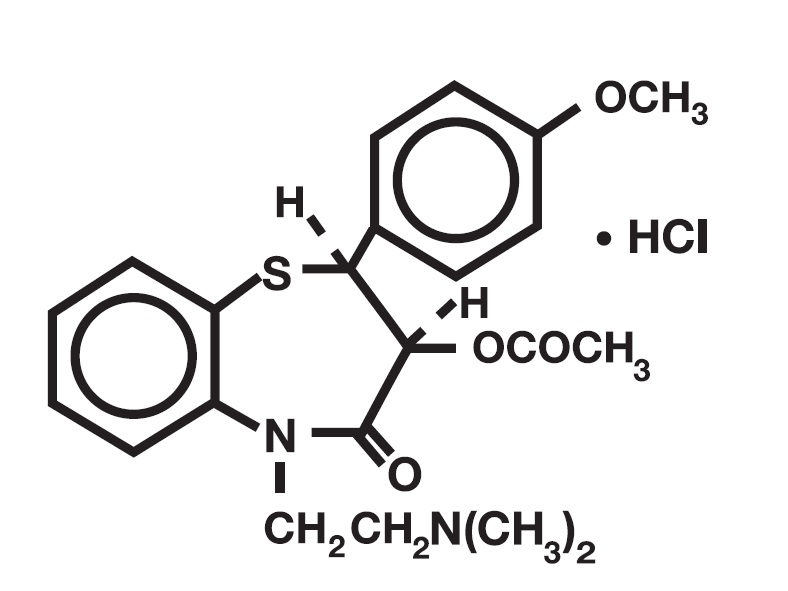
Diltiazem hydrochloride is a white to off-white crystalline powder with a bitter taste. It is soluble in water, methanol, and chloroform. It has a molecular weight of 450.98. Each tablet of CARDIZEM contains 30 mg, 60 mg, 90 mg, or 120 mg diltiazem hydrochloride.
Also contains: colloidal silicon dioxide, D&C Yellow #10 Aluminum Lake, FD&C Blue #1 Aluminum Lake (30 mg and 90 mg), FD&C Yellow #6 Aluminum Lake (60 mg and 120 mg), hydroxypropyl cellulose, hypromellose, lactose, magnesium stearate, methylparaben, microcrystalline cellulose, and polyethylene glycol.
For oral administration.
CLINICAL PHARMACOLOGY
The therapeutic benefits achieved with CARDIZEM are believed to be related to its ability to inhibit the influx of calcium ions during membrane depolarization of cardiac and vascular smooth muscle.
Mechanisms of Action
Although precise mechanisms of its antianginal actions are still being delineated, CARDIZEM is believed to act in the following ways:
- Angina Due to Coronary Artery Spasm: CARDIZEM has been shown to be a potent dilator of coronary arteries both epicardial and subendocardial. Spontaneous and ergonovine-induced coronary artery spasms are inhibited by CARDIZEM.
- Exertional Angina: CARDIZEM has been shown to produce increases in exercise tolerance, probably due to its ability to reduce myocardial oxygen demand. This is accomplished via reductions in heart rate and systemic blood pressure at submaximal and maximal exercise workloads.
In animal models, diltiazem interferes with the slow inward (depolarizing) current in excitable tissue. It causes excitation-contraction uncoupling in various myocardial tissues without changes in the configuration of the action potential. Diltiazem produces relaxation of coronary vascular smooth muscle and dilation of both large and small coronary arteries at drug levels which cause little or no negative inotropic effect. The resultant increases in coronary blood flow (epicardial and subendocardial) occur in ischemic and nonischemic models and are accompanied by dose-dependent decreases in systemic blood pressure and decreases in peripheral resistance.
Hemodynamic and Electrophysiologic Effects
Like other calcium antagonists, diltiazem decreases sinoatrial and atrioventricular conduction in isolated tissues and has a negative inotropic effect in isolated preparations. In the intact animal, prolongation of the AH interval can be seen at higher doses.
In man, diltiazem prevents spontaneous and ergonovine-provoked coronary artery spasm. It causes a decrease in peripheral vascular resistance and a modest fall in blood pressure, and in exercise tolerance studies in patients with ischemic heart disease, reduces the heart rate-blood pressure product for any given workload. Studies to date, primarily in patients with good ventricular function, have not revealed evidence of a negative inotropic effect; cardiac output, ejection fraction, and left ventricular end-diastolic pressure have not been affected. There are as yet few data on the interaction of diltiazem and beta-blockers. Resting heart rate is usually unchanged or slightly reduced by diltiazem.
Intravenous diltiazem in doses of 20 mg prolongs AH conduction time and AV node functional and effective refractory periods approximately 20%. In a study involving single oral doses of 300 mg of CARDIZEM in six normal volunteers, the average maximum PR prolongation was 14% with no instances of greater than first-degree AV block. Diltiazem-associated prolongation of the AH interval is not more pronounced in patients with first-degree heart block. In patients with sick sinus syndrome, diltiazem significantly prolongs sinus cycle length (up to 50% in some cases).
Chronic oral administration of CARDIZEM in doses of up to 240 mg/day has resulted in small increases in PR interval but has not usually produced abnormal prolongation.
Pharmacokinetics and Metabolism
Diltiazem is well absorbed from the gastrointestinal tract and is subject to an extensive first-pass effect, giving an absolute bioavailability (compared to intravenous dosing) of about 40%. CARDIZEM undergoes extensive metabolism in which 2% to 4% of the unchanged drug appears in the urine. In vitro binding studies show CARDIZEM is 70% to 80% bound to plasma proteins. Competitive in vitro ligand binding studies have also shown CARDIZEM binding is not altered by therapeutic concentrations of digoxin, hydrochlorothiazide, phenylbutazone, propranolol, salicylic acid, or warfarin. The plasma elimination half-life following single or multiple drug administration is approximately 3.0 to 4.5 hours. Desacetyl diltiazem is also present in the plasma at levels of 10% to 20% of the parent drug and is 25% to 50% as potent as a coronary vasodilator as diltiazem. Minimum therapeutic plasma levels of CARDIZEM appear to be in the range of 50 to 200 ng/mL. There is a departure from linearity when dose strengths are increased. A study that compared patients with normal hepatic function to patients with cirrhosis found an increase in half-life and a 69% increase in AUC (area-under-the-plasma concentration vs. time curve) in the hepatically impaired patients. A single study in nine patients with severely impaired renal functions showed no difference in the pharmacokinetic profile of diltiazem as compared to patients with normal renal function.
CARDIZEM Tablets: Diltiazem is absorbed from the tablet formulation to about 98% of a reference solution. Single oral doses of 30 to 120 mg of CARDIZEM tablets result in detectable plasma levels within 30 to 60 minutes and peak plasma levels 2 to 4 hours after drug administration. As the dose of CARDIZEM tablets is increased from a daily dose of 120 mg (30 mg QID) to 240 mg (60 mg QID) daily, there is an increase in area-under-the-curve of 2.3 times. When the dose is increased from 240 mg to 360 mg daily, there is an increase in area-under-the-curve of 1.8 times.
HOW SUPPLIED
CARDIZEM 30 mg tablets are supplied in bottles of 100 (NDC 0187-0771-47) and 500 (NDC 0187-0771-55). Each light green, round tablet is engraved with MARION on one side and 1771 on the other.
CARDIZEM 60 mg scored tablets are supplied in bottles of 100 (NDC 0187-0772-47) and 500 (NDC 0187-0772-55). Each light yellow, round tablet is engraved with MARION on one side and 1772 on the other.
CARDIZEM 90 mg scored tablets are supplied in bottles of 100 (NDC 0187-0791-47) and 500 (NDC 0187-0791-55). Each light green, capsule-shaped tablet is engraved with CARDIZEM on one side and 90 mg on the other.
CARDIZEM 120 mg scored tablets are supplied in bottles of 100 (NDC 0187-0792-47). Each yellow, capsule-shaped tablet is engraved with CARDIZEM on one side and 120 mg on the other.
Store at 25°C (77°F); excursions permitted to 15° to 30°C (59° to 86°F) [see USP Controlled Room Temperature]. Avoid excessive humidity.
Mechanisms of Action
Although precise mechanisms of its antianginal actions are still being delineated, CARDIZEM is believed to act in the following ways:
- Angina Due to Coronary Artery Spasm: CARDIZEM has been shown to be a potent dilator of coronary arteries both epicardial and subendocardial. Spontaneous and ergonovine-induced coronary artery spasms are inhibited by CARDIZEM.
- Exertional Angina: CARDIZEM has been shown to produce increases in exercise tolerance, probably due to its ability to reduce myocardial oxygen demand. This is accomplished via reductions in heart rate and systemic blood pressure at submaximal and maximal exercise workloads.
In animal models, diltiazem interferes with the slow inward (depolarizing) current in excitable tissue. It causes excitation-contraction uncoupling in various myocardial tissues without changes in the configuration of the action potential. Diltiazem produces relaxation of coronary vascular smooth muscle and dilation of both large and small coronary arteries at drug levels which cause little or no negative inotropic effect. The resultant increases in coronary blood flow (epicardial and subendocardial) occur in ischemic and nonischemic models and are accompanied by dose-dependent decreases in systemic blood pressure and decreases in peripheral resistance.
